
The figures you have across Meta Ads Manager, Google Ads, and Shopify all look like your e-commerce business is doing well. But when the time comes to make key decisions like which campaigns need to be scaled or cut back, you find that your reporting data across these platforms doesn’t match.
Your ad platforms say you should have more purchases showing up in your Shopify dashboard. So what’s going on? Who’s telling the truth? Is it the ad platforms or your backend?
Here’s the deal: While your ad platforms are not entirely inaccurate, your Shopify report is more accurate. The numbers you see there are a true reflection of reality. Your ad platforms, on the other hand, show their version of reality and what they deem they brought to the table (the number of conversions they delivered).
In this use case, we explain what causes this mismatch of conversions and actual purchases. We tell you what making ad budget decisions using ad platform reports will cost you, and show you how a third-party attribution tool can solve all your ad management and optimization problems.
The Challenge: Multiple Ad Platforms, Multiple Versions of One Truth
If you’re using ad platforms to manage and optimize your ad campaigns, first, you’re leaning on tools that can’t answer your questions from a neutral standpoint. Second, if you’re managing multiple websites, you don’t just need accurate attribution data; you also need to get your hands on that data quickly and efficiently.
By depending on ad platforms, you’re actually turning to the wrong places for support and guidance, and we’ll explain why.
1. Every Ad Platform Follows Its Own Set of Attribution & Conversion Rules
The core of the problem lies in the siloed nature of ad platforms and bias. Each one is a separate system that measures conversions differently and wants to demonstrate its own worth and value.
For example, if someone clicks on a Meta ad and makes a purchase within seven days, based on its rules, Meta can rightfully claim that conversion, and it will show up in your Meta reporting dashboard.
That same person might have clicked a Google ad in the last 14 days, so based on Google’s rules, they can also rightfully claim that conversion, which finally finished up as a purchase as their own, and it will show up in your Google Ads reporting dashboard, also.
Now, if you go and pull all your conversion reports from all your platforms and reconcile and compare them with your backend, it will tell you you have one purchase, but two different platforms have claimed it.
So ad platforms are not designed to give you a holistic view of conversions so you can optimize campaigns more effectively. They are designed to help you manage ads solely on their platforms, and to present their contribution to your sales, based on their terms.
2. Native Ad Platforms Can’t Answer Key Growth Questions
The second problem is that you have specific questions you need answered to make key growth decisions, but they cannot be answered by ad platforms. They are structurally incapable of gathering that data.
For e-commerce businesses, those questions might include:
- Did a customer who converted through one campaign, come back and make more purchases in the next few months or were they a one-time customer?
- Which products were sold as a direct result of this one campaign?
- Is the customer group from one Meta campaign worth more or less that the customer group from another Google campagin?
Once a customer leaves its ecosystem:
- Meta doesn’t know what other actions or interactions they have with your store.
- Google doesn’t know what happens in your Shopify’s backend, It just sees its own conversions.
For answers to these types of questions you need a tool that can cross-examine all your ad platforms, reconciles it and then compile it into one centralized dashboard.
The Cost of Not Having Accurate Cross-Platform Attribution Insights
This siloed and incomplete data problem then leads to much bigger issues that compile in the long term.
You Optimize Based on Averages
Say you have three products in one Meta campaign. One product may be doing really well, but the other two might be failing. Because Meta only does campaign level reporting, the RAOS of the campaign is actually displaying a blended average of the two. So while the average might be good, the two underperforming products are draining your budget.
So you can’t dig deeper to find out exactly which products are making the campaign perform well.
You Can’t See Which Group of Customers are Your Winners
Now say you have two campaigns with identical cost-per-purchase, but they might be bringing in two completely different customer groups, which bring different value to your business.
- One group might be the type that buys once and never returns.
- The other might include customers who come back in the next month and make greater purchases.
This second one is the one you want to focus on. However, first-purchase ROAS treats both customer groups as equivalent, even though over a longer term, they’re not, because the returning customer group is significan’ty more valuable.
So, a campaign that looks expensive on day one, may have ended up bringing in customers worth three times as much three months down the line.
But if you don’t have a tool that can track your customers’ post conversion behaviour, you won’t know which campaigns bring which group of customers and you end up scaling the wrong campaigns.
You Make Budget Allocation Decisions on Competiting Claims
Finally, when the time comes to allocate ad budgets for campaigns across your platforms, you end up relying on instinct. Every one of your platforms is saying its doing a stellar job, but you know one must be better than another.
You might look at cost-per-purchase in the native dashboards and see Google is doing much better than the others. But Google’s attribution window (30-days) is much wider than Meta’s (7 days) so you’re comparing things that are not measured on equal terms.
Without a clean set of unified conversion data for all of your ad platforms, you cannot make ad budget decisions with confidence. You are literally guessing what might give you the best results.
Solution: Get Performance Insights From an Independent Attribution Tool
To get clear insights on what’s working and what isn’t you need to switch to an independent attribution tool.
These are tools like RedTrack, which operate on server-side (S2S) tracking to gather conversion data across all your ad platforms.
So instead of relying on each platform’s claimed conversions, it captures first-party conversion data directly and then applies one consistent attribution model to all your channels to display everything in one clean dashboard.
That way you get one clean reporting layer where:
- Every conversion is counted once
- Every channel is measured on the same set of rules
- Customer behaviour after purchase is linked back to the original acquisition source
- Product-level performance is visible across campaigns and channels
When you have independent attribution, you can evaluate ad performance more effectively and accurately.
So instead of following what each platform tells you simply through ROAS, you compare channels from a neutral stand point and on genuinely equal terms.
You Get Customer Analytics Post-Purchase
One of the greatest benefits of third-party attribution tools is that you can finally see and analyze what customers do after their purchase.
If you use RedTrack’s Customer Analytics feature, you can connect acquisition campaigns to understand customer behavior around:
- Repeat purchases
- Revenue over time
- Customer lifetime value (LTV)
- Cohort retention patterns
For e-commerce businesses, first-purchase ROAS on native ad platforms only reveals the first connection. But you want and need more than that. You want to know how your customers interact post that initial purchase.
You Get Product-Level Reporting
The other great things about third-party attribution tools like RedTrack is that they also connect your campaign data to product-level order data form your store’s backend.
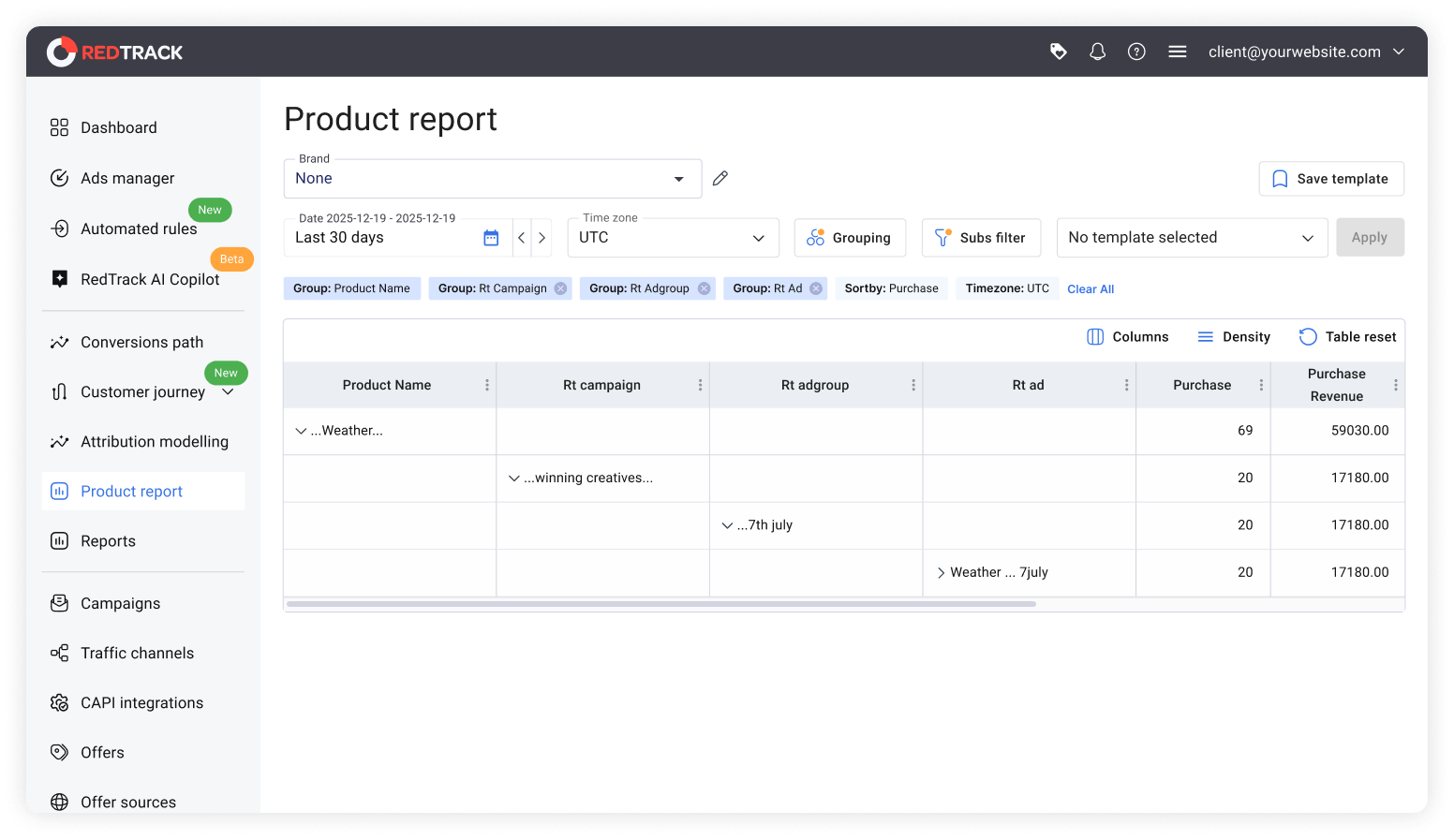
So you can finally see:
- Exactly which products specific campaigns are actually selling
- Revenue and ROAS at product level (not just campaign level)
- Which products deliver the best margins
- Which products are wasting budget without delivering results
So with this, you know longer make decisions on blended campaign averages, but on actual products which you see are definitely contributing a profit.
This means you change the way your run campaigns completely. It changes how you build cmapaings, allocate spend and decide what deserves more attention.
How to Know When You’ve Outgrown Native Ad Platform Reporting
An independent attribution tool might not be for every advertiser, but here are a few signs to look out for which indicate you do.
- You start to run ad campaigns across more than one channel – If you’re only running campaigns on one ad channel, there is no risk of attribution overlap. But the moment you move to two, three or more, the level of attribution overlap increases.
- You want to understand LTV – If repeat purchases matter to you, that’s something ad platform reports can’t reveal or deliver. All you get is first-purchase ROAS.
- You sell an array of products – The more products you sell, the harder it is to optimize ads based on campaign-level averages. Without product-level attribution, you won’t know which products are top performers and which are weak.
- You can’t reconcile your ad platform data – If you’re spending too much time trying to match up the data from your ad platform dashboards and becoming frustrated, it’s a good time to get a third-party ally.
How to Use RedTrack To Get Accurate Ad Insights for Your E-Commeerce Business
When you set up RedTrack, you can use three key features to get better insights into your ad performance across platforms.
The first thing you would need to do is connect to all your ad platforms via Conversion API (CAPI).
Once that’s set up, you can take the following steps.
Step 1: Run Attribution Modeling Across All Your Channels Simultaneously
- Go to Attribution Modelling in the left-hand navigation
- Select your Website/Source which you’ve already connected via CAPI
- Then configure the filters from the drop-down options:
- Conversion event (for example ‘Purchase’)
- Lockback period (select a window that matches your sales cycle)
- Attribution model (you have multiple options to choose from)
- Click Apply and analyze the data to which shows how much revenue each channel contributed
Step 2: Do Customer Analytics To Find Out What Happens After Purchase
- Go to Tools and then Conversion Tracking
- Activate Order Tracking (this will activate the ‘Customer Journey’ feature)
- Confirm that your checkout system is sending ‘email’ or ‘phone’ as parameters to RedTrack
- Go to Customer Analytics in the left-hand navigation
- Click on Order List
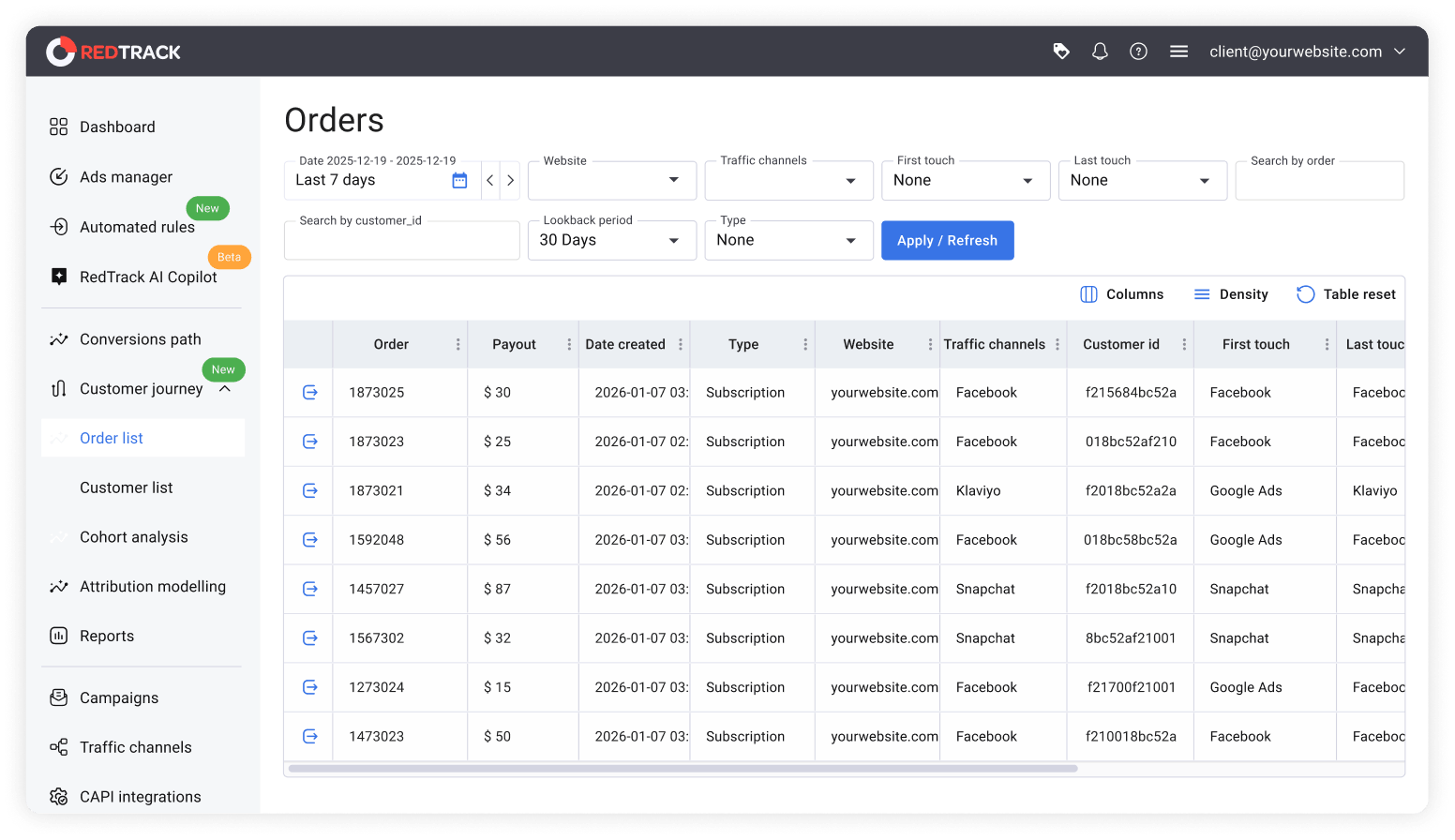
- Filter by Customer and search by email to see the full path of a single customer
- To analyze customer cohorts, go back to Customer Analytics and select Cohort Analysis (this will show you if customers who bought on day one, came back to buy again)
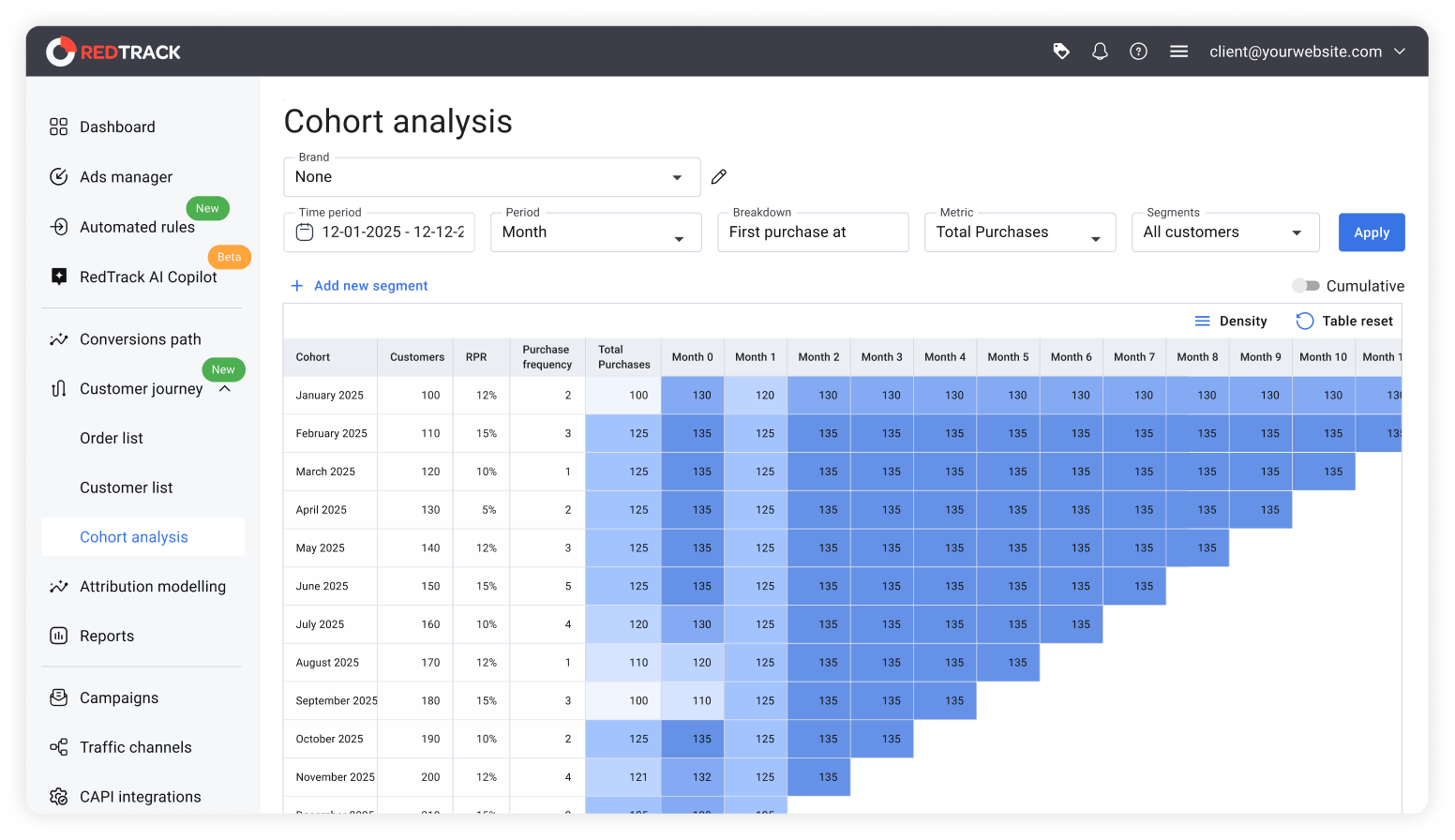
Step 3: Look at Product-Level Performance For Deeper Analysis
- First, check Data Structure to make sure your CAPI integration is passing product IDs or product names within the purchase postback
- Then, go to Reports and create a Custom Report
- Add dimensions including:
- Campaign or Traffic Source for the top level
- Procuct Name or Product ID
- Then set your metrics by choosing Revenue and ROI (or ROAS)
- Click Apply to run the report and see which specific products are driving the highest ROI for each campaign
RedTrack: The Complete Source of Truth for E-Commerce Attribution
For as long as you turn to your ad platforms for attribution data, you’ll be making decisions based on vague insights, not the real numbers.
That’s because, you’re dealing with fragmented figures, from different sources which all get something out of claiming they are doing great work when it comes to delivering conversions from the ads you run on their platforms.
Third-party attribution tools are the only way to get to the truth and insights you need to make effective use of you ad budgets.
RedTrack is an independent platform that take all the information from your ad channels, cleans it and brings everything into true perspective. It sits as a reporting layer above all your other platforms to reveal actual attribution at channel, campaign and product level.
And that’s what e-commerce business need. They need the depth that will let them answer key quesitons around which products are doing well and which customer groups are supporting their profits.
If you want to see how RedTrack does this, book a demo with one of our people or give the tool a go by signing up for the 14-day free trial.


