
If a potential customer discovers your brand via a social media post, reads a blog on your website, subscribes to your newsletter, and then converts after clicking a retargeting ad, which marketing channel do you think deserves credit for the conversion?
If you rely on last-click attribution, only the retargeting ad will get recognition. But does that mean all the other touchpoints didn’t nurture the customer to the final conversion? Absolutely not. Chances are, it was all those multiple touchpoints in the middle that built the initial awareness and trust that resulted in the conversion. That’s the whole logic of the linear attribution model, and that’s exactly why the strategy gives equal credit (and value) to every touchpoint in the customer journey.
While the single-touch attribution model oversimplifies reality, the linear attribution approach recognizes the true complexity of the customer journey. The fact is, purchase decisions are messy, back-and-forth processes where customers interact with many marketing channels and pieces of content before they eventually buy.
In this post, we give you a complete breakdown of the linear attribution model. We tell you how it works, when to use it, and how to apply it and make it your most effective go-to marketing strategy.
What is a linear attribution model
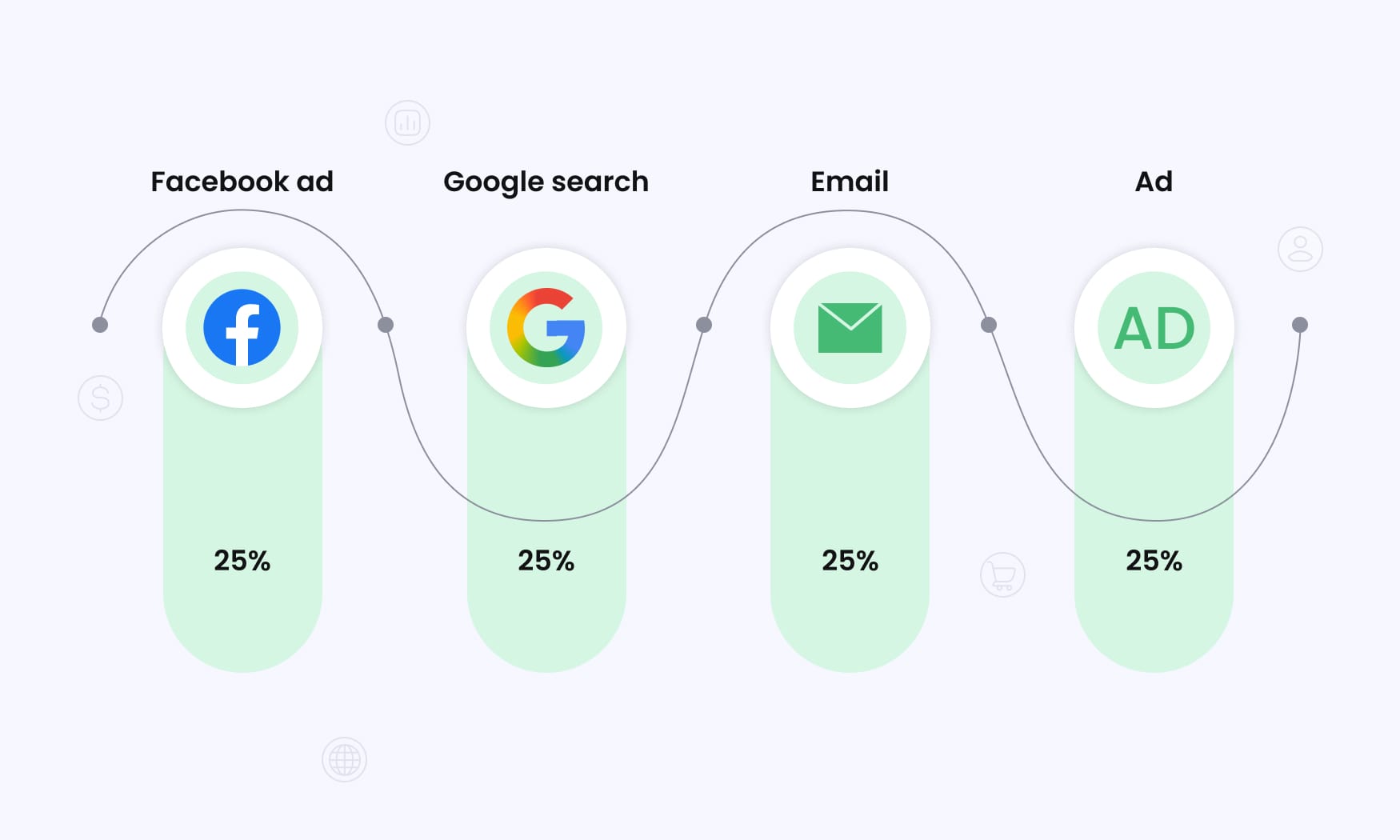
A linear attribution model is a marketing attribution strategy that assigns equal credit to every touchpoint a customer interacts with before converting.
So, instead of giving all the credit to the first or last interaction (single-touch attribution models), this attribution method works on the concept that each marketing touchpoint contributes equally to the final conversion.
Here’s what a real-life customer journey looks like:
- The buyer first sees a Facebook ad (25% credit)
- Then, they go and read a blog post they found via a Google search (25% credit)
- In a day or two, they receive a promotional email as a prompt, which reminds them of their search (25% credit)
- A few days later, an ad to purchase the product pops up in their search, and they finally convert (25% credit)
So this customer journey’s reality took 4 touchpoints, and each one received 25% conversion credit.
How linear attribution works
The linear attribution model works on two core principles that split conversion credit equally and consider all marketing channels.
1. Divide the conversion: Give equal credit to every touchpoint
If the linear attribution model takes into consideration the full customer journey (from the very first interaction to the very final conversion), that means you need to do a simple division calculation.
So you need to use the following formula to find out how much each touchpoint is worth:
Total conversion value ÷ Number of touchpoints = Credit per touchpoint
2. Grab the whole picture: Include every marketing channel
The other thing you need to make sure you do with the linear attribution model is to include every single marketing channel or platform the customer used. This could include any of the following, and more:
- Paid ads: Think Google Ads, Facebook ads, and LinkedIn sponsored content
- Organic search: Thing SEO content like blog posts, case studies, and affiliate marketing content
- Social media: Think organic posts, community engagement, and influencer content
- Email marketing: Think newsletters, promotional campaigns, automated sequences
- Direct traffic: This is your standard website visits, brand searches, and referral links
Example: Applying the linear attribution model to a real-life scenario
Say a customer generates a $100 sale after interacting via five different marketing touchpoints, which included:
- An Amazon display ad impression (1st touchpoint = 20% credit for the conversion)
- A Facebook social media post engagement (2nd touchpoint = 20% credit for the conversion)
- The email newsletter the customer is subscribed to (3rd touchpoint = 20% credit for the conversion)
- A blog post describing the benefits of the product (4th touchpoint = 20% credit for the conversion)
- A Google search ad click on the product (5th touchpoint = 20% credit for the conversion)
So this is what the linear attribution model looks like in reality:
$100 ÷ 5 touchpoints = $20 per channel
Each marketing channel receives $20 attribution from the $100 sale:
The idea behind the linear attribution model is that it gives you a more comprehensive way to analyze your marketing campaign effectiveness. Basically, it makes sure no marketing effort is missed or goes unrecognized in your attribution data.
Final thought: Using the linear attribution model should make it easier for you to justify investments to a mix of awareness campaigns and nurturing content (not just converting content). So you make it clear that even though nurturing content won’t generate the instant conversion, it will play a significant role in building the trust that leads to conversion at a later, final touchpoint.
When to use the linear attribution model
Now the linear attribution model works best when you need transparency and simplicity in your marketing analysis. The equal credit distribution is also easy to explain to your stakeholders. On top of that, it also doesn’t require the complex statistical interpretation some other attribution models do.
Best use case scenarios for the linear attribution model
There are three specific business types and certain sales cycle types where equal credit distribution works best.
The 3 ideal business types for the linear attribution model
- E-commerce businesses – If you’re an e-commerce business with 30-90 day customer consideration periods. These businesses normally run multiple marketing channels simultaneously (social media ads, email campaigns, content marketing, and retargeting), where customers interact with multiple touchpoints before hitting the buy button.
- SaaS companies – These companies normally operate on freemium models and 3-7 touchpoint customer journeys. The model is super handy for SaaS companies because it lets them understand how all their marketing initiatives and campaigns work together to deliver the final conversion.
- Small and mid-sized businesses – This group normally runs 3-6 marketing channels simultaneously. Because they don’t have complex buyer journeys, the simplicity of the model makes it easy to get a clear understanding of their multi-touch attribution.
Insight: Businesses want to understand how their overall marketing ecosystem works in unison to deliver the final result. This model works really well for businesses that want and need to prioritize brand building and customer education over immediate conversion optimization.
The ideal sales cycle types for the linear attribution model
The linear attribution model performs best with:
- 2-8 touchpoint sales cycle – This number gives you enough interactions to justify multi-touch attribution, but it also avoids the credit dilution problem (explained later in this post), which happens with longer customer journeys.
- Consumer goods that need to be researched – These are products for which customers usually compare options, read reviews, and look at multiple purchase occasions before hitting buy. So think electronics, home goods, and subscription services.
- Digital products and services – Most digital product buyers dedicate a significant amount of time to research before they make the purchase, so blogs, videos, and comparison and review content play a huge role in their final buying choice. The model reveals the content they viewed, which lets businesses justify investments and decide which marketing content is working and which has flopped.
Tip: It’s a good idea to avoid linear attribution for complex B2B sales with 15+ interactions. The reason for this is that equal credit distribution in these business scenarios creates more confusion than clarity. The position-based attribution model or custom attribution models are much more beneficial for true insights that the business can use to their advantage.
3 Benefits of linear attribution
There are three main benefits for marketing teams using the linear attribution model.
#1 You get a complete multi-touch view & understanding of the customer journey
First, linear attribution models capture the entire customer journey, which reveals how different marketing channels work together throughout the entire sales funnel. The model shows the true value of Middle-of-the-Funnel (MoFu) content.
It captures how awareness-stage pieces like blog posts and social media actively contribute to final conversions.
#2 It’s easy to implement, understand & apply to your marketing strategy
Second, linear attribution models work on a simple mathematical formula that doesn’t involve complex algorithms and analysis. This is what makes it easy to use and apply if you’re a small business and don’t have the luxury of a dedicated data scientist on your team!
So marketing teams can quickly do the calculations and interpret linear attribution data without extensive training.
#3 It promotes a balanced budget allocation approach
Third, linear attribution models prevent marketing teams from overspending on Bottom-of-the-Funnel (BoFu) content channels (like paid search), and makes sure that the entire content funnel is covered. By applying this balanced marketing and budget spend approach, you land and maintain a diversified marketing strategy that nurtures potential customers throughout their entire buying process.
So, the model identifies and credits the marketing channels that are missed and generally undervalued when it comes to conversions.
3 Limitations of the linear attribution model
Even though the linear attribution model is an effective marketing strategy for many business scenarios, it also has three key limitations you should consider before you decide to apply it.
#1 Oversimplifying the impact of each touchpoint
First, the model makes an assumption. That assumption is that all touchpoints influence conversions equally. But is that necessarily true? Maybe not. For most customer journeys, specific, single interactions will naturally carry more weight in their final decision. However, we don’t have any marketing attribution models that can reveal which ones those are exactly.
So this simplistic approach could lead to misleading optimization efforts. Some marketing campaigns may drive higher conversion rates than others, but there’s no way to identify which one was more impactful and therefore deserves more investment.
#2 Diluting the credit of each touchpoint in long sales cycles
The second drawback of the linear attribution model is credit dilution, and this happens when customer journeys involve significantly more touchpoints. We mentioned before that it’s not uncommon for B2Bs to have 15+ interactions before a conversion takes place. In this case, each touchpoint will only receive a 6.7% credit. This makes it really difficult to identify truly influential marketing channels.
Credit dilution is one of the biggest problems for enterprise sales cycles that last anywhere between 6-18 months. In these cases, customers might interact with dozens of marketing touchpoints. How do you distribute those conversion credits?
On top of that, long consideration periods also increase the likelihood of external factors influencing purchase decisions, such as word-of-mouth, which you can’t account for.
#3 It relies on highly accurate tracking and data quality
Finally, the third constraint of linear attribution models is that if you don’t have accurate and comprehensive cross-device and cross-platform tracking, it won’t work. This has become even more difficult due to privacy regulations and technical limitations.
For example, cookie consent laws (GDPR, CCPA) now limit data collection capabilities, which creates gaps in customer journey tracking. There are two things causing this:
- Since users now have the option to completely opt out of tracking (with iOS 14.5 App Tracking Transparency), businesses now have less accurate mobile attribution because some customers’ touchpoints cannot be captured.
- The ongoing third-party cookie deprecation further affects web tracking capabilities.
All these things make it hard to get all the data you need to carry out a linear attribution model accurately. So in many cases, what businesses get is a skewed picture of credit attribution. The channels that can be tracked accurately (like email marketing) get the credit, while the ones that can’t be tracked properly (mobile app interactions or cross-device behavior) get sidelined and misinterpreted.
How to set up linear attribution with RedTrack
Before you can apply and adopt the linear attribution strategy to your strategic decision-making, you first need to set the right foundations in place.
If you get the setup right, your team gets full visibility into the customer journey, without the fragmentation, sampling, or guesswork that slows most marketers down.
#1 Know that linear attribution is a conscious decision (the strategic part)
Before you do anything else, you must understand your ultimate goal and purpose. Choosing to go with the linear attribution approach means you have already decided that every touchpoint matters equally.
And make no mistake about it: This is a strategic choice. Your team is now committed to understanding the entire path – not just the final click that happens to close the sale.
#2 Configure your RedTrack tracking tool (the tactical part)
To take your strategic decision and make it work in practice, you need the right technology and process in place. This means you need a tool that can actually capture those touchpoints accurately, and that’s where RedTrack comes in.
This is the tactical implementation part, where you subscribe to RedTrack and configure it so you can distribute credit evenly across every touchpoint.
Here’s what you need to do:
- Define your conversion events
Set up all key actions that signal value to your business. These can be purchases, sign-ups, lead submissions, demo requests, or content downloads. In RedTrack, you can register macro and micro events using server-to-server postbacks or browser-side fallback pixels. - Apply consistent UTM structures across campaigns
Use RedTrack’s recommended UTM conventions to maintain consistent channel, campaign, and creative naming so every touchpoint is identifiable. This will give you clean data you can actually analyze (especially when reports break down performance using multiple dimensions). - Set cross-domain and multi-property tracking
If your funnel operates across a mix of domains, subdomains, or landing pages, configure RedTrack’s direct or S2S tracking to maintain continuity. (This is where most attribution breaks, but because RedTrack is a first-party tracking tool, it makes sure no touchpoint gets lost) - Choose your attribution window
Set a lookback window that matches your sales cycle. This will typically be 30–90 days, in which you can see real user behavior. Be conscious that shorter cycles need tighter windows, while longer cycles need more room for multiple engagements. With RedTrack, you have complete control to tailor this window to exactly what that looks like for your business.
#3 Validate your data (the reality-check part)
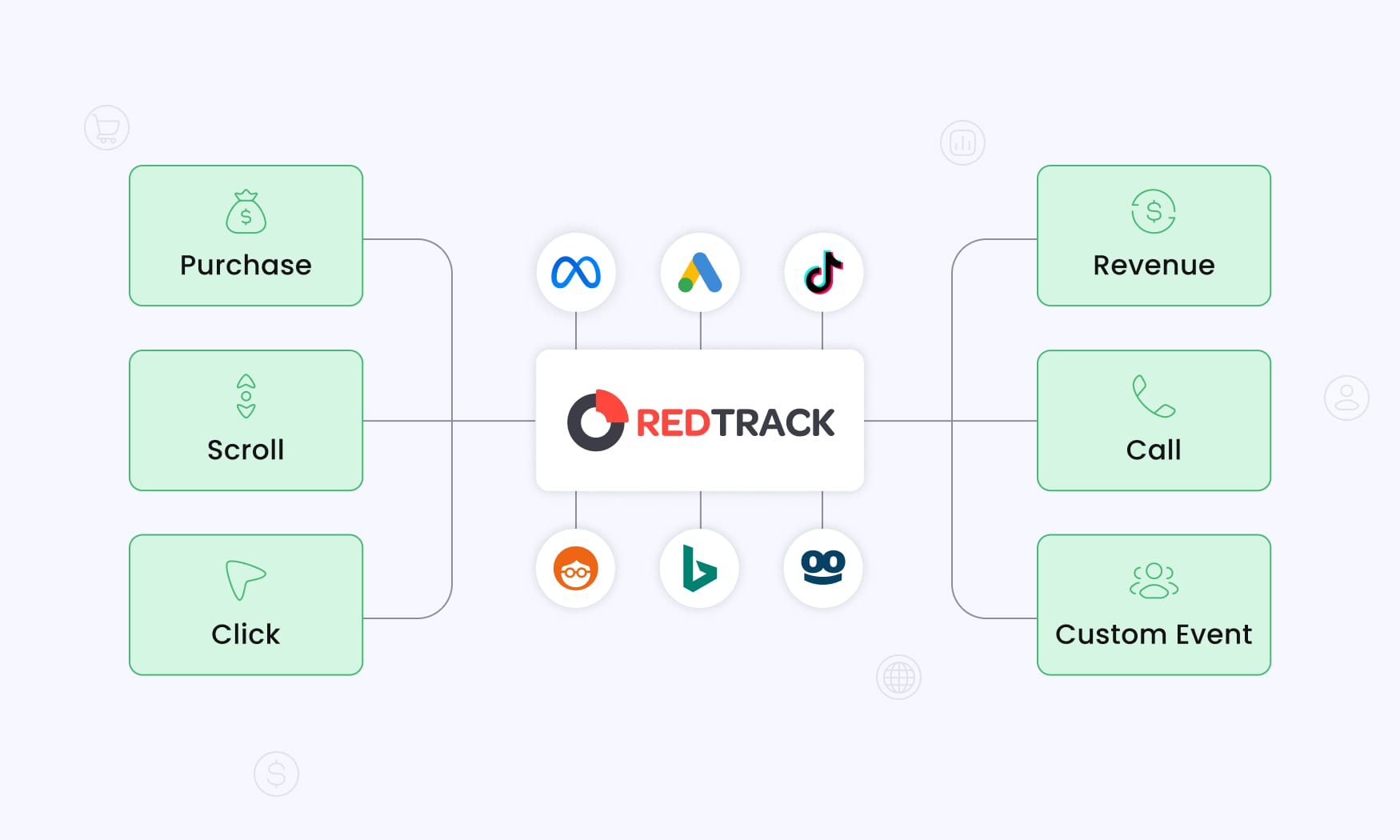
When you’ve set up the tool, your next step will be to validate your data. Here, you will confirm that your linear model is assigning and distributing credit correctly across every channel, campaign, and touchpoint.
The way to do that is:
- Connect all advertising and marketing platforms via RedTrack’s one-click integrations
This can include Meta, Google, TikTok, Bing, Taboola, Outbrain, and 200+ other networks. That way, all your attributions (all traffic and cost data) flow into a single reporting environment.
This is essential – linear attribution only works if you have all your data. - Import offline conversions where needed
If your business involves phone sales or offline events, pull that data into RedTrack through CRM or API integrations. This will make sure you close the loop so the linear model reflects the full journey, not just the digital part of it. - Validate the model against known customer paths
Take a few real customer journeys and compare them with your RedTrack attribution reports.
What you’re trying to do here is check whether the model properly attributes every touchpoint (without double-counting, missing steps, or giving disproportionate credit to any specific channel). - Compare with last-click as a baseline
This final step will highlight exactly how your understanding shifts when you move away from the first or last-click bias embedded in most ad platforms. Document any major differences that reveal hidden high-value channels, under-credited campaigns, or overlooked mid-funnel assets that deserve more budget.
Why linear attribution works best with RedTrack
Choosing the right attribution model can make all the difference to your optimization strategy. The linear attribution model does one thing single-touch models can’t – it reveals the true value of your mid-funnel content.
On top of that, it’s also one of the most accurate models because it distributes credit evenly across every touchpoint, so no one campaign, content, or ad takes the credit for something that was achieved by multiple marketing channels and activities.
When you use the linear attribution model, you discover which channels introduced, nurtured, or re-engaged users before they finally converted. So it gives you the real customer journey path.
But if you want to use this method, you’ve need to take care of one thing: Youra performance marketing analytics and ad tracking tool needs to be able to capture every touchpoint accurately, independently, and without platform bias.
And that’s exactly what RedTrack does. It’s a tool that performance media buyers love (especially if they operate on the linear model) for three reasons: it provides reliable first-party data, it gives you neutral cross-channel attribution, and you get reporting that shows the full journey – not just the final click.
RedTrack’s postback tracking means no touchpoint is lost to pixels, blockers, or privacy updates. Its multi-touch attribution engine distributes credit exactly as intended (evenly), without relying on modeled or sampled data. And with granular, real-time reporting across 50+ data points, media buyers get a complete, unsiloed understanding of how every channel contributes to revenue.
Linear attribution reveals how your marketing ecosystem works as a whole. RedTrack picks up every touchpoint to paint the exact picture of that ecosystem with clarity, accuracy, and independence.
If you’re a performance media buyers who need unbiased, journey-level insights through a platform that’s been built to support multi-touch attribution in a privacy-first world, you need RedTrack.


