
So you ran a campaign across Meta, Google, and TikTok. When you look at platform attribution reports and your backend conversions, you get the following numbers:
- Meta = 130
- Google = 95
- TikTok = 73
- Your backend (might be your Shopify dashboard) = 143
What’s wrong with this picture is that those platform conversion numbers don’t add up to your backend:
130 + 95 + 73 ≠ 143
It equals 298. That’s more than double the actual conversions your backend recorded. Now you know your backend is telling the truth. So what is going on?
The problem lies in how platform attribution is designed and how it works. Each ad platform uses its own set of rules when it comes to rationalizing attribution.
This includes:
- Different attribution windows
- Different conversion definitions and logic
- Differentiation models
What you end up with when you try to compare and make sense of your ad platform attribution reports is a messy heap of data. You get inflated performance numbers because you have overlapping conversions. And then you use that misleading data to make expensive ad budget allocation decisions.
In the long term, this leads to sliding performance across your campaigns and channels.
But there is a way around this, and it lies in getting your hands on an independent attribution and attribution modelling tool. In this use case, we explain why your ad platforms are giving you conflicting insights and how you can use third-party tracking tools like RedTrack to overcome this challenge and finally get to the truth.
Challenge: Misleading platform-native conversion data not adding up to reality
While there’s no doubt that each ad platform favors itself when reporting conversion numbers (there’s definitely an element of bias there), it’s not complete malice on their side.
The core of the problem lies in how ad platforms are set up, since there is no integrated layer of reporting for all.
So, what you will always get (no matter which platform’s reporting you use) is one part of the story, told in a way that skews real performance in each platform’s favor.
And because each platform reports conversions exclusively as it sees them and according to its own incentives, not only do you get fragmented data, you also get misleading data.
There are four main issues you’ll face if you try to get a true picture of the performance of your campaigns and channels, if you only use individual ad platform conversion data.
1. Ad Platforms Set The Rules To Work in Their Favor (The Bias Roadblock)
We’ve already mentioned that each ad platform sets its own attribution logic. Each one is designed to maximise the number of conversions it can claim as its own.
Take the scenario below as an example, where we also show the attribution windows for each platform in brackets.
A single user:
- Clicks a TikTok ad today but doesn’t buy (7-day click, 1-day view)
- Clicks on a Meta ad the following day, but doesn’t buy (7-day click, 1-day engage-through/view
- Clicks on a Google ad and buys your product 3 days after the last interaction (30-day click, 1 -day view)
If we consider the attribution windows for all three platforms, we know that all three will legitimately claim the conversion as their own. So even though your backend system shows 1 purchase, three platforms will claim 3 separate conversions.
What you have here is called an attribution overlap.
And while each platform is technically correct within its own system, for you, it’s an inflated performance result that’s simply not correct.
2. Your Ad Platforms Don’t Talk to Each Other (The Silo Roadblock)
Part of the reason #1 happens is because of the siloed nature of ad platforms. They only see what goes on in their own platforms.
- Google can only see and track Google interactions
- TikTok can only track TikTok interactions
- Meta can only track Instagram and Facebook interactions
And while they can show you every interaction that happened in their platform, they can’t show you the real cross-platform journeys and multi-touch interactions that took place across the board, which made them click “Buy” in the end.
So every time you access ad platform reports, all you see is what they brought to the table individually. You don’t see how all three platforms worked together to deliver the final conversion. Just by looking at ad platform reports, there is no way you can track the full sequence of ad interactions that took place.
To get that, you need a system that:
- Sits above all your ad platforms.
- Connects the interactions. Acts as a neutral reporting layer
3. Ad Platforms Favor One Attribution Model Above the Rest (The Last-Click Roadblock)
Then you come to another problem: most platforms lean on some variation of last-click attribution models.
This means:
- The final ad interaction gets all the credit (lower-funnel campaigns)
- All the ad interactions that preceded the conversion get zero credit (upper-funnel campaigns)
So your reporting tells you that retargeting and branded search campaigns are doing all the work, while prospecting and awareness campaigns look like they’re not performing.
But is that true? Is it logical?
Absolutely not.
Buyers go through a research and analysis stage. Very few will go and buy your product instantaneously. The only time this might happen is when a trusted colleague recommends your product, and they don’t have time to do their own investigation. But even then, chances are they’ll do a bit of due diligence.
So those upper-funnel campaigns are vital for generating new customers.
They:
- Introduce the customer to your product
- Play a vital role in influencing their final decision
- Initiates awareness with your brand, which then pushes them further down the funnel
When you rely only on performance reports that focus on last-click attribution, you’ll end up doing two things with your budget:
- You’ll overinvest in your closing campaigns.
- And underinvest in the awareness campaigns that drive new demand, and nurture those potential customers to close.
Because you have misleading data, you make decisions that miss the mark.
4. Individual Ad Platform Data Can’t be Compared Evenly (The Fair Game Roadblock)
Finally, you realize the hidden issue: you’re comparing data that can never be compared fairly.
In #1, we said that different ad platforms use different measurement systems to generate performance reports.
If you go and grab the data from each and try to analyze them side by side to understand what’s working well and what isn’t, you’re actually working with numbers that are not equal in value.
If different platforms use different measurements and logic, they are not directly comparable.
To make it a fair game (and accurate), you need to align all the numbers to one universal measurement system. That’s the only way you’ll see true performance that can be fairly compared, and that’ll give you insights worth using when making optimization and budget reallocation decisions.
So, ad platforms, as they are, don’t give you a level playing field for data analysis. While each platform may look strong. When you compare their original data side-by-side, you’ll see:
- The numbers don’t reconcile
- Initial insights don’t align
- You have numbers you can’t trust with certainty
But that’s why tools like RedTrack exist: to play the vital role of referee. A neutral party that analyzes and applies one measurement system for all brings all the ad platforms into alignment.
What Inaccurate Attribution Actually Costs You
Initially, you might not notice the cost of inaccurate attribution, but using bad attribution data over a longer period will result in three main consequences.
You Scale Channels That Aren’t Driving Incremental Revenue
When every ad channel reports strong ROAS, naturally, you’ll feel confident about scaling each. But if those ROAS figures are inflated because a single purchase is counted multiple times, then you’ll end up paying more for the same revenue.
But if you had a way to record and track true attribution through an independent source of conversion data, you would know exactly which channels you could cut without losing real conversions.
You Pause Valuable Prospecting Campaigns That Are Contributing
Ad-platform-favored last click attribution numbers make prospecting and awareness campaigns appear like failures. Here again, it would seem logical to pause or cut them out completely. But if you do that, you end up losing most of the top of the funnel campaigns that actually introduce your brand and product to buyers. Without them, those people never actually convert into customers.
But if you had accurate and complete attribution and conversion data that you could play around with and apply different attribution models to, you would know exactly which channels are delivering strong results in introducing new customers, and which ones are completing the deal.
You Make Expensive Budget Allocation Decisions Guided by Guesses
Missattribution compounds. This is the long-term impact that leads to wasted budget and money being placed into ads that never performed well in the first place. If those dollars were placed into channels that truly delivered, your growth would have soared. This way, your growth figures take a dive.
But if you could bring all your attribution data into alignment with a consistent attribution logic, you could then compare every channel, side-by-side, evenly. And you would know exactly which channels deserve what portion of your budget based on your business goals and performance marketing strategy priorities.
Solution: Use an Independent Tool To Get True Attribution & Do Attribution Modelling
If you want to reveal true attribution and uncover which channels are best for driving which campaign types at which stage of the funnel, you need to switch from platform-native attribution reports to independent ad performance tracking tools that:
- Track full customer journeys across all channels
- Apply a consistent attribution logic
RedTrack achieves independent attribution reports through three components.
1. Server-Side, Cross-Channel Tracking Of The Full Customer Journey
If you want true attribution figures, you need clean conversion data. Thanks to server-side tracking, RedTrack collects conversion signals from your website or backend via webhooks or through direct channel integration, which then lets it construct the full customer journey that took place across all your channels.
Here’s how it works:
- Every click that comes through a RedTrack-tracked channel gets its own unique Click ID
- That ID travels through your funnel and is then matched to the conversion when it happens.
So what happens with independent attribution tracking here is this: When a user clicks a TikTok ad, then views a Meta ad,d and then converts through branded search via Google, RedTrack doesn’t see this as three separate conversions. It sees it as one conversion with multiple touchpoints in the customer journey.
Ultimately, what you end up with is attribution data in RedTrack matching up with your backend data.
2. Consistent Attribution Logic Applied To All Channels
Once you have the exact customer journey with all the touchpoints, RedTrack goes and applies a consistent attribution logic to all channels. So you get data that fits one conversion definition, applies one attribution window, and uses one counting method.
This component is what makes true cross-channel analysis possible and the numbers comparable.
3. Attribution Modelling & Comparison Side-By-Side
The final component is the possibility to apply different attribution models to your ad performance data to understand how conversions actually happen.
Different businesses favor and use different models. While last-touch tells you which ads closed the deal, first-touch tells you which ads introduced the customer to your brand or product. But then you also have linear, which shows all the touchpoints in a single customer journey and then distributes credit evenly across each.
Most performance marketers like to view and compare ad campaign performance through multiple attribution models because it can uncover where the business needs to focus and optimize.
How RedTrack Enables Independent Attribution & Gives Attribution Modelling Options
RedTrack is a performance marketing analytics and automation platform that uses first-party data and server-side tracking (S2S) to gather and centralize the numbers from multiple channels.
This approach is what allows the tool to give you accurate conversion and attribution data for marketing professionals who run paid traffic across platforms and want to understand what’s truly driving results.
It’s perfect for:
- Media buyers
- Performance marketers
- E-commerce brands
- Agencies managing ad spend for multiple clients and campaigns across many channels.
Because RedTrack sits outside ad platforms like Meta, Google, Snapchat, and TikTok, its independence means it sees all channel interactions and provides one true version of the whole conversion and attribution story.
Instead of simply relying on each platform’s reporting, RedTrack’s independent attribution gives you a platform-agnostic layer.
It receives conversion data from your backend or store, matches it to the click data collected across your connected ad channels (via CAPI), and applies a consistent attribution logic that is not shaped by platforms’ commercial interests but yours.
What you get in the end is the universal truth behind every conversion, not what each ad platform claims.
How to Run an Attribution Modelling Report in RedTrack
You can run multiple attribution modelling reports in RedTrack to get different insights on your ad campaigns.
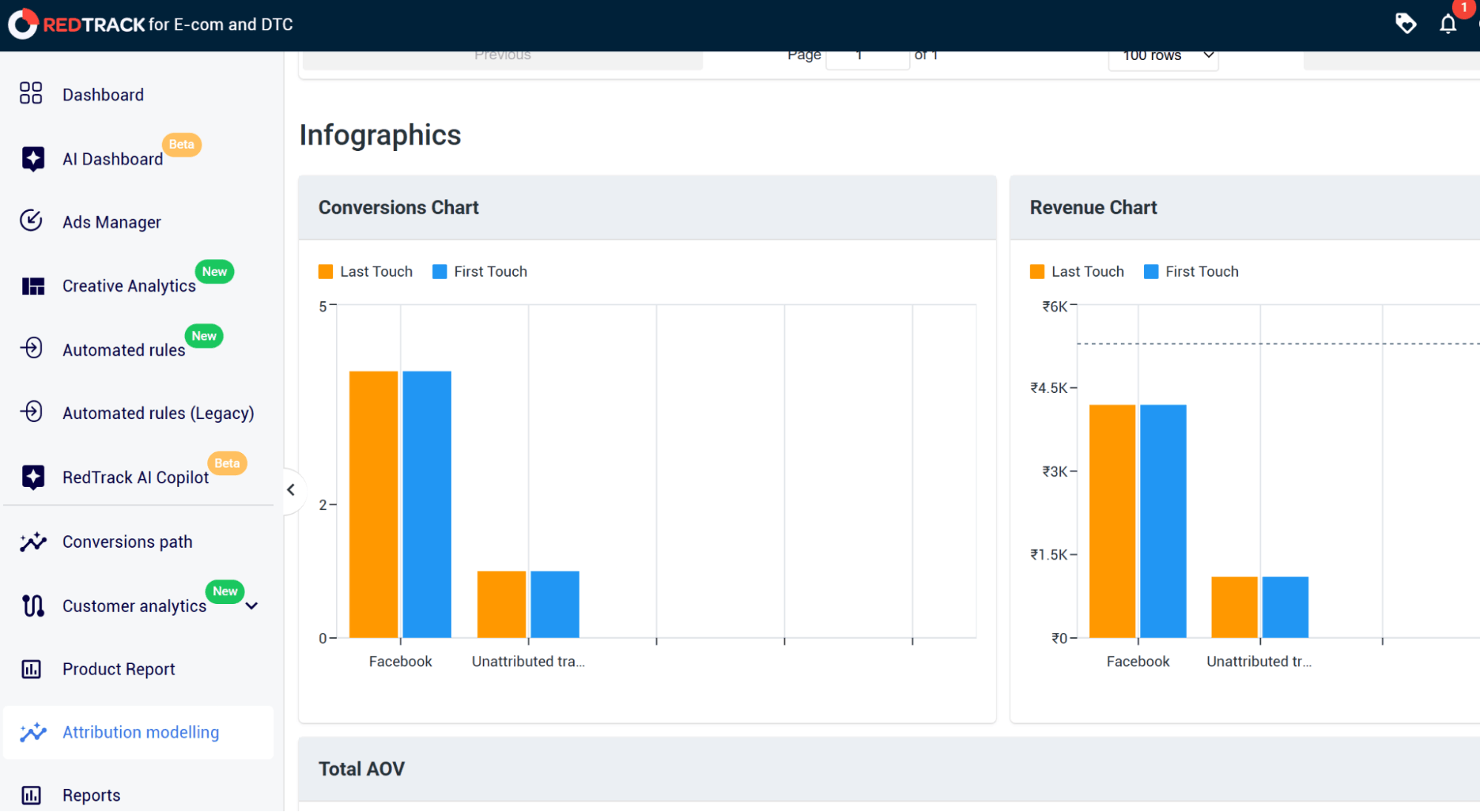
Here are the five attribution models you can use in RedTrack and what they uncover:
- First-Click – Shows which campaigns, ads, or channels generate initial interest and traffic
- Last-Click – Shows which campaigns, ads, or channels drive the final purchase
- Linear – Shows how different channels work together to deliver a conversion
- U-Shaped – Shows you the channels that captured the lead and closed the deal
- Time-Decay – Shows you which ads are good at driving immediate action, and are close to final conversion.
To run an attribution modelling report, you need to take the following steps.
Step 1: Initiate the report
- In the left-hand navigation menu, click on Attribution modelling
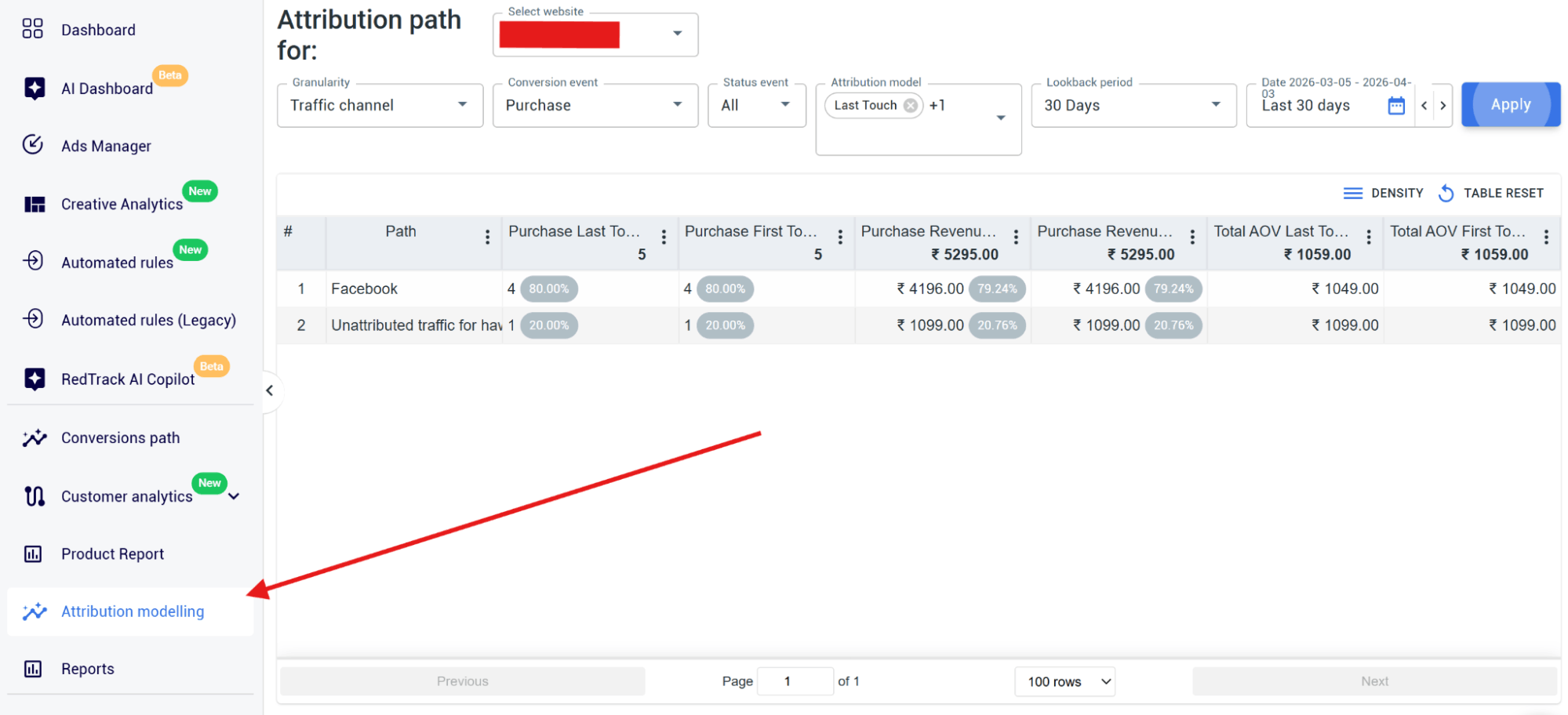
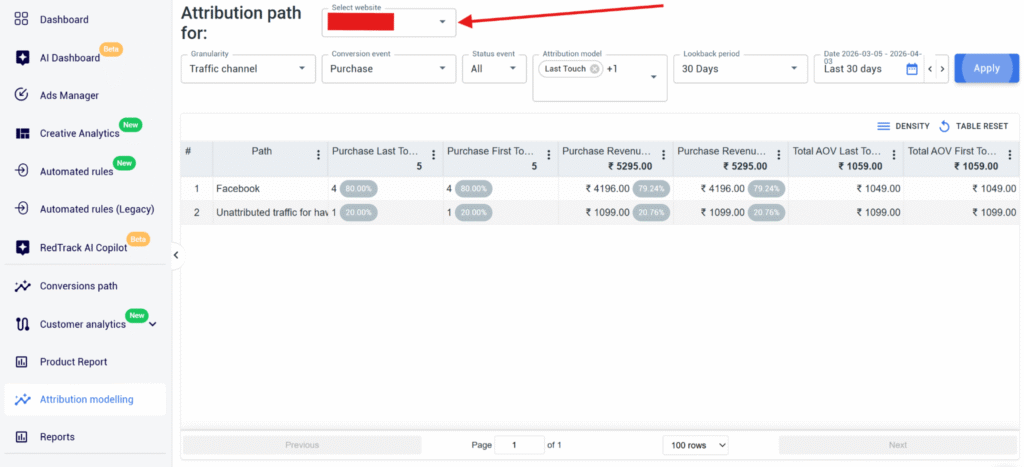
- At the top of the screen, click the Select website dropdown and select the website you want to analyze
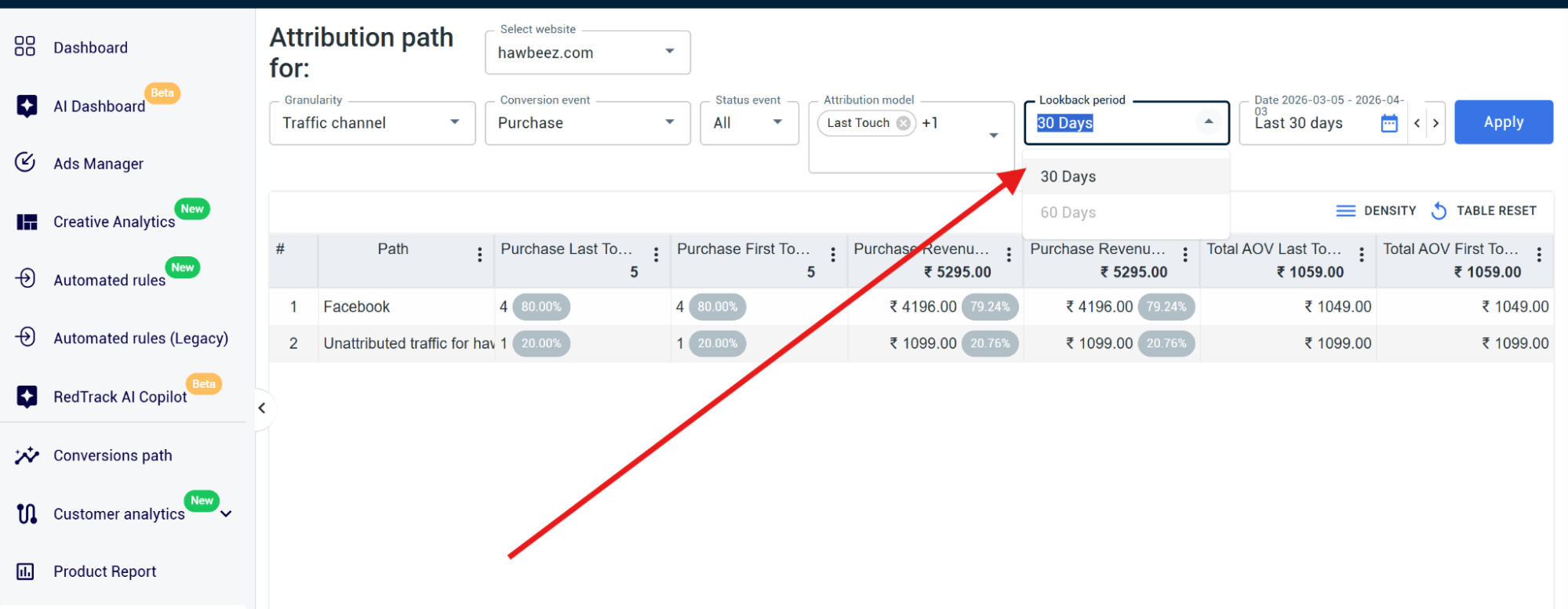
- Then go to the Lockback period on the top, left-hand corner of the screen, and select your date range
Step 2: Set granularity & conversion event
- In the top left, click the Granularity drop-down and select the traffic channel, campaign, or ad set you want to compare.
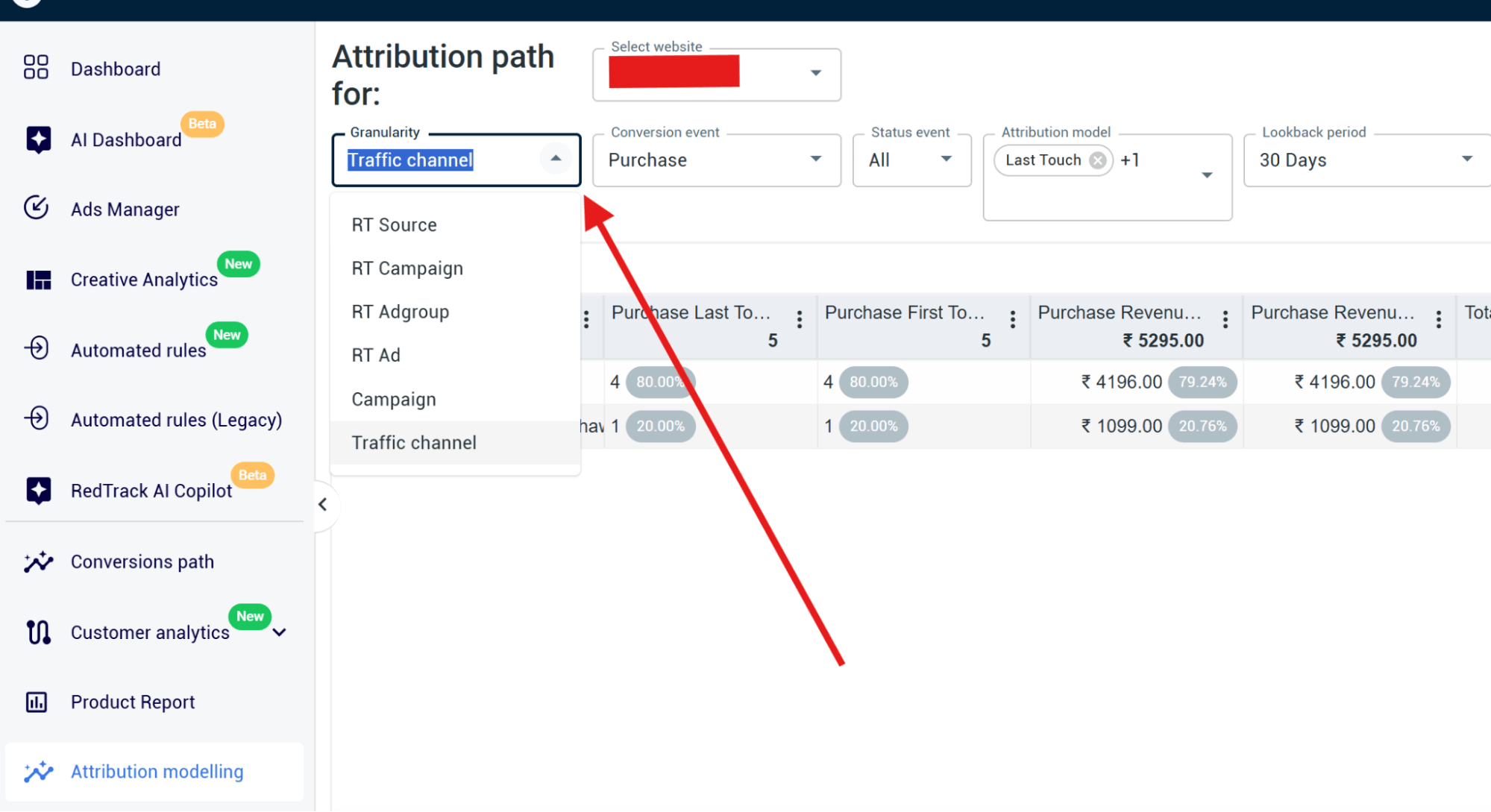
- Then go to Conversion event, which is the next drop-down to your right, and select Purchase (you can also run the same report for Add to Cart, Initiate Checkout, or a custom event)

Step 3: Select the attribution models you want to compare
- In the top, middle of the screen, go to the Attribution model drop-down and select the two attribution models you want to compare in this report.
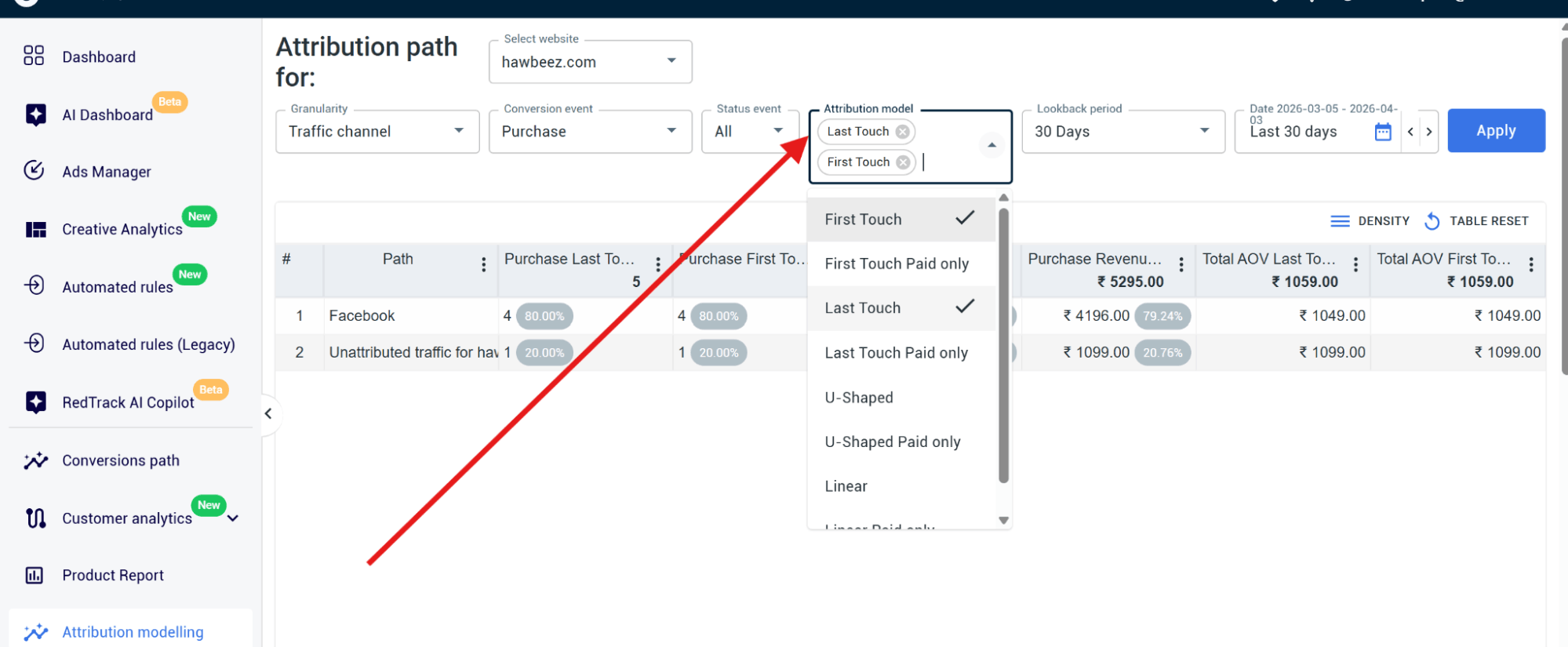
Note: If you want to compare a channel’s closing power to its acquisition power, select Last-Touch and First-Touch models
Step 4: Generate the report
- Click Apply in the top-left corner.
- Both reports for Last-Touch and First-Touch will be displayed side-by-side for you to compare results.
Step 5: Read the report and get your insights
- The report will give you a row for each traffic channel,l and for each row, you will see:
- Purchase Last-Touch – Shows conversions where the channel was the final touchpoint before purchase.
- Purchase First Touch – Shows the channel where the customer journey was initiated.
- Purchase Revenue (under each model) – You’ll get a percentage of total revenue shown alongside the dollar figure.
- Total AOV (under each model) – Higher AOV in First-Touch than Last-Touch shows you the channels that initiate journeys but don’t close them
- Find the channels you are undervaluing by sorting the report by First-Touch conversions in descending order.
- These are your upper-funnel drivers, which do the most acquisition work
- Find the channels that are closing purchases by sorting the report by Last-Touch conversions and placing them in descending order.
- These are your lower-funnel drivers,s which close the deal.
This is just one attribution modeling report comparison you can do to better understand how credit and performance are distributed across your platforms in reality.
You can also try some of the following:
- Linear vs. Last-Touch – To uncover which channels assisted conversions
- U-shaped vs. First-Touch – to find out if your retargeting strategy is actually adding value or just claiming sales that would have happened anyway.
Why You Can’t Make Smart Ad Budget Decisions Without RedTrack
If you are still making ad budget decisions primarily on individual platform reporting data, you are being misled. You’re basically optimizing on half-truths and biased performance data.
But if you move to an independent reporting tool like RedTrack, you remove the inflation/bias factor to uncover the real story behind your ad campaign. You can then see exactly how effective individual ad channels are in driving your client’s profit.
Getting your hands on a tool like this, which prioritizes accuracy, isn’t just about having access to clean data (which is vital). It’s about having a tool buddy that has your back always and guides you to better decision-making when it comes to ad spend.
If you want to know which channels are worth putting more money into, and which need to be pulled back a little, you need to think outside the box. Think above and beyond each channel.
Reach out to the RedTrack team to book a demo and see how the tool can become the foundation you need for running successful performance marketing long-term. And if you’ve heard enough and want to give us a shot, sign up for our 14-day free trial.


