
Every marketing dollar you spend tells a story, but are you reading it correctly? The wrong attribution model can skew your data, mislead your budget decisions, and cause you to undervalue the very channels driving growth.
Attribution modeling is simply the framework for assigning credit to marketing touchpoints along the customer journey.
It answers the question: Which channels actually contributed to this conversion, and how much? That answer determines where budgets get increased, which campaigns get cut, and how effectively you can optimize for ROI.
Here’s the problem: many marketers stick with Google Analytics’ default settings or pick an attribution model without checking if it matches their business goals or customer behavior. That’s how budgets end up misallocated, channels that drive demand get ignored, and short-term wins get over-prioritized at the expense of sustainable growth.
Customer journeys today are anything but linear and they can span weeks, multiple channels, and countless touchpoints.
Imagine someone discovering your brand via a social post, clicking a Google ad, reading your blog, downloading a whitepaper, and finally converting from an email.
Depending on your attribution model, the “credit” for that sale could go entirely to the last email, be split evenly across all touchpoints, or be weighted toward the first click. Each approach paints a different picture, and drives different budget decisions.
Choosing the right attribution model isn’t about picking what’s popular; it’s about aligning your credit assignment with your sales cycle, buying behavior, and growth strategy. Get it wrong, and you risk scaling the wrong channels. Get it right, and you’ll have the clarity to double down on what actually drives conversions.
Understand Key Factors When Choosing Your Attribution Model
Selecting the right marketing attribution model requires careful consideration of several critical factors, and trust me, your choice should align with your specific business context rather than following a one-size-fits-all approach that everyone seems to be pushing these days.
What Are Your Business Goals and Objectives?
Start by clearly defining what you’re trying to achieve with your marketing attribution, because without this clarity, you’re basically shooting in the dark.
Are you primarily focused on demand creation or demand capture?
Different marketing attribution models emphasize different parts of the customer’s journey, and the choice is not going to be as clear-cut as you’d want it to be.
If your goal is building brand awareness and generating new demand, you’ll want an attribution model that gives appropriate credit to first-touch interactions and top-of-funnel activities. This is your bread and butter for long-term growth.
Conversely, if you’re focused on optimizing conversion rates and immediate ROI, models that emphasize bottom-funnel touchpoints might be more suitable for your needs. And here’s the thing – both approaches work, but they work differently depending on where your business stands right now.
How Long is Your Sales Cycle?
Sales cycle length is one of the most important factors in attribution model selection. The duration and complexity of your sales process should directly influence which attribution model you choose.
Short sales cycles (typically found in e-commerce and B2C businesses) often involve fewer touchpoints and faster decision-making. In these scenarios, single touch attribution models like last-click or first-click can provide sufficient insight for optimization decisions.
Medium sales cycles spanning a few weeks to several months benefit from linear attribution model or time decay attribution model approaches. These models acknowledge that multiple interactions influence the decision while still weighting more recent touchpoints appropriately.
Longer sales cycles common in B2B and enterprise sales require multi touch attribution models that recognize the complex interplay of awareness, consideration, and decision-stage interactions across extended timeframes.
How Complex is Your Customer Journey?
The number of touchpoints and complexity of your customer journey significantly impacts which attribution model will provide the most accurate insights.
Simple journeys with 2-3 touchpoints work well with single touch attribution models because there’s less ambiguity about which interactions matter most. The attribution analysis remains straightforward and actionable.
Complex journeys involving 5+ touchpoints across multiple marketing channels require multi touch attribution models to properly assign credit. These journeys often span different devices, channels, and time periods, making it essential to use an attribution model that can handle this complexity.
Cross-device and cross-platform considerations add another layer of complexity. If your customers regularly switch between mobile, desktop, and in-person interactions, you’ll need attribution models and tools that can stitch these touchpoints together for accurate analysis.
Data Quality and Technical Capabilities
Your attribution model choice must align with your data infrastructure and quality standards. More sophisticated attribution models require higher data quality and more robust technical implementation.
Rule based models like linear attribution or position based attribution model work with basic tracking data, while data driven attribution requires substantial volume and clean event-level data to function effectively.
Consider your team’s technical capabilities as well. Custom attribution models and machine learning approaches demand more advanced analytics skills and ongoing maintenance compared to standard rule-based approaches available in most marketing platforms.
Understand Differences Between Single-Touch and Multi-Touch Attribution Models
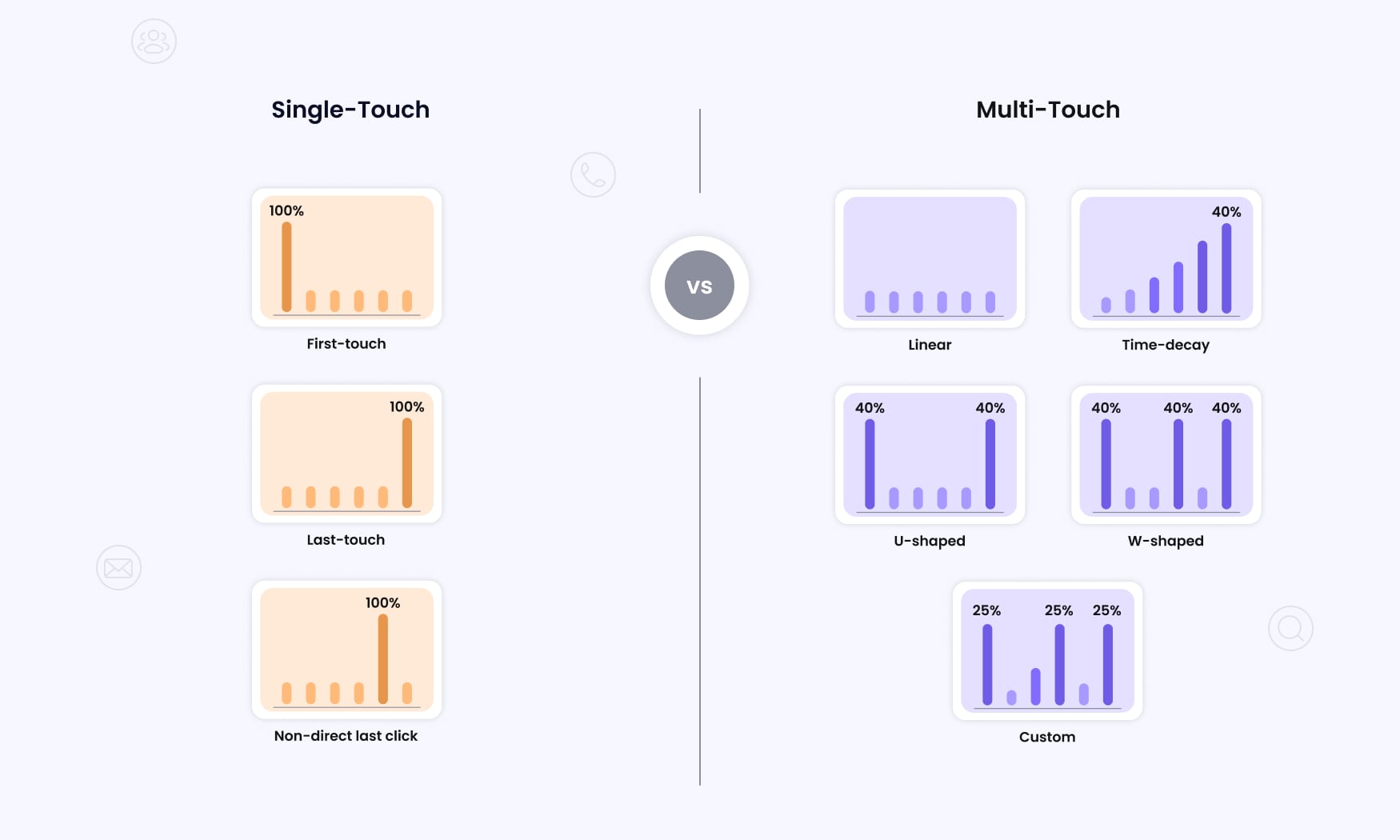
Attribution models fall into two camps: single-touch (all credit goes to one interaction) and multi-touch (credit is split across multiple touchpoints). Which you choose shapes how you value channels and where your budget goes.
Single-Touch Attribution
Simple to set up, but limited in insight.
- First-touch: 100% credit to the first interaction; ideal for measuring brand awareness and demand generation impact.
- Last-click: All credit to the final touchpoint before conversion; good for direct response, but undervalues earlier efforts.
- Non-direct last click: Same as last-click but ignores direct visits, avoiding skewed data from brand recall.
Use single-touch when you need quick, baseline insights or want to spotlight a specific funnel stage. Always track UTMs consistently for accuracy.
Multi-Touch Attribution
Captures the reality that conversions rarely come from one touchpoint.
- Linear: Equal credit to all interactions.
- Time decay: More weight on touchpoints closer to conversion.
- Position-based (U-shaped): Emphasizes first and last touch (40% each) with the rest split in between.
- W-shaped: Highlights first touch, lead creation, and last touch (30% each), spreading the rest across others.
- Custom: Tailored weighting based on your sales cycle and buyer behavior — most accurate, but hardest to implement.
Bottom line: Single-touch is easy but oversimplifies. Multi-touch gives you a fuller, truer picture — and often leads to smarter budget allocation. The right choice depends on your goals, sales cycle length, and how deeply you want to understand your customer journey.
Industry-Specific Attribution Model Recommendations
Different industries have distinct customer behavior patterns, sales cycles, and marketing channel effectiveness that influence which attribution model works best.
E-commerce and Retail
E-commerce businesses typically benefit from last click attribution or linear model approaches due to relatively short sales cycles and clear conversion events. However, the best attribution model depends on your specific product category and customer behavior.
For high-consideration purchases, consider time decay attribution to acknowledge the research phase while emphasizing purchase-driving interactions. Fashion and impulse-buy categories often work well with last-click, while furniture or electronics might benefit from position based attribution.
B2B SaaS and Technology
B2B SaaS companies almost always benefit from multi touch models due to longer sales cycles and complex decision-making processes involving multiple stakeholders. The w shaped attribution model works particularly well because it acknowledges:
- Initial brand discovery (first-touch)
- Lead qualification and nurturing (middle-funnel milestone)
- Final decision and conversion (last-touch)
Data driven attribution becomes especially valuable in B2B contexts where you have sufficient volume and clean conversion data to let machine learning identify the most influential touchpoints.
Financial Services
Financial services companies often require position based attribution model approaches that emphasize both awareness-building and decision-stage interactions. Trust-building and educational content play crucial roles in these industries, making first-touch attribution important for measuring brand-building efforts.
The extended consideration periods and compliance requirements in financial services mean that custom attribution models often provide the most accurate insights by accounting for regulatory touchpoints and educational phases.
Healthcare and Pharmaceuticals
Healthcare organizations face unique attribution challenges due to privacy regulations, extended decision cycles, and multiple stakeholder involvement. Custom attribution model approaches that account for educational content, compliance interactions, and referral sources typically work best, and working with a healthcare software consultancy can help design and implement these models effectively.
Consider implementing models that weight educational touchpoints appropriately, as patients often require extensive information gathering before making healthcare decisions.
Real Estate
Real estate attribution benefits from time decay attribution model approaches that emphasize recent interactions while still crediting earlier research activities. The extended consideration period and high-value nature of real estate decisions mean that prospects often have multiple touchpoints over weeks or months.
Position based attribution can also work well by emphasizing both the initial property discovery and final decision-making interactions.
Make Sure You Meet Data Requirements and Technical Considerations
Your attribution model choice must align with your data infrastructure, quality standards, and technical capabilities. More sophisticated models require higher data quality and more robust implementation.
Minimum Data Volume Requirements
Different attribution models have varying data requirements for reliable results:
Single touch attribution models can function with minimal data volumes as long as basic tracking is properly implemented. These models require consistent UTM parameters and clear conversion event definition.
Rule-based multi-touch models (linear, time decay, position-based) need moderate data volumes and consistent touchpoint tracking across all marketing channels. The key requirement is comprehensive and accurate event tracking rather than massive volume.
Data driven attribution requires substantial data volume to train machine learning algorithms effectively. Most platforms recommend hundreds or thousands of conversions per month for reliable algorithmic attribution. Historical data spanning several months is also essential for algorithm training.
Data Quality Standards
Successful attribution modeling depends on consistent, accurate data collection across all touchpoints. Key requirements include:
- Consistent UTM parameter usage across all marketing campaigns
- Proper conversion tracking setup for all important business events
- Channel taxonomy that clearly distinguishes between different marketing efforts
- Cross-device tracking implementation for businesses with significant mobile/desktop switching
- CRM integration to capture offline conversions and sales milestones
Poor data quality will undermine any attribution model, regardless of sophistication. Start by auditing your current tracking implementation before selecting an advanced attribution approach.
Privacy and Compliance Considerations
GDPR, CCPA, and similar privacy regulations significantly impact attribution modeling capabilities. These regulations limit user-level tracking and require explicit consent for many tracking activities.
The practical implications include:
- Reduced cross-device tracking accuracy
- Shorter data retention periods
- Limited ability to track users who haven’t provided consent
- Increased reliance on aggregated rather than individual-level data
Consider these limitations when choosing your attribution model. More sophisticated models may provide less reliable results in privacy-constrained environments.
Get Proper Tools and Platforms for Attribution Implementation
While platforms like Google Analytics 4, Adobe Analytics, or other specialized attribution tools (e.g., Bizible, HockeyStack) are widely used, they often come with limitations – whether it’s GA4’s data sampling and cross-device tracking gaps, Adobe’s complexity and cost, or niche tools’ long setup cycles.
RedTrack is built from the ground up for performance marketers, ecom brands, agencies, and affiliates who need accurate, real-time, and privacy-compliant attribution without the compromises.
With RedTrack, you can implement multi-touch attribution that reveals the true contribution of every channel and touchpoint, backed by server-to-server tracking that prevents data loss from ad blockers or privacy restrictions.
Its native integrations with 200+ ad platforms ensure seamless cost and revenue sync (as fast as every 1–5 minutes), while real-time unsampled reporting gives you complete clarity without modeled guesses.
You have full flexibility to choose or customize attribution models – first click, last click, linear, time decay, position-based, plus the ability to feed this data back to ad platforms to improve their optimization algorithms.
And with built-in automation, RedTrack can scale winners and cut losses instantly, making it a single solution for tracking, attribution, and campaign optimization in one place.
Try it for yourself or book a demo and let us show you around!
Rinse and repeat; Testing and Optimization Strategy
Implementing a systematic approach to testing and optimizing your attribution model ensures you’re making data-driven decisions rather than relying on assumptions.
Model Comparison Framework
Run multiple attribution models simultaneously to understand how different approaches affect your understanding of marketing channel performance. Most platforms allow you to view the same conversion data through different attribution lenses.
Key comparisons to make:
- Last-click vs. first-click to understand the difference between demand capture and demand creation credit
- Single-touch vs. multi-touch to assess the impact of journey complexity
- Linear vs. time-decay to evaluate the importance of recency weighting
- Rule-based vs. data-driven (when available) to assess algorithmic insights
Key Metrics to Monitor
Track how different attribution models affect your core marketing metrics:
Conversion attribution by channel: How does credit distribution change across your marketing channels under different models?
Cost per acquisition (CPA) by channel: Which channels appear more or less efficient under different attribution approaches?
Return on ad spend (ROAS): How do ROAS calculations change when you assign credit differently?
Budget allocation impact: If you made budget decisions based on each model, how would your spending change?
Timeline for Model Evaluation
Allow sufficient time to gather reliable data before making attribution model decisions:
Short sales cycles (B2C/ecommerce): Monthly evaluation periods provide enough data for meaningful comparison
Medium sales cycles (3-6 months): Quarterly reviews allow complete cycle evaluation
Long sales cycles (6+ months): Semi-annual or annual reviews ensure you capture full customer journey patterns
Avoid making hasty decisions based on short-term data fluctuations. Attribution model selection should be based on consistent patterns over time.
When to Switch or Adjust Models
Consider changing your attribution model when:
- Business goals evolve (shifting from growth to profitability focus)
- Customer behavior changes significantly (new channels, different journey patterns)
- Data quality improves enough to support more sophisticated models
- Marketing strategy changes (launching brand awareness campaigns, adding new channels)
- Current model conflicts consistently with business results or team understanding
Document your rationale for model changes to maintain consistency and enable future optimization.
Common Attribution Model Selection Mistakes
Learning from common pitfalls can help you avoid attribution modeling mistakes that undermine your marketing optimization efforts.
Choosing Overly Complex Models Without Sufficient Data
One of the most frequent mistakes is implementing sophisticated attribution models before establishing the data quality and volume needed to support them. Data driven attribution requires substantial conversion volume and clean tracking to produce reliable results.
Solution: Start with simpler rule-based models and gradually increase complexity as your data infrastructure and volume mature.
Ignoring Offline Touchpoints
Many organizations focus exclusively on digital attribution while ignoring phone calls, in-person interactions, and other offline conversion paths. This digital-only approach can severely misrepresent the effectiveness of different marketing efforts.
Solution: Integrate call tracking, CRM data, and offline conversion sources into your attribution analysis. Even if you can’t track every offline interaction, acknowledge the limitations in your model interpretation.
Misalignment with Business Goals
Selecting an attribution model without considering your primary business objectives often leads to optimizing for the wrong outcomes. For example, using last-click attribution when your priority is brand building will systematically undervalue awareness-generating marketing efforts.
Solution: Clearly define your marketing objectives before choosing an attribution model. Align your model choice with whether you’re prioritizing demand creation, demand capture, or balanced growth.
Neglecting Team Training and Change Management
Even the most accurate attribution model fails if your team doesn’t understand how to interpret the results or if the insights conflict with how different departments are measured and incentivized.
Solution: Invest in training your marketing team on attribution model interpretation. Ensure cross-department alignment on how attribution insights will influence decision-making and performance measurement.
Failing to Account for Privacy Constraints
Many organizations choose attribution models without considering how privacy regulations and tracking limitations affect data accuracy. This oversight can lead to overconfidence in attribution insights that are actually based on incomplete data.
Solution: Acknowledge privacy-related data gaps in your attribution analysis. Use model comparison and conservative interpretation when tracking limitations are significant.
Implementation Best Practices
While it’s a given that successful attribution modeling requires systematic implementation, being able to build from simple foundations toward more sophisticated approaches can make a huge impact not just on your data accuracy but also your marketing insights.
Your approach is going to depend on a number of factors, including your current goals, data capabilities, and the complexity of your marketing operations. And sometimes, the choice is not going to be as clear-cut as you’d want it to be.
Start Simple, Then Add Complexity
If you’re running any kind of marketing operation, understanding your attribution is basically your bread and butter. There is something to be said about the clarity and reliability of simple models that can’t be replicated with overly complex approaches, which is why starting with basic attribution models is the clear winner here.
Single touch attribution models provide that foundation you need for understanding your data quality and establishing those all-important baseline performance metrics. Think of it as learning to walk before you run.
But here’s the thing – once you’ve validated your tracking implementation and gathered sufficient data, gradually introducing more sophisticated approaches just gets those analytical insights flowing unlike anything else.
This progression allows you to understand how different models affect your insights before making significant strategic changes, which is why you can’t beat this methodical approach.
Ensure Consistent Tracking Implementation
As a marketing professional, you can probably already tell that your attribution models thrive when built on solid tracking foundations. Reaching that level of data reliability often produces wonderful results, but it can take only one inconsistent parameter or missing conversion event to completely derail your analysis accuracy.
Proper conversion tracking and consistent UTM parameter usage across all marketing campaigns form the foundation of reliable attribution, which is why systematic standards can’t be beat here.
Here’s what you need to develop and document:
- UTM parameter structure and naming conventions: Your team members can implement these whenever they launch campaigns, ensuring consistency across all touchpoints.
- Conversion event definition and implementation: Even if the setup isn’t especially complex, it still needs to get done right. Clear definitions help your team maintain accuracy.
- Marketing channel taxonomy and classification rules: Following standardized rules can help you categorize even the most complex, varied, or time-consuming campaign types much faster.
- Cross-device tracking setup (where privacy regulations allow): Proper implementation enables your team to save their energy for the most crucial analysis tasks.
Remember, inconsistent tracking implementation will undermine any attribution model’s accuracy and reliability.
Set Up Regular Review Cycles
Going through attribution analysis used to consist not just of your monthly reports, but also of ongoing optimization and adjustments, because we need to adapt our models at the end of the day.
It’s how data accuracy, model performance, and your attribution’s reliability is maintained, so having as many scheduled reviews through regular cycles as possible is a must. The review frequency should align with your sales cycle length, and if your team has varying cycle lengths or is managing mostly different campaign types, what can you do?
We recommend one or more of the following approaches:
- Monthly reviews: We are talking about short-cycle businesses or something as simple as quick e-commerce operations.
- Quarterly reviews: Regular intervals provide a fertile ground for medium-cycle organizations, strategic adjustments, or comprehensive model evaluations.
- Semi-annual reviews: Instead of constantly tweaking models throughout the year, have structured reviews. You can address major changes in minutes, plus you get to maintain long-term consistency.
Document your attribution model decisions, rationale, and any custom configurations to maintain consistency as team members change.
Integrate with Marketing Operations
Remote and cross-departmental collaboration has been battle-tested, especially throughout modern marketing operations. And you know what? It works. It really works when attribution insights connect to actual budget allocation processes.
If your marketing team’s insights are spread across different tools and reports, you don’t have to worry about having everyone available for complex analysis sessions. It gives your team members not only the freedom to adopt attribution-driven decision making, but also the necessary data to provide better budget recommendations.
Attribution modeling only creates value when insights translate into better marketing decisions, resulting in improved campaign performance and resource allocation, which can really come in handy for teams who have joined at later stages of implementation, as well as for cross-functional marketing operations.
Practical integration steps include:
- Include attribution analysis in campaign planning processes: Gauging the model’s insights in real time helps you make adjustments to strategy, answer budget questions, or simply optimize spending if campaigns aren’t performing well.
- Use attribution insights to inform budget allocation discussions: You can easily adjust spending and channel focus based on the model’s findings, which results in more effective resource deployment.
- Track how attribution-driven changes affect actual marketing performance: Provide ongoing measurement and evaluation, which can help validate any improvements that your attribution implementation might have delivered.
- Train media buyers and campaign managers on interpreting attribution data: This builds understanding and ensures successful adoption across your marketing operations.
Document and Communicate Model Decisions
For documentation and communication matters, systematic approaches are the best option available, because they give you and your marketing team time to craft more thoughtful explanations without the pressure of having to give instant justifications.
And it’s more of the same story when communicating with leadership, but there is an added benefit as well. For example, if your agency has stakeholders across departments, you can provide clarity, address concerns, and share model rationale without the need for constant meetings.
We know that nobody likes writing down documentation (except for technical writers), but it keeps all of your attribution decisions organized in one place for later access and reference.
Create clear documentation explaining your chosen attribution model, the rationale behind the selection, and how results should be interpreted. This documentation becomes essential for:
- Onboarding new team members: Even though training can be delivered through various methods, only comprehensive documentation can capture the logic, implementation details, and interpretation guidelines, leaving very little room for confusion.
- Maintaining consistency across departments: Documentation feels a lot more reliable and supportive if it covers all the nuances, and it goes a long way toward establishing a consistent analytical environment in your organization.
- Supporting budget allocation discussions with leadership: Well-documented processes also provide the foundation for confident presentations, follow-up discussions, and strategic decisions.
- Troubleshooting data discrepancies: Real-time problem-solving becomes much easier when you have documented processes, configuration details, and troubleshooting guides readily available.
This is where you need to find the right balance between comprehensive documentation and practical usability. When managing your attribution implementation, detailed guides become just as crucial as accessible summaries for different stakeholder groups.
But all those documentation formats, such as technical specs, executive summaries, training materials, and troubleshooting guides, pile up pretty quickly, so keeping everything organized not only saves time, but enhances your team’s ability to leverage attribution insights effectively.
Each format serves a purpose, no matter how specific, and it’s essential to maintain clarity when stakeholders need to access different types of information about your attribution approach.
Measure Attribution Model Success

Evaluating whether your attribution model is actually improving marketing performance requires tracking both quantitative metrics and qualitative adoption indicators.
Key Performance Indicators
Budget allocation accuracy: Track whether attribution-guided budget changes lead to improved performance in the channels that received increased investment. Consistent positive results suggest your model provides reliable guidance.
ROI improvement over time: Monitor overall marketing ROI and channel-specific performance after implementing attribution-driven optimizations. Look for sustained improvements rather than short-term fluctuations.
Attribution-to-outcome correlation: Compare attribution model predictions with actual business outcomes. In B2B contexts, track whether channels credited with early-stage conversions actually correlate with pipeline creation and closed revenue over time.
Cross-model consistency: When running multiple attribution models simultaneously, evaluate whether they provide consistent directional insights even if specific credit allocations differ.
Business Impact Assessment
Pipeline and revenue correlation: For longer sales cycles, assess whether attribution-influenced marketing decisions correlate with downstream business results. This analysis requires patience but provides the ultimate validation of model accuracy.
Marketing efficiency metrics: Track cost per acquisition, customer lifetime value, and return on marketing spend across different channels before and after attribution implementation.
Strategic decision confidence: Evaluate whether attribution insights increase confidence in marketing strategy decisions and reduce internal disputes over channel effectiveness.
Adoption and Operational Metrics
Team utilization: Monitor whether marketing team members regularly use attribution insights in their planning and optimization processes. Low adoption suggests training gaps or model complexity issues.
Cross-department alignment: Assess whether attribution results reduce conflicts between different marketing functions (paid media, content, demand generation) over credit and budget allocation.
Decision-making speed: Track whether attribution insights help resolve marketing strategy questions more quickly by providing data-driven evidence for channel effectiveness debates.
Conclusion – RedTrack as Tool For Most Efficient Successful Marketing Attribution Model Identification Process
Choosing the right marketing attribution model is a strategic decision that can dramatically influence your ROI. The ideal model depends on factors like your business goals, sales cycle length, customer journey complexity, and the quality of your available data.
Attribution isn’t a “set it and forget it” process; your customer behavior, marketing channels, and business priorities will evolve. That’s why your attribution model should be reviewed and refined regularly to stay aligned with reality.
Start by evaluating your current tracking setup and identifying gaps in understanding how customers move from first touch to conversion. Select a model that addresses these gaps while fitting your data and technical capabilities. Most importantly, act on attribution insights—an imperfect model that drives action is far more valuable than a complex one that never gets applied.
This is where RedTrack becomes your competitive advantage.
Instead of struggling with fragmented tools and incomplete data, RedTrack gives you accurate, real-time, privacy-compliant attribution across every channel – from first click to final sale.
With multi-touch attribution, customizable models, 200+ native integrations, and automation features, RedTrack not only reveals the true contribution of each marketing touchpoint but also empowers you to scale winners and cut wasted spend instantly.
If you’re ready to see better results from your attribution modeling, start with a platform that combines tracking, analytics, and optimization in one place. Choose RedTrack, implement your ideal attribution model, and turn insights into measurable revenue growth!


