
Incrementality and attribution are vital for media buying. Teams that are serious about delivering impactful results in the short and long term will track and analyze both. But do you and your team know the actual difference between the two, and how they actually support a successful marketing strategy?
We’re going to explain both terms in this blog, and we’ll establish how one fundamental aspect (accurate conversion data) holds the two together to help guide all your ad spend and marketing budget allocation decisions.
Incrementality vs Attribution
Unfortunately, many teams out there use the terms interchangeably simply because they are not clear on the purpose each serves which is why that’s something we should clarify first.
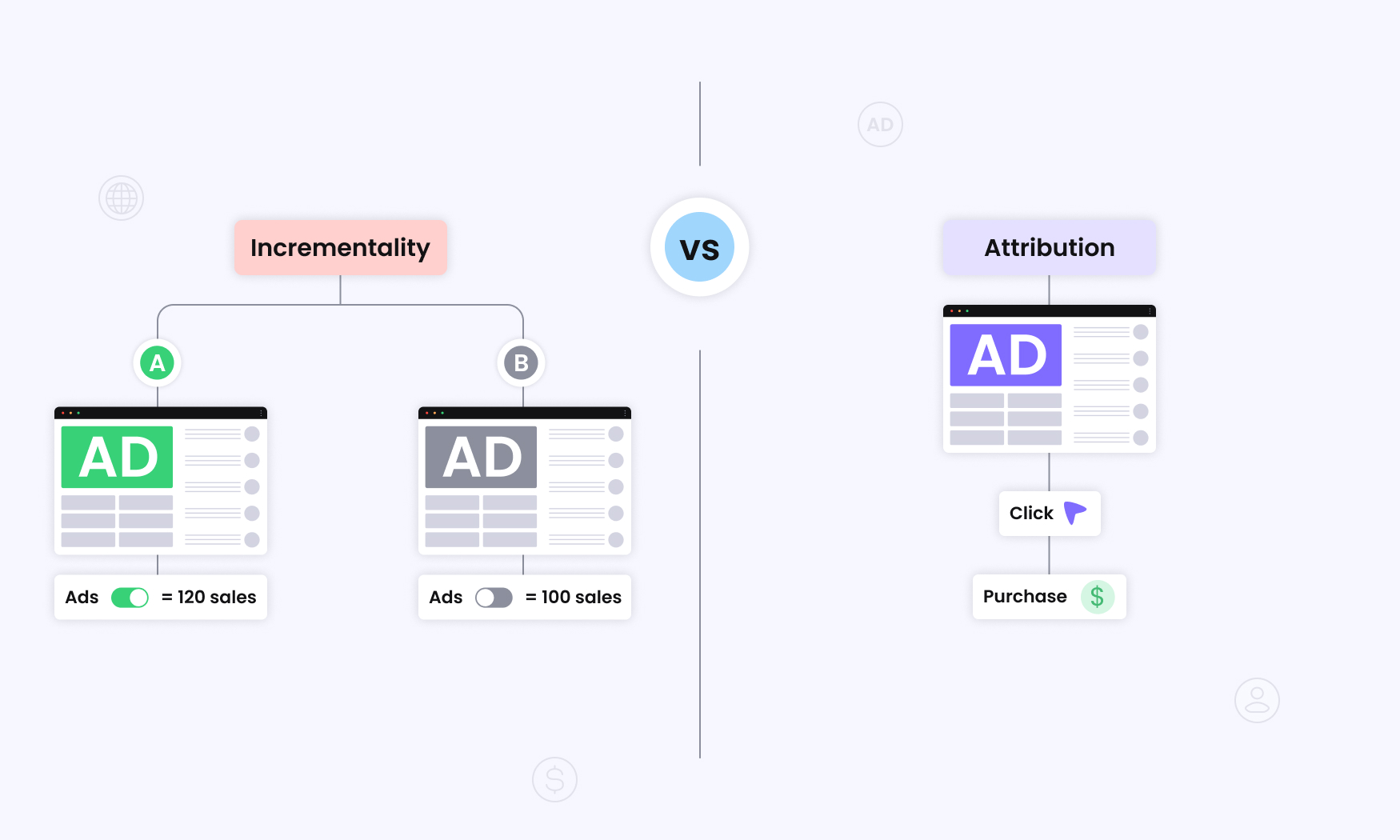
Attribution measures and distributes credit for conversions across ads and marketing channels.
To make it even simpler, attribution answers the question which ads or channels get credit for this conversion?
Incrementality, on the other hand, measures and identifies which conversions would not have happened without a particular channel, campaign, or tactic.
It answers the question:
- Would this conversion have happened anyway, even if we didn’t run that campaign on that channel?
If we were to simplify the difference even further, you could say:
Attribution distributes credit.
Incrementality measures impact.
Key Differences Between Attribution and Incrementality
There are multiple key differences between attribution and incrementality.
At a high level:
- Attribution drives daily bid management, creative testing, and audience optimization.
- Incrementality informs strategic decisions like “Should we double Meta Advantage+ spend in Q3 2026?” or “Is our retargeting spend actually generating incremental revenue?”
Some other differences include:
- Correlation vs causation: attribution tells you which touchpoints happened, incrementality tells you which ones caused the actual outcome.
- Individual paths vs. group-level testing: Attribution tracks an individual customer journey, incrementality tests and compares groups at scale.
- Continuous vs episodic attribution runs and is tracked constantly, incrementality testing is usually done quarterly or biannually.
- Optimization vs investment: attribution guides your daily creative and bid decisions, while incrementality tells you which channels to pull or increase budget spend on.
Now, before we explain the two in detail, let’s establish the one thing that connects the two: the data.
The Shared Link: Data for Incrementality & Attribution
To get the insights marketers need to make daily and long-term strategic media buying decisions, teams rely on conversion data.
Until 2021, teams relied on browser-based tracking. But since third-party cookies started disappearing, performance marketers have found themselves in a pickle. The data they used to use and depend on to track attribution is no longer complete, accurate, and valid.
In the current environment, where third-party cookies are dying and where signal loss is almost a default, performance marketers are hitting a brick wall due to:
- Incomplete conversion paths
- Missing or duplicated data
- Questionable reporting accuracy due to platform bias
Before the iOS 14.5 changes and the decline of third-party cookies, teams could track user behavior across websites and apps with relatively high precision. And that’s why they could heavily lean on using just attribution to inform their decisions. But these days, incrementality testing is what gives you a clearer picture for better decision-making.
And that’s why we are discussing the two and explaining which one should be used when and for what.
Understanding Where Attribution is King
Attribution is essential. You need to know which touchpoints led to the final conversions. But attribution is an operational, day-to-day tactic that lets your team optimize campaigns on a daily basis.
If you’re running paid ads, you’re living inside attribution dashboards. It’s what powers and runs your paid media and guides decisions like:
- Pausing underperforming ads
- Shifting budgets from one ad campaign to another
- Testing creative variations
- Comparing audiences
- Reporting campaign performance to clients and stakeholders
So attribution tells you which changes to make now, later today, or tomorrow to get the most out of your campaign ad spend.
But attribution can’t tell you what caused the conversions.
Let’s look at an example to make this clearer.
Say a customer:
- Sees a TikTok ad
- Clicks on a meta retargeting ad
- Then searches your brand on Google and finally converts
Depending on the types of attribution models you use, the same customer journey will give you a different winner:
- If you use the last touch attribution model, Google gets all the credit
- If you use the first touch attribution model, TikTok gets all the credit
- If you use a multi-touch attribution model, conversion credit will be split across all three evenly.
But no type of attribution model tracking will tell you if that conversion would have happened organically without the ads.
Where Attribution Can Fall Short
The problem with using just attribution to make all your media spend decisions (especially strategic ones) is that certain channels will consistently deliver amazing results in attribution because they are so close to the final conversion that they pick up a lot of the credit.
These are:
- Branded search
- Retargeting
- BoFu campaigns
But while they do play a role and do deserve credit, the issue that goes unnoticed is that, while they capture demand, they aren’t actually creating it.
So if you are guided only by your attribution models and numbers, you’ll end up with channels that:
- Look seriously efficient
- Scale easily
- Feel safe investments
But they also capture conversions from people who were going to buy anyway.
And more importantly, the moves you make based on these numbers and insights are not actually going to drive incremental growth, which is what every business is after.
Understanding Why Incrementality is Queen
Incrementality takes a completely different approach. It’s the queen because it measures the true effectiveness of your advertising spend.
Instead of telling you “who touched this conversion?”, it tells you:
- How many conversions were truly caused by this ad spend?
- What changed because we ran these ads?
To answer these questions, incrementally relies on testing and comparisons, including:
- Audience holdouts where one group of people sees ads, and another doesn’t
- Geo experiments, where you analyze the difference in conversions between regions with ad spend against those without
- Time-based tests, where you pause one channel for a period of time and see if the pause made an impact
So with incrementality, you’re not tracking behavior, you’re actually isolating impact.
Let’s look at a few examples to really show you how these tests isolate impact and then help guide your decision-making.
Example 1: The Audience Holdout
Say you intentionally exclude a portion of your audience from seeing your ads.
- 50% sees your ads
- 50% doesn’t
Once the campaign is over, you compare your conversion rates. If both groups converted at similar rates, this is a sign that the ad campaign isn’t adding much value.
Example 2: The Geo Experiment
Then you might run a campaign in some regions and exclude them in others.
- Run ads in Florida and Georgia
- Pause ads in North and South Carolina
When the campaign is over, you measure the difference in outcomes across the two groups. If conversions were considerably higher in the regions where you ran ads, it means the campaign is delivering worthy results, and you might up the budget to run across the regions that were initially paused.
Example 3: The Time-Based Test
Another tactic is to turn a channel off for a set period and see what happens.
- If conversions drop, it means the channel was definitely contributing
- If conversions stay the same, you’re better off investing that budget in another channel
What Incrementality Tests Should Give You
There are three things incrementality testing should uncover:
- Incremental conversions – If and how many extra conversions your ads generate
- Incremental revenue – The dollar value of all the extra conversions, which is important for those who create, approve, and distribute ad budgets (finance controllers).
- Incremental ROAS – This is not your standard ROAS. It’s your return on net-new ROAS.
Why Understanding & Using Both Impacts Budget Allocation
Treating attribution results as if they were incrementality and letting them guide your budget strategy is not ideal. If you take that approach, chances are it will lead you to focus on marketing channels that are mostly harvesting existing demand, not creating new demand.
So, without incrementality measurement, you’re making budget decisions based on correlation, not causation.
Also, by relying only on attribution, chances are you’ll overinvest in channels that look like they’re delivering results, and underinvest in channels that actually drive growth.
That scenario will also, in most cases, eventually lead to three things no performance marketer wants to see:
- Diminishing returns
- Plateaued growth
- Rising acquisition costs
But if you apply incrementality testing alongside attribution, you can moderate and rebalance your budget allocation based on the numbers, which reveal where new growth lies.
Why First-Party Data & Server-Side Tracking is a Must for Both
We’ve already briefly mentioned the data issues and challenges marketers are having in getting access to clean conversion and click data.
For proper attribution and incrementality, you need clean, accurate, consistent, click-level data. To avoid all the clean and complete data issues performance marketers face with traditional conversion tracking methods and ad platforms, they turn to specialized tools like RedTrack, which:
- Offers server-side tracking and first-party data collection outside of platform silos
- Reconstructs user journeys more accurately, feeding back accurate data to ad platforms for algorithms
- Provides an independent, single dataset for reporting and analysis, which you can slice, dice, and analyze any way you like
What RedTrack provides is accuracy, clarity, and consistency. And when your data and the platform it sits on are clean, both attribution and incrementality testing work and deliver more reliable results.
It lets you compare attribution insights with incrementality results without them contradicting one another.
How RedTrack Connects Attribution and Incrementality
Attribution and incrementality must share the same clean, independent dataset to be trustworthy. If you’re running attribution on platform-reported data and incrementality on separate first-party data, you’re going to end up with conflicting results that won’t be worth much.
What RedTrack does is capture raw click and conversion data, enriches it, and then goes on to support both attribution reporting and incrementality from a unified data source.
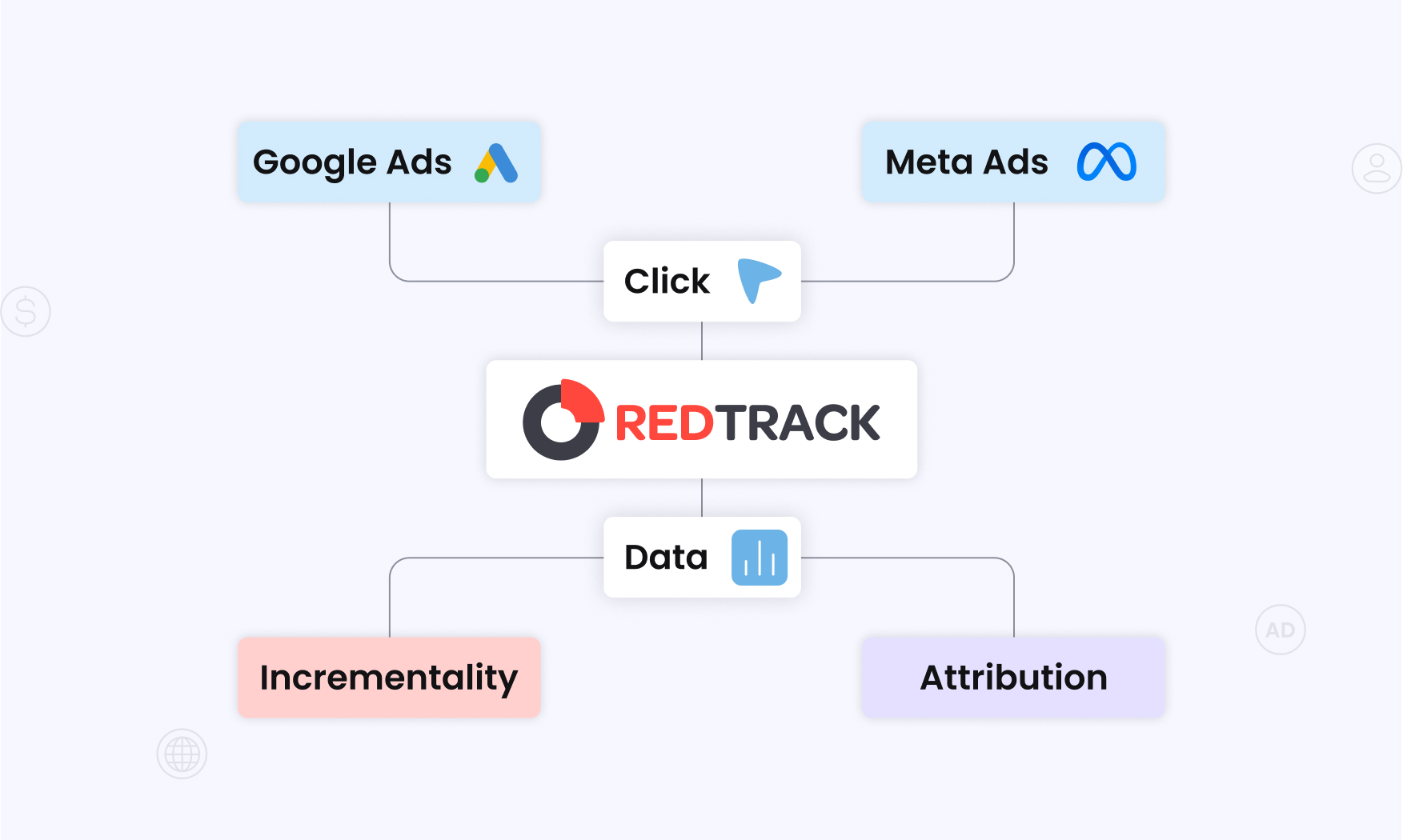
In the case of attribution, when Meta and Google both claim credit for the same conversion, RedTrack acts as the neutral referee that identifies where the true credit lies.
This kind of independence is also vital for incrementality tests. If you’re trying to measure lift based on Meta’s conversion reporting, what you’re facing is an inherent conflict of interest. Here, again, RedTrack provides consistent conversion definitions that make your combination of incrementality testing with attribution actually reliable.
On top of that, RedTrack can stream granular click and conversion logs, complete with timestamps, campaign IDs, device type, and geographic locations, into warehouses like Google BigQuery.
Analysts can then use this data to build:
- Geo experiments with custom market matching
- Matched-market tests using propensity scoring
- Custom lift models beyond platform limitations
This then makes sure you avoid sampling and black-box adjustments, which are common in walled-garden reports. So every ad dollar you spend is traceable, and every conversion auditable.
When to Use Attribution vs Incrementality (And How to Combine Them)
The best performance marketing teams don’t choose between attribution and incrementality because they combine the two.
Use Attribution for Daily Ad Management & to Spot Patterns
- Daily bid management and budget shifts between campaigns
- Creative testing and rapid iteration
- Audience optimization within channels
- See which channels look strong, and how each one is trending
Do daily or weekly attribution experiments to optimize marketing campaigns.
Use Incrementality to Validate and for Budget Adjustments
- Validate major budget shifts based on real performance
- Evaluate new channels before scaling
- See which channels are driving new demand
- Judging the true value of branded search and retargeting
- Informing annual planning and investor conversations
Run quarterly or bi-annual incrementality testing on key channels.
Why RedTrack is the Foundation for Smarter Media Buying Decisions
Performance marketing and ad spend budget decisions shouldn’t be exclusively based on attribution or incrementality testing. For the right decisions, you need to leverage both.
You want to make both work together in a way that’s practical, scalable, and trustworthy.
No marketing team has uncapped budget potential, and most operate on tracking systems that are less than perfect. This leaves a whole lot of room for error and inconsistency, and wasted time.
Smaller advertisers need longer test windows, offline-heavy businesses need flexible conversion input, and every media buyer runs into the issue of conflicting platform data, which frustrates them to no end.
RedTrack is a tool that can remove a good deal of these frustrations. As a server-side tracking tool, it supports marketing and media teams running large-scale campaigns who need reliable data to run attribution models and do incrementality testing.
It’s a platform that closes the loop and ties conversions back to campaigns, letting you run meaningful geo-based tests and control groups without relying on granular user-level tracking. And when ad platforms like Meta and Google give you conflicting results, it acts as the neutral sanity test that accurately allocates credit to the right platform and feeds that clean data to their algorithms for better targeting.
So instead of relying on misaligned data with gaps, it gives you a way to centralize raw conversion and click data on one platform. Not only will it feed your ad platform algorithms with accurate data via CAPI, but it will also let you run proper attribution and incrementality testing for your business and brand.


