
Your customer clicks a Facebook ad, reads your blog post, receives an email, then finally purchases through a Google search. Which marketing channel deserves credit for that sale? This scenario plays out millions of times daily across ecommerce sites, yet most businesses still rely on oversimplified tracking that credits only the last touchpoint.
The reality is that over 90% of customers interact with multiple marketing channels before making a purchase. Without proper ecommerce attribution models in place, you’re essentially making billion-dollar marketing decisions based on fragments of the customer’s journey story.
In this post, we’ll walk you through everything you need to know about ecommerce attribution models, from understanding the basics to implementing advanced tracking that can improve your marketing ROI by up to 30%.
Whether you’re struggling with budget allocation across marketing channels or trying to prove the value of your marketing strategy and efforts, the right attribution model can transform how you measure and optimize performance.
The 7 Essential Ecommerce Attribution Models
Each attribution model offers a different perspective on which touchpoints drive conversions. The right choice depends on your business model, sales cycle length, and campaign objectives.
Let’s examine how the same customer journey gets credited differently across models. Imagine a customer who clicks a Facebook ad, reads a blog post, engages with an email, then clicks a Google ad before purchasing:
- First-touch credits the Facebook ad 100%
- Last-click credits the Google ad 100%
- Linear attribution gives equal credit to all four touchpoints (25% each)
- Time decay attribution increases credit toward the Google ad
- Position-based gives most credit to Facebook and Google ads, less to middle touchpoints
Understanding how different attribution models work will help you select the best model for your specific ecommerce needs.
First-Touch Attribution
The first touch attribution model assigns 100% of conversion credit to the first marketing touchpoint in the customer journey. This single touch attribution approach excels at measuring top-of-funnel performance, making it ideal for identifying which marketing channels drive initial brand discovery and awareness.
Strengths and Use Cases:
- Excellent for measuring brand awareness campaigns and new customer acquisition efforts
- Perfect for content marketing, influencer partnerships, and display advertising evaluation
- Helps identify which channels bring the most valuable new traffic to your ecommerce site
- Useful for businesses focused heavily on top-of-funnel marketing activities
Limitations:
- Completely ignores nurturing and conversion-driving touchpoints later in the journey
- May lead to overinvestment in awareness activities while undervaluing conversion optimization
- Doesn’t account for the sales funnel complexity in longer customer journeys
The first touch attribution model works best for ecommerce businesses where the initial discovery moment strongly correlates with eventual purchases, such as impulse-buy products or businesses with very short sales cycles.
Last-Touch Attribution
Last click attribution gives all conversion credit to the final touchpoint before purchase. This is the default attribution model in Google Analytics and most ecommerce platforms, making it the most commonly used approach despite its limitations.
Strengths and Applications:
- Effective for measuring bottom-funnel activities like retargeting campaigns and branded search
- Useful for optimizing Google ads, email marketing, and direct mail promotions
- Simple to understand and implement across different marketing platforms
- Good for identifying which final marketing asset drives immediate conversions
Significant Limitations:
- Overlooks the critical role of earlier touchpoints in building customer interest and consideration
- May lead to over-attribution of credit to channels that simply “finish the job”
- Can result in cutting budgets for important awareness-building marketing efforts
- Fails to capture the collaborative effect of multi-channel marketing strategies
The last click attribution model works reasonably well for businesses with very short customer journeys or when most customers convert immediately after first discovering the brand.
Linear Attribution
Linear attribution distributes conversion credit equally across all touchpoints in the customer journey. This multi touch attribution model provides a balanced view of all marketing efforts without favoring any particular stage of the sales funnel.
Key Benefits:
- Gives equal credit to all customer interactions, ensuring no marketing channel is overlooked
- Useful for ecommerce businesses with consistent multi-channel marketing approaches
- Transparent and easy to explain to stakeholders across different departments
- Helps maintain balanced investment across various marketing strategies
Potential Drawbacks:
- Assumes every touchpoint is equally important, which rarely reflects actual customer behavior
- May not highlight which specific marketing channels have the strongest conversion impact
- Can dilute focus from high-performing channels that deserve increased investment
The linear attribution model works well for omnichannel brands that want to maintain balanced investment across various marketing tactics, particularly when customer journeys are long and the relative importance of different touchpoints is unclear.
Time Decay Attribution
The time decay attribution model credits touchpoints more heavily as they get closer to the conversion event. This approach recognizes that recent interactions typically have stronger influence on immediate purchase decisions.
Core Principles:
- Applies the recency effect principle from behavioral psychology
- Credits often discount by 50% for each step away from conversion
- Acknowledges that marketing touchpoints closer to purchase carry more conversion influence
Ideal Applications:
- Perfect for retargeting campaigns, abandoned cart recovery, and flash sales
- Suits ecommerce businesses with seasonal sales or time-sensitive promotions
- Effective for measuring performance of urgency-based marketing campaigns
- Works well when customer intent increases significantly as they approach purchase
Considerations:
- May underestimate the impact of initial branding and awareness-building activities
- Less effective for businesses where early touchpoints play crucial roles in purchase decisions
- Requires careful calibration of decay rates based on typical customer journey length
Time decay attribution works exceptionally well for ecommerce businesses that rely heavily on conversion-focused tactics like limited-time offers, flash sales, and abandoned cart recovery campaigns.
Position-Based (U-Shaped) Attribution
Position based attribution typically distributes 40% credit each to the first and last touchpoints, with the remaining 20% spread across middle interactions. This model balances the importance of customer acquisition and conversion activities.
Strategic Advantages:
- Recognizes that introduction and closing moments are critical in ecommerce sales
- Balances investment between awareness-building and conversion-driving activities
- Suitable for businesses where both discovery and final conversion touchpoints are crucial
- Helps optimize both top-of-funnel and bottom-of-funnel marketing efforts
Implementation Considerations:
- Fixed percentage distribution may not reflect actual customer behavior patterns across all journey types
- Requires clear definition of what constitutes “first” and “last” touchpoints
- May not suit businesses where middle-funnel nurturing is particularly important
Position-based attribution works great for B2B ecommerce and lead-generation-focused funnels where defining clear beginning and end points makes logical sense for the business model.
W-Shaped Attribution
W-shaped attribution credits first touch (30%), lead creation (30%), opportunity creation (30%), and distributes the remaining 10% across other customer touchpoints. This model is designed for longer B2B ecommerce sales cycles with clearly defined milestone events.
Specialized Applications:
- Excels in long, multi-stage B2B sales where nurturing activities are crucial
- Perfect for subscription services, high-ticket items, and complex purchase decisions
- Highlights key moments when prospects move through qualification stages of the sales funnel
- Helps optimize marketing efforts at each critical stage of the buyer’s journey
Requirements:
- Needs well-defined sales funnel milestone tracking
- Requires clear identification of lead and opportunity creation events
- Works best when you can track customer interactions across extended time periods
W-shaped attribution is ideal for B2B ecommerce businesses, subscription models, and high-value purchases where the journey from awareness to purchase involves multiple distinct stages.
Data-Driven Attribution
Data driven attribution employs machine learning algorithms to analyze historical conversion data and automatically assign credit based on each touchpoint’s actual influence on conversions. This represents the most sophisticated approach to marketing attribution modeling.
Advanced Capabilities:
- Uses algorithmic attribution to capture non-linear patterns in customer behavior
- Automatically adapts credit distribution as customer behavior patterns change over time
- Employs techniques like Shapley value analysis and Markov Chain modeling
- Provides the most accurate insights when sufficient historical data is available
Implementation Requirements:
- Typically requires 3,000+ conversions per month for statistical confidence
- Available in Google Analytics 4, Google Ads, and advanced attribution platforms
- Needs significant data volume to avoid overfitting or producing unreliable results
- Works best for established ecommerce businesses with rich customer interaction data
Technical Foundation: Data driven attribution often uses sophisticated models that calculate the “removal effect” of each marketing channel – essentially determining what percentage of conversions would be lost if a specific touchpoint was removed from customer journeys.
This represents the gold standard for marketing attribution models when sufficient data is available, providing insights that simpler models simply cannot match.
Choosing the Right Attribution Model for Your Ecommerce Business
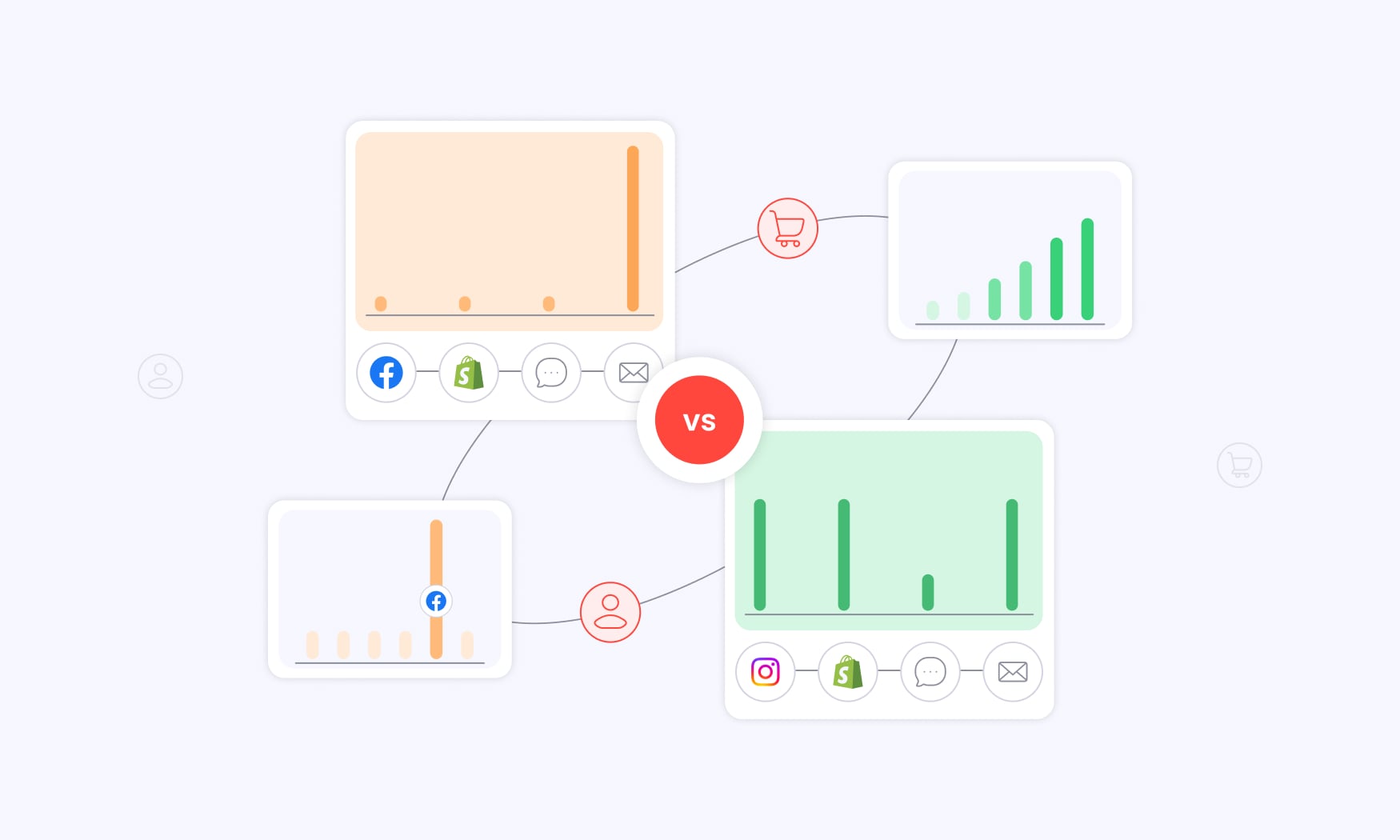
There is no universal best attribution model – the optimal choice depends on your business objectives, customer journey complexity, marketing strategy, and available data. Understanding how different models align with various business goals will help you select the approach that provides the most actionable insights.
For New Traffic and Brand Awareness
When your primary marketing strategy focuses on customer acquisition and brand discovery, first-touch attribution provides the clearest insights into which marketing channels bring valuable new visitors to your ecommerce site.
Key Performance Indicators to Track:
- New user acquisition rates across different marketing channels
- Brand search volume increases following awareness campaigns
- Early-funnel engagement metrics like time on site and pages per session
- Cost per new customer acquisition by channel
First-touch attribution works particularly well for businesses investing heavily in content marketing, influencer partnerships, display advertising, and social media campaigns designed to introduce new audiences to your brand.
For Conversion Optimization
If your focus is optimizing the final stages of the sales funnel, last-click attribution or time decay models highlight which marketing channels and campaigns drive final purchase decisions most effectively.
Optimization Focus Areas:
- Retargeting campaign performance and abandoned cart recovery effectiveness
- Email marketing campaigns that drive immediate conversions
- Branded search campaign optimization and conversion rate improvement
- Bottom-funnel advertising campaigns with high purchase intent
These models help you identify which marketing efforts convince customers who are already considering a purchase to actually complete the transaction, allowing you to optimize budget allocation toward conversion-driving activities.
For Comprehensive Marketing Analysis
When you need a holistic view of how all your marketing efforts work together, linear attribution provides balanced insights across the entire customer journey, while data-driven models offer the most sophisticated analysis for businesses with sufficient data.
Comprehensive Analysis Benefits:
- Understanding how different marketing channels complement each other
- Identifying optimization opportunities across the entire sales funnel
- Making strategic decisions about multi-channel marketing strategies
- Balancing investment between awareness-building and conversion-driving activities
Linear attribution works well for omnichannel brands, while data driven attribution in Google Analytics offers the most accurate insights for established businesses with substantial conversion volume.
The best attribution model for your business might actually be using multiple models simultaneously, comparing insights across different approaches to gain a more complete understanding of your marketing performance.
Attribution Model Differences Across Platforms
One of the most confusing aspects of ecommerce attribution is understanding why Google Ads, Facebook Ads, and your website analytics show different conversion numbers for the same campaigns.
Each platform views attribution through its own lens, leading to discrepancies that can make marketing performance analysis challenging.
Understanding these platform-specific differences is crucial for interpreting cross-platform marketing data effectively and making informed decisions about budget allocation across different advertising channels.
Google Ads Attribution
Google Ads attribution focuses exclusively on interactions within the Google advertising ecosystem, which creates important differences from the broader view provided by Google Analytics.
Platform-Specific Characteristics:
- Only tracks Google Ads traffic and conversions within the platform
- Does not deduplicate conversions from other marketing channels
- Default last click attribution model with 30-day click and 1-day view windows
- Credits any user interaction with Google ads regardless of other marketing channels
- Position-based and data driven attribution available for accounts with sufficient conversion volume
Why Numbers Differ: Google Ads will claim credit for conversions even when other marketing channels played significant roles in the customer journey. This means Google Ads conversion numbers often appear higher than the credit assigned to Google Ads in your website analytics.
Facebook and Meta Ads Attribution
Facebook’s attribution approach has been significantly impacted by iOS 14.5+ privacy changes, making it less reliable for comprehensive attribution analysis than it was previously.
Current Attribution Characteristics:
- Tracks only Facebook, Instagram, and Meta-owned properties ad interactions
- Default 7-day click and 1-day view attribution windows
- Credits both click-through and view-through conversions from Meta platforms
- Does not account for other marketing channels in the conversion path
- Significantly reduced tracking accuracy due to iOS privacy updates
Impact of Privacy Changes: The iOS 14.5+ updates have dramatically reduced Facebook’s ability to track conversions, particularly for users who opt out of tracking. This has made Facebook attribution data less reliable and created larger discrepancies between Facebook’s reported performance and other attribution sources.
Shopify Attribution Reporting
For ecommerce businesses using Shopify, the platform’s built-in attribution reporting offers some advantages over third-party attribution platforms, particularly in the current privacy-focused environment.
Shopify Attribution Benefits:
- Channel Performance reports provide holistic view across all marketing sources
- Toggle between different attribution models within the same interface
- Integrates seamlessly with UTM parameters for detailed campaign tracking, a capability often enhanced when working alongside a specialized Shopify Agency
- Shows customer journey visualization with multiple touchpoint analysis. Such insights are invaluable when running Shopify AB testing, as they help pinpoint which user interactions drive conversions
- First-party data collection provides more accurate attribution than third-party tracking
Why Shopify data is often more reliable? Because Shopify controls both the ecommerce platform and attribution tracking, it can provide more accurate conversion data than platforms that rely on third-party cookies or cross-domain tracking.
Platform Reconciliation Strategy: Rather than trying to make platform numbers match exactly, focus on understanding the relative performance trends across platforms and using each platform’s data for its specific optimization purposes.
Why Ecommerce Businesses Need Attribution Models
The challenge that ecommerce attribution solves is the “cross-channel, multi-touch” problem. Customers might discover your brand through organic search, engage with your content on social media, receive targeted emails, and finally convert through a retargeting campaign.
Traditional last-click attribution would credit the entire sale to retargeting, completely ignoring the crucial role of earlier touchpoints.
Marketing attribution models provide a more nuanced view by distributing conversion credit across the customer journey which enables businesses to:
- Allocate marketing budgets based on actual channel performance rather than misleading last-click data
- Optimize campaigns across the entire sales funnel instead of just bottom-funnel activities
- Improve overall marketing ROI through better understanding of customer behavior
- Make informed decisions about which marketing strategies deserve increased investment
Single-Touch vs Multi-Touch Attribution
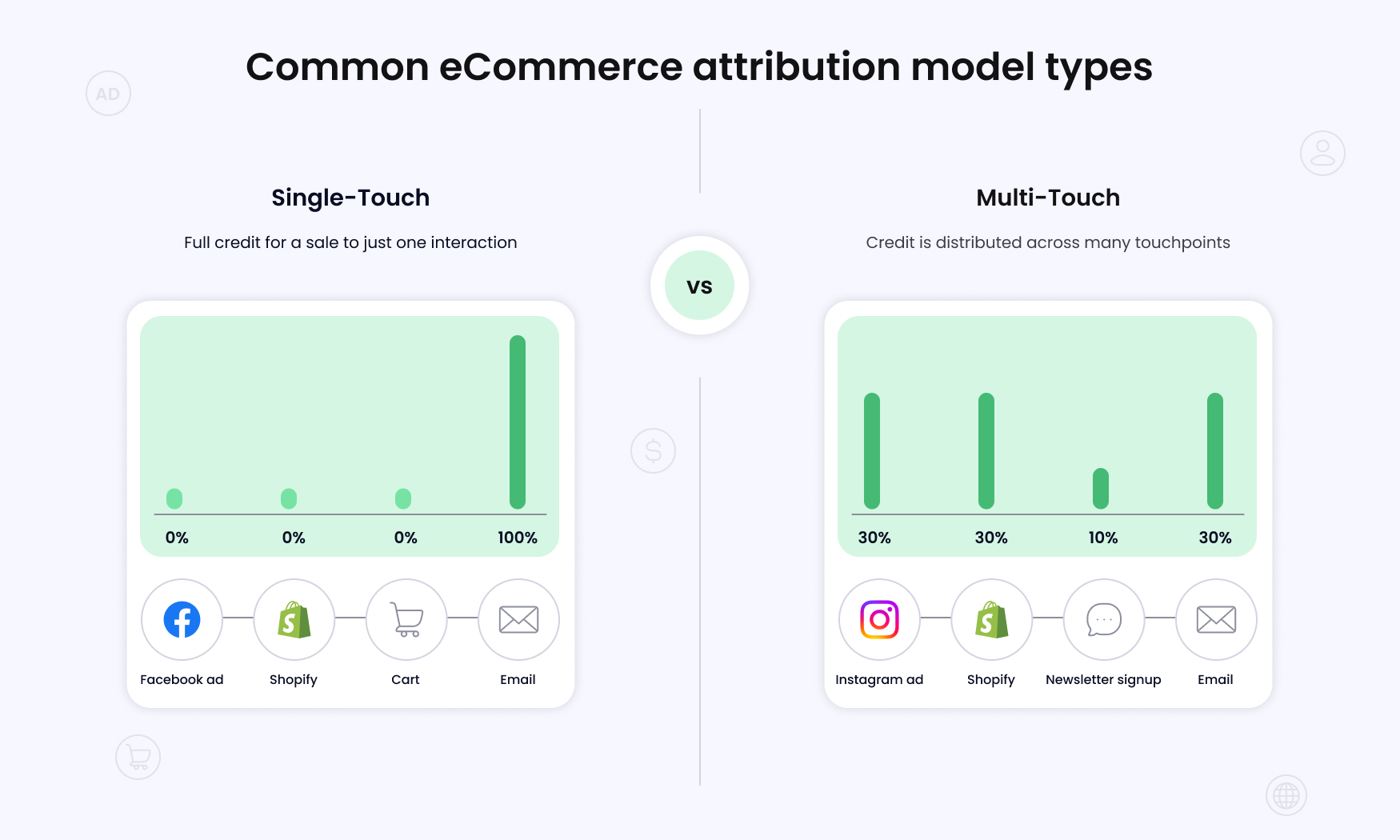
The distinction between single touch attribution models and multi touch attribution models is fundamental to understanding ecommerce attribution.
Single touch attribution model approaches like first-touch or last-touch credit only one interaction, simplifying reporting but often oversimplifying the complex customer journeys that characterize modern ecommerce.
Multi touch attribution models distribute influence across multiple relevant touchpoints, better reflecting the true complexity of how customers make purchasing decisions.
While single-touch models are easier to implement and understand, they fail to capture the collaborative effect of different marketing campaigns working together throughout the buyer’s journey.
RedTrack as Ultimate Solution for Attribution and Tracking Issues
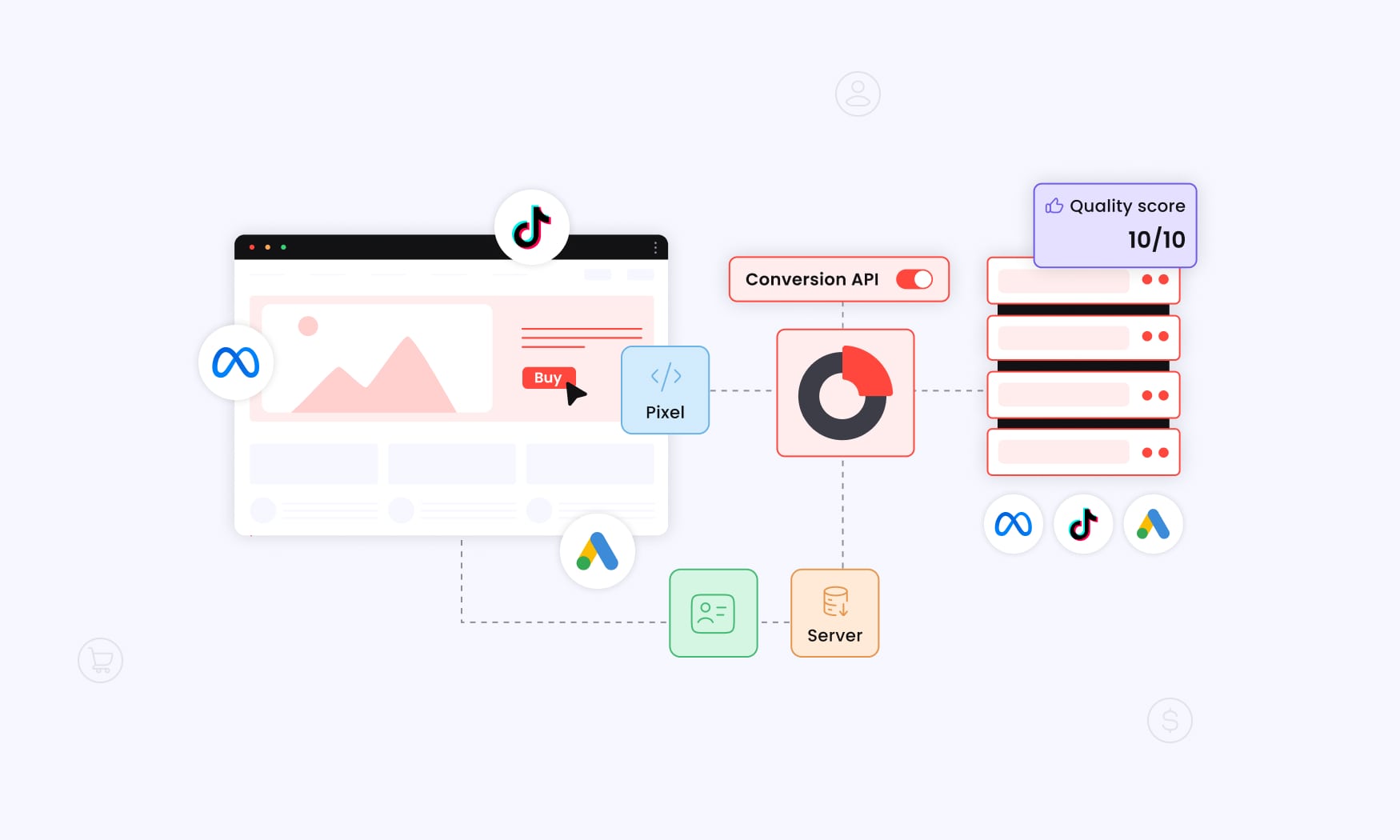
With platforms like Google Ads, Meta, and Shopify each using different attribution windows, conversion logic, and reporting methodologies, it’s super easy to get confused and frustrated by inconsistent numbers.
RedTrack was built specifically to resolve these attribution discrepancies and bring clarity to cross-platform performance analysis.
RedTrack acts as an independent, unbiased attribution and tracking hub. Instead of relying on each platform’s self-reported data (which often overstates its contribution) RedTrack accurately captures every touchpoint across the customer journey using server-side tracking and direct API integrations. Whether a user clicked a Meta ad, searched again on Google, and then converted through an email campaign, RedTrack sees it all and attributes credit accordingly.
Where Google and Meta fail to deduplicate conversions or reflect multi-channel journeys, RedTrack provides a complete picture. Our platform enables multi-touch attribution models, giving marketers full visibility into what actually drove conversions, not just what platform claims the last click. You can see which channels initiate, assist, and close conversions, helping you optimize budgets with data that reflects true performance, not platform bias.
Additionally, RedTrack’s real-time tracking eliminates delays and sampling common in native reporting tools. With full data ownership, marketers are no longer dependent on third-party cookies or restricted platform ecosystems. Whether you’re managing campaigns across Shopify, Google Ads, Meta, TikTok, or affiliate networks, RedTrack consolidates it all in one interface – accurate, transparent, and actionable.
By using RedTrack, media buyers, performance marketers, and ecommerce brands finally gain a single source of truth for performance data. Instead of reconciling conflicting reports, you can focus on what matters: scaling profitable campaigns, cutting wasted spend, and maximizing ROAS across all channel.
Don’t take our word for it – try it for yourself or book a demo and let us show you around!
Future of Ecommerce Attribution
The future of marketing attribution modeling is being shaped by artificial intelligence, privacy regulations, and the development of new measurement frameworks that balance accuracy with user privacy protection.
Machine Learning and AI Attribution
Advanced algorithms are transforming how ecommerce businesses analyze customer journey data and optimize marketing performance based on attribution insights.
AI-Powered Attribution Capabilities:
- Predictive attribution models that forecast future conversion probability based on current customer touchpoint interactions
- Real-time bid optimization that adjusts advertising spend automatically based on attribution performance data
- Customer segmentation based on attribution behavior patterns, enabling more precise targeting and personalization
- Algorithmic attribution that identifies hidden patterns in customer journey data that simpler models miss
Implementation Considerations: Machine learning attribution requires substantial historical data and ongoing model training to maintain accuracy. Businesses with lower conversion volumes may need to start with simpler models and evolve toward AI-powered approaches as data volume increases.
Practical Applications: AI attribution enables dynamic campaign optimization, where marketing budgets automatically shift toward the highest-performing marketing channels and customer segments in real time, rather than requiring manual monthly or quarterly adjustments.
Unified Measurement Frameworks
The industry is developing new standards for attribution measurement that address privacy concerns while maintaining marketing effectiveness measurement.
Privacy-First Attribution:
- Google’s Privacy Sandbox and similar initiatives aim to establish industry standards for attribution tracking that preserve user privacy
- Aggregated reporting methods that provide marketing insights without individual-level tracking
- Consent-based attribution frameworks that respect user preferences while enabling marketing measurement
Industry Collaboration: Major advertising platforms are working together to develop unified attribution standards that provide consistent measurement across different marketing channels and platforms, reducing the current confusion caused by platform-specific attribution differences.
Preparation Strategies: Ecommerce businesses should focus on building robust first-party data collection, implementing server-side tracking infrastructure, and developing attribution analysis capabilities that work effectively with privacy-preserving data collection methods.
According to industry research, over 50% of large ecommerce brands are expected to transition to data driven attribution or hybrid attribution approaches by 2026, balancing measurement accuracy with privacy compliance requirements.
The evolution toward more sophisticated, privacy-conscious attribution measurement represents both a challenge and an opportunity for ecommerce businesses willing to invest in advanced measurement capabilities and first-party customer relationship building.
Conclusion – Getting Ready for The Future with RedTrack
Ecommerce attribution models are essential tools for understanding and optimizing marketing performance in today’s multi-channel customer journey environment.
While no single attribution model provides perfect insights, choosing the right approach for your business objectives and implementing proper tracking infrastructure can dramatically improve your marketing ROI and budget allocation decisions.
The thing about mastering attribution? It’s not about chasing perfection, but about taking control. With RedTrack, you can finally move beyond those last-click models and platform biases that have been driving you crazy.
We’re talking about getting a holistic view of your customer journey that actually makes sense.
Whether you’re just dipping your toes into linear attribution model or you’re ready to dive headfirst into advanced, data-driven models, RedTrack gives you the infrastructure and flexibility to grow at your own pace.
Here’s the reality: we’re living in a world that’s being reshaped by stricter privacy laws and AI-driven decisions every single day.
The brands that are going to stay ahead? They’re the ones prioritizing first-party data, owning their conversion tracking, and implementing privacy-compliant attribution frameworks. And RedTrack helps you do exactly that – no more guesswork, no more missing conversions, just actionable insights you can actually trust and act on.
So here’s what you need to do: audit your current setup, find those gaps, and let RedTrack fill them with accurate tracking, real attribution, and reporting that drives real growth. Because at the end of the day, that’s what this is all about getting results that matter.
Sign up for a free trial or book a demo and let us show you a whole new level of running paid campaigns for your ecommerce store!


