
Running an online store in 2026 is a whole different ball game when it comes to grabbing people’s attention. You’re up against rising ad costs, changing privacy regulations, and customers who want and expect more for their loyalty.
What worked for a brand a year ago won’t cut it in the year to come, and this guide is here to give you the lowdown on the e-commerce marketing strategies that will actually drive the results you want.
We’ll tell you how to get genuine website visitors, convert them into paying customers, and turn those customers into loyal fans who keep coming back and bring their friends along, too.
Whether you’re just starting your first e-commerce store or scaling up an established brand, the tactics here are built for the current landscape where first-party data is king and smart customer retention beats expensive customer acquisition every time.
Building a data-driven e-commerce marketing plan
Applying smart tactics without a plan is a recipe for scattered efforts and wasted marketing budget.
So, before you start looking at specific marketing channels to focus on, you need to sit down and do a proper strategy:
One that ties your e-commerce marketing efforts to some measurable business goals.
This is especially important for small to mid-sized brands that are spending 10-15% of their revenue on marketing. Because without clear direction, it’s easy to get caught up in the latest and greatest quick-win approaches and forget about the fundamentals that actually drive sales.
One of the best ways to go about this is to use a simple 6-step planning framework that works for most e-commerce businesses:
- Goals – What does success look like in plain English, with some specific numbers to back it up
- Audience – Who are the people you’re trying to reach out to, and what are their pain points
- Channels – Which marketing channels are going to work best for your audience and your budget
- Budget – Where are you going to put your marketing spend, with some room for experimentation
- Execution – Build the campaigns, create the content, sort out your automation flows
- Optimization – Track what’s working, and keep tweaking things until you get it right
From the very beginning, you should start tracking a core set of metrics using Google Analytics 4, your e-commerce platform’s built-in analytics, and any ad platform dashboards you’re using.
Now, while tools like GA4 and ad platform dashboards are solid starting points, they don’t always give you the full picture. Each channel tells its own story about how it’s doing, which makes it a real pain to figure out what’s really driving revenue across the entire sales funnel.
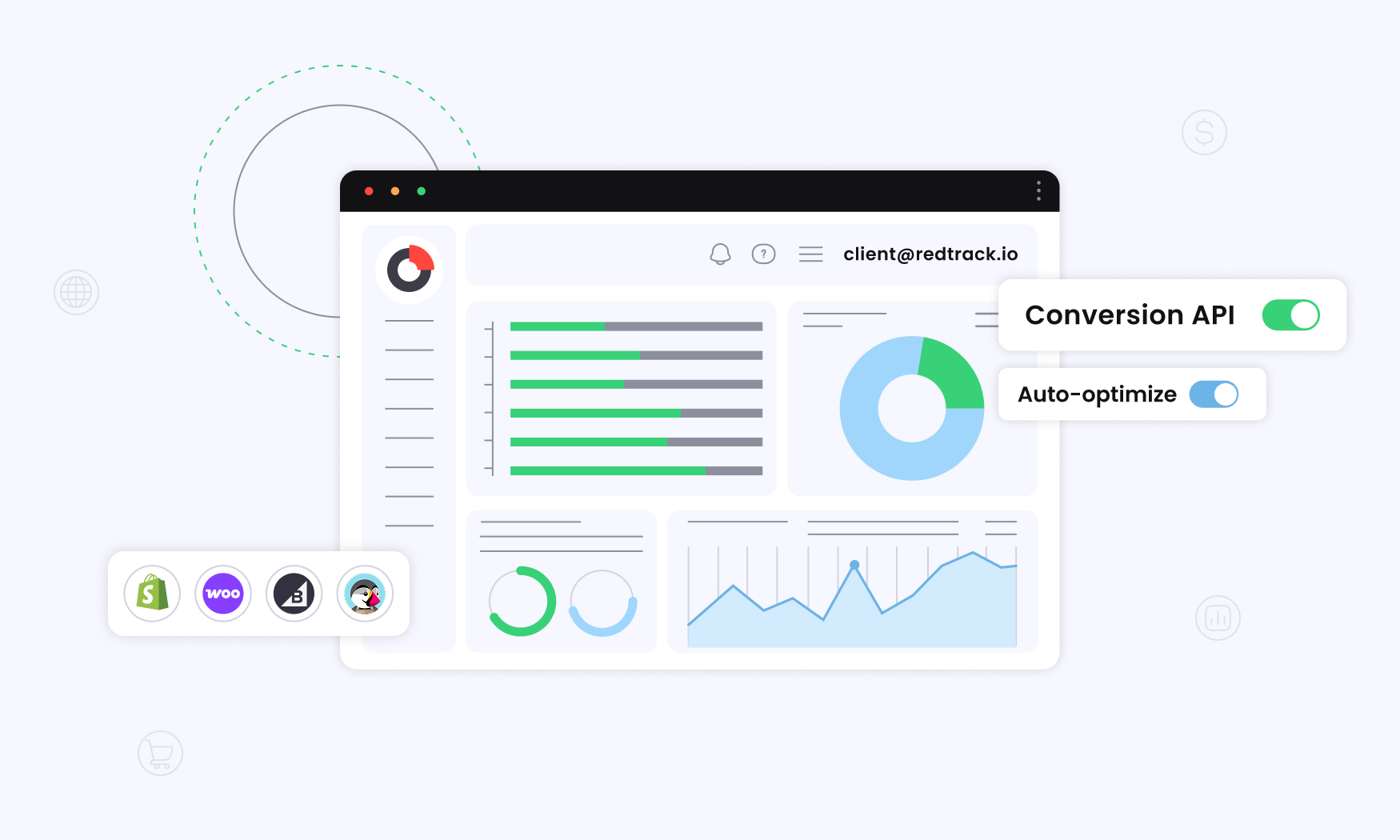
On the other hand, using attribution tools like RedTrack can tell you exactly which campaigns, which traffic sources, and which touchpoints are actually making sales happen. And because RedTrack is a server-side, first-party data tracking platform, it’s been designed for e-commerce brands that want to connect and unify all their ad platforms, tracking links, and conversion events into one accurate and reliable data source.
Think of your marketing funnel like a big journey, with four stages:
- Stage 1: People discover you (awareness)
- Stage 2: They think about you and your products (consideration)
- Stage 3: They decide to buy (conversion)
- Stage 4: They come back for more (retention)
Different marketing tactics work best at each stage, and a successful e-commerce marketing plan needs to cover all four.
Traffic-driving strategies: Getting qualified shoppers to your store
Not all website traffic is equal. A thousand visitors with no intent to buy matter less than a hundred ready to purchase. So, what you should be focusing on in 2026 is intent and relevance. To get there, you’ll need to cover a few bases with the tactics below. But before you start, make sure you tie each one to specific outcomes. Ask yourself what you want to achieve.
More organic sessions? Improved ROAS? A growing customer list, or are you after the marketplace sales share?
Tactic 1: Nailing e-commerce SEO fundamentals
Unlike paid advertising, organic traffic doesn’t stop when you stop spending and investing in it.
E-commerce SEO still rests on three pillars:
- Keyword research
- Technical SEO health
- High-intent content
So focus on optimizing your best content pieces and make sure you provide great mobile experiences over rather than stuffing your content with just keywords.
Now you don’t have to go trying to optimize every single page; instead, focus on:
- The top 20% that are driving revenue.
- Category pages, which usually target higher-volume, broader keywords
- Timeless content pieces that are always relevant, like “2025 Buying Guide for Televisions,” capture potential customers during the research phase.
SEO optimization basics to remember
To get your on-page SEO basics right, focus on:
- Having descriptive, keyword-informed titles and meta descriptions
- Doing structured data markup for products by including price, availability, and reviews
- Connecting related products and categories via internal links
- Providing unique and helpful product descriptions instead of doing a boring copy-paste from the manufacturer
When it comes to technical SEO basics, focus on:
- Having the Core Web Vitals (CWV) passing scores for desktop and mobile
- Establishing HTTPS security
- Having clean URL structures without excessive parameters
- Proper canonical tags to avoid duplicate content issues
Tip for best-practice SEO optimization: Make sure to refresh keyword research quarterly, run technical SEO audits monthly, and update your best-performing pages with new content weekly.\
Tactic 2: Creating content marketing that actually converts
Content marketing plays an important role in moving prospects from brand discovery to purchase.
And when we talk about content marketing, we’re not just thinking blog posts. You’ve also got:
- Buying guides
- Comparison pages
- How-to guides
- Customer stories
All these different pieces of marketing content work together to help potential customers make their buying decisions and to hopefully choose you.
Content marketing basics to cover
There are two things you need to do to get the most out of your content marketing efforts:
- Focus on producing high-intent content – Think of blog articles that target a specific purchase reason, such as “Best Mother’s Day Gifts.”
- Reformatting and repurposing content across channels – From one customer interview you post on YouTube, you can create a written customer story, a video testimonial, and several social media posts or reels.
Tactic 3: Getting onto social media and TikTok marketing
If you’re an e-commerce brand and aren’t on TikTok, Instagram, and YouTube showcasing your products via reels or shorts, you’ll be losing out on a huge audience segment of all the under-40s who are on these platforms religiously.
Your social media marketing schedule doesn’t have to be complicated, time-consuming, or sales-pitch-focused all the time. You just have to make sure you are present and consistent.
The great thing about this type of marketing is that you can have a bit of fun with it. Try out different things and see what works best.
A sample social media marketing campaign schedule might look something like this:
- Mondays – How-to guide or educational tutorial for your product
- Wednesdays – Behind the scenes posts (making the product or ad photo shoot)
- Fridays – Customer story or product sales pitch
- Weekends – Entertaining, light-hearted content, keeping your brand top of mind
Social media marketing basics to remember
Here are a couple of things e-commerce businesses need to keep in mind for each of the main social media platforms:
- TikTok Shop: If you set up in-app purchases, you’ll reduce friction dramatically
- Instagram Shopping: Make sure you tag products in posts, stories, and reels so people know what to look for
Tip for social media marketing: Make sure to track platform KPIs that tie to revenue so you know what’s working and what isn’t. Remember that views are vanity metrics. What you want to see is click-throughs to your site, add-to-carts from social, because these are the things that will result in online sales. And when you know what drives sales, you’ll know what kind of social media marketing you should invest more in.
Tactic 4: Doing paid ads that work for search, social, and shopping
Like it or not, paid advertising remains an essential component for most e-commerce brands. And yes, we’ve noticed that the cost of ads is increasing, but instead of canceling your paid ad campaigns, what you should be doing is analyzing the results, reallocating more resources towards the channels that are working, and optimizing or canceling the ones that are total flops.
Here are the paid ad channels you can focus on in 2026:
- Google Ads: Great for high-intent keyword search campaigns
- Microsoft Ads: More cost-effective for e-commerce brands and good for targeting specific demographics
- Meta (Facebook/Instagram): Solid choice for prospecting, retargeting, and dynamic product ads
- TikTok Ads: Good for discovery and impulse purchases, and perfect if your target market is a younger demographic
Paid ads basics to cover
Before you jump into paid ads, you first need to structure your campaigns by objective. A sample paid ads plan and breakdown might look something like this:
| Campaign type | Purpose | Budget % |
| Branded search | Capture people searching for your brand | 10-15% |
| Non-branded high-intent | Capture category/product searches | 30-40% |
| Remarketing | Convert visitors who didn’t buy | 20-25% |
| Prospecting | Find new potential customers | 25-35% |
The logic you should use when deciding on how much to allocate to each campaign type should be a combination of ROAS (Return on Ad Spend) and blended CAC (Customer Acquisition Cost).
If you’re a new e-commerce shop or brand, in your first year, you might go for a 2-3x ROAS target.
On the other hand, if you’re a well-established and mature brand, you can go with a lower ROAS if you know your Customer Lifetime Value (CLV) will make up for it.
Tip for scaling paid ad campaigns: Start small, say $30-$100 per day with pay-per-click (PPC) campaigns, and only scale after you see stable performance for 2-4 weeks.
Tactic 5: Being strategic with your influencer and affiliate marketing
Influencer and affiliate marketing work to deliver different outcomes, but both are great ways to build trust in your brand and get more eyes seeing you.
While influencer marketing pays or gifts creators for exposure, affiliate marketing pays commissions on tracked sales. However, both are ecommerce marketing strategies that drive sales and generate user-generated authentic content and storytelling you can share and leverage across your marketing channels.
Influencer marketing basics to remember
If you want to get the best results from influencer marketing, focus on the following best practices:
- Go for niche influencers that are most relevant to your product and target market
- To get better engagement, focus on nano- and micro-influencers with 1,000-50,000 followers (this will keep your costs down)
- Look for influencers with highly engaged followers (a micro-influencer with 10,000 highly engaged followers in your niche usually outperforms a celebrity influencer with millions of passive followers)
Affiliate marketing basics to cover
On the other hand, if you want to invest your money and time into affiliate programs, here’s what you should focus on:
- Be strategic when selecting your affiliate marketing partners (find relevant micro-influencers and content creators whose audience aligns with your product and brand)
- Setting a reasonable commission rate that’s aligned to the going rate (this varies across industries and can be anywhere between 2%-70%)
- Building quality relationships with your affiliates, giving them high-quality creative assets, discount codes, and tracking links so you know who’s delivering how many sales.
Tip for repurposing content: Make sure you collect all the User-Generated Content (UGC) from your influencer and affiliate partners and repurpose it across your marketing channels, including social media platforms, email marketing, product pages, and paid ads. But before you do that, make sure you have permission from the creators!
Tactic 6: Getting onto marketplaces and comparison channels
Your e-commerce marketing efforts don’t need to be restricted to your branded website. You can, and should, expand your reach by selling your products on marketplaces like Amazon, Walmart, eBay, or regional platforms (Zalando in Europe, Mercado Libre in Latin America). On top of that, you should also look at getting onto popular comparison channels.
Expanding in this way doesn’t mean you lose focus on all your other primary sales channels. You are simply complementing and adding more ways for people to hear, see, and buy from you.
Marketplace basics to remember
Here again, you need to be strategic when deciding which marketplaces to get onto:
- Treat the marketplaces you choose to sell on as discovery channels for new customers
- For the platforms that allow it, make sure to use inserts and follow-up emails encouraging buyers to follow your brand elsewhere (like social media)
- Don’t offer everything on marketplaces; instead, use them as bait to drive buyers to your own store for exclusive products or bundles (this will keep your margins safe)
Comparison channels basics to cover
This tactic is especially effective if your products are competitively priced. That’s because Google Shopping and price comparison engines have already captured high-intent, ready-to-buy traffic; all you need to do is make sure you’re there as an option.
A few things to make sure include:
- Keep your inventory logs synced across channels to avoid overselling
- Maintaining pricing parity or justifying differences clearly (otherwise, this can damage your brand reputation)
- Monitoring and responding to reviews on every platform
Conversion optimization: Turn visitors into buyers
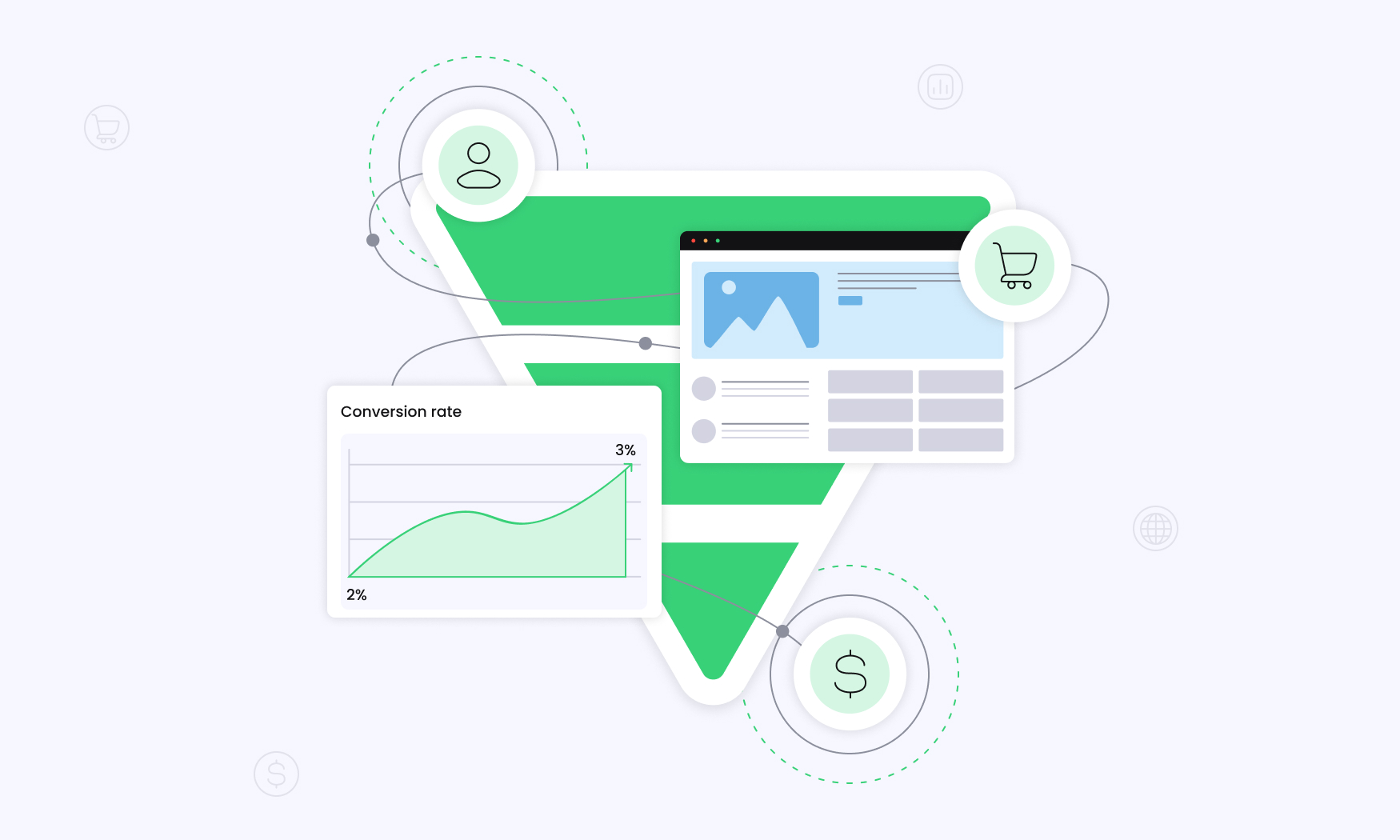
Conversion optimization is one of the most underrated e-commerce marketing strategies. It’s also something many online retailers completely overlook, but when you do the math, you actually realize a tiny increase in conversions can have a massively positive impact on your revenue.
Here’s what we’re talking about:
If you can manage to raise your conversion rate from 2% to 3% you’ll produce the same revenue impact as a 50% increase in traffic.
Now, which one do you think is easier and cheaper to achieve?
It’s conversion rate optimization (without a doubt!). Why? Because all you have to do is work on all the steps in the buyer’s initial journey from landing page to checkout, and make sure you:
- Remove friction
- Add motivation
We’ll go through three key tactics you can use to increase your conversion rate so you can increase sales.
Tactic 1: Design product pages that actually sell
First and foremost is to get your product page design right. This is vital because it’s your product pages that do all the heavy lifting. They answer all the questions, overcome all the possible objections, and make the add to cart maneuver feel like the obvious, easy, and natural next step.
Best design practices for high-converting product pages
Stick to the essential design and optimization elements:
- Write clear headlines (product name and key benefit)
- Place a greater focus on explaining what the product does, less on what it is (do benefit-focused copy)
- Complement with 4-6 high-quality images (do multiple angle views or settings)
- Show how the product works (include a short demo video)
- Make price and shipping info clearly visible (don’t make them scroll for this)
- Include all the trust collateral (reviews, guarantees, star ratings, secure payment badges)
- Add helpful size guides (with real-world fit notes – not just measurements)
- Provide a clear, short returns policy (place it near the “Add to Cart” button)
- Insert “Low stock” indicators (this will create urgency to buy sooner)
- Place “Order by” timers for time-sensitive delivery windows (especially helpful during high-peak season)
Tactic 2: Streamline navigation and site experience
Things like confusing menus, overwhelming homepages, and too many options can all kill conversion by making potential buyers leave before they even start. It’s vital you get the website and pages where you’re selling and converting customers up to scratch, and also make the search for items easy and fast.
Best ways to streamline navigation and site experience
Here are some of the main things you need to take care of:
- Create clear category hierarchies that mirror the natural behavior of a shopper
- Make the Search component a prominent feature on the page, and make sure it offers autocomplete suggestions
- Do filters the way customers actually shop: by size, color, price, or use case
- Make your top sellers, best products, and current promotions the focus of your homepage
- Do all the right things to keep site speed top-notch (compress images, minimal JavaScript, CDN usage, and CWV optimization)
Tactic 3: Reduce abandoned carts and checkout
The average cart abandonment rate exceeds 70%. This is the global average based on 50 different studies on e-commerce shopping cart abandonment rates. Now, that’s a whole lot of lost revenue from people who were ready to buy but didn’t because of something you’ve done wrong.
The reasons for abandonment range from unexpected shipping costs (revealed at checkout) to forced account creation, limited payment options, and long and complicated buyer forms.
But there are ways you can avoid this.
Best ways to reduce and recover cart abandonment
- Disclose shipping costs early (on the product page or in cart)
- Let customers choose and give them the option of guest checkouts (always)
- Offer multiple express payment options (Apple Pay, Google Pay, PayPal, etc.)
- Eliminate unnecessary fields and make forms short and sweet (only essential data)
- Send abandoned cart emails within 1 hour, then 24 hours, and then 72 hours (maybe they were interrupted)
- Do SMS reminders within 1-24 hours (only for customers who have opted in)
- Provide free returns to build confidence
Retention and loyalty: Keep customers coming back
Acquiring a new customer can cost more and take more time than retaining an existing loyal customer. If you can increase customer retention by 5%, you can expect to increase your profits by anywhere between 25-90%.
Now that, right there, is the reason why healthy e-commerce brands put some serious effort into building a loyal customer base.
There are several practical ways ecommerce businesses can foster customer loyalty. Strong customer retention will only happen if you make the four parts work together. There’s email marketing, SMS marketing, loyalty programs, subscriptions, and thoughtful post-purchase experiences.
Each will increase Customer Lifetime Value (CLV) and reduce your dependence on the more expensive alternative: paid acquisition of new customers.
Tactic 1: Do email marketing for the lifecycle journey
It may be old-school, but it works. For e-commerce businesses, email remains one of the highest-ROI channels. And while the average ROI across industries sits between $36-$42 for every dollar spent, retail and e-commerce businesses show even better performance.
How to structure your core automated email flow
While you can segment campaigns by customer behavior and use things like dynamic product recommendations, the basic flow of your core automated customer journey email marketing campaign should look something like this:
| Flow | Purpose | Timing |
| Welcome series | Introduce brand, set expectations, drive first purchase | 3 emails over 5 days |
| Abandoned cart | Recover lost sales | 2-3 emails: 1 hour, 24 hours, 72 hours |
| Browse abandonment | Re-engage product viewers | 1-2 emails within 24 hours |
| Post-purchase | Confirm order, provide value, cross-sell | Start immediately, continue 7-14 days |
| Win-back | Reactivate lapsed customers | 30-90 days after last purchase |
| Review request | Collect social proof | 7-14 days after delivery |
Tactic 2: Mix it up with SMS and mobile messaging
The other thing that works well and complements email is SMS and mobile messaging. People are on their phones all the time, and SMS naturally feels more urgent than email, so you can use this to your advantage.
The main thing with SMS marketing campaigns is to be mindful of frequency so you don’t achieve the opposite effect: instead of being helpful (as is the case when you provide delivery update notifications), you end up being irritating (if you duplicate the same message or push too hard on sales offers, too frequently).
Best practices for SMS marketing campaigns
- First, make sure the customer has explicitly opted in to SMS marketing notifications
- Make it super easy to opt out (from a link within the SMS message)
- It works best for time-sensitive messages like flash sales and limited-time offers
- Use it as an additional channel for delivery updates and shipping notifications
- You can even adopt it for back-in-stock alerts and abandoned cart reminders
Tactic 3: Loyalty & referrals programs, and VIP experiences
Customer loyalty programs and referral programs encourage customers to buy more and more often.
When you structure and gamify these programs properly and provide the right kind of incentives to customers who genuinely love your product, these marketing strategies work like a dream to attract customers by the dozens. But if you don’t cover the basics, it will fail to boost online sales.
Best practices for customer loyalty programs
- Stick to a simple point-based structure where customers earn points for purchases and redeem them for discounts or products
- Go for the tier-based model by having Silver/Gold/Platinum statuses based on annual spend, and add escalating perks
- Include the must-have perks like free shipping, early access, and birthday gifts
Best practices for customer referral programs
turn existing customers into acquisition channels. Typical structure:
- Turn existing customers into your best acquisition channel by offering a referrer credit incentive when a friend makes their first purchase
- Give the friend an initial discount off their first order
The right approach for VIP experiences
- Take your top 5-10% of customers by CLV and make them your VIP base
- Surprise them with gifts or handwritten notes
- Give them direct access to founders or the customer success team
- Offer early access to new products and exclusive bundles
From Traffic to Loyalty: Use RedTrack to Boost E-commerce Growth
A rock-solid e-commerce marketing strategy is one with a good working foundation and reliable metrics you can track.
The brands that succeed in this space are the ones that are focused on making sure their marketing efforts are actually aligned with what their customers are trying to do, and what the business is trying to deliver.
The strategies in this playbook are designed to help you achieve that alignment. From SEO and content through to paid ads, influencers, marketplaces, and the work of keeping customers coming back – every tactic has its place in the sales process.
The key to figuring out how they all fit into the bigger picture, and which ones actually generate revenue (not just getting clicks), lies in using the right tools.
That’s the only way you’ll know which campaigns are delivering results (traffic, conversions, retention). And for that, your ad tracking and attribution data needs to be accurate, centralized, and accessible.
Tools like RedTrack show you exactly which campaigns, channels, and touch points are really driving sales. When you can see clearly how your entire sales process is performing, you can spend your budget with more confidence, make faster tweaks, and focus on dedicating time and effort into building and pushing out campaigns that work for you.Curious to find out how RedTrack can boost your e-commerce marketing efforts? Sign up for our 14-day free trial or book a demo with one of our people to learn more about how the tool can serve you!


