
Google processes 16.4 billion searches every day, which is exactly why search intent remains one of the most valuable signals in performance marketing. When someone types a query, they’re looking for answers, options, or a solution to a problem. That moment of intent is what makes search arbitrage so appealing to affiliates and media buyers.
But intent alone doesn’t guarantee results. What matters is how well the traffic you buy lines up with what users expect to see next and what advertisers are willing to pay for. One small mismatch can turn a campaign from profitable to flagged. Add in strict feed rules and ad platform policies, and it becomes clear why many setups don’t survive for long.
That’s why understanding the mechanics is important. Search arbitrage rewards media buyers who pay attention, test deliberately, and optimize campaigns based on real data. In this guide, we’ll break down how search arbitrage works and how affiliates and media buyers make money with it. We’ll also show you how to start search arbitrage step by step without wasting budget.
What Is Search Arbitrage?
Search arbitrage is a digital marketing strategy where you buy traffic at lower costs and redirect it to a search results page for profit. The entire model relies on a price difference between what you pay for traffic and the higher price advertisers are willing to pay for qualified clicks. As an affiliate, your job is to find traffic that matches real intent and route it in a way that makes sense for users and advertisers.
What differentiates search arbitrage from general media arbitrage is intent. Instead of pushing traffic to an offer or content page, you’re routing users to the search engine results pages (SERPs) where advertisers are actively bidding for clicks. Let’s learn more about how this works.
How Does Search Arbitrage Work?
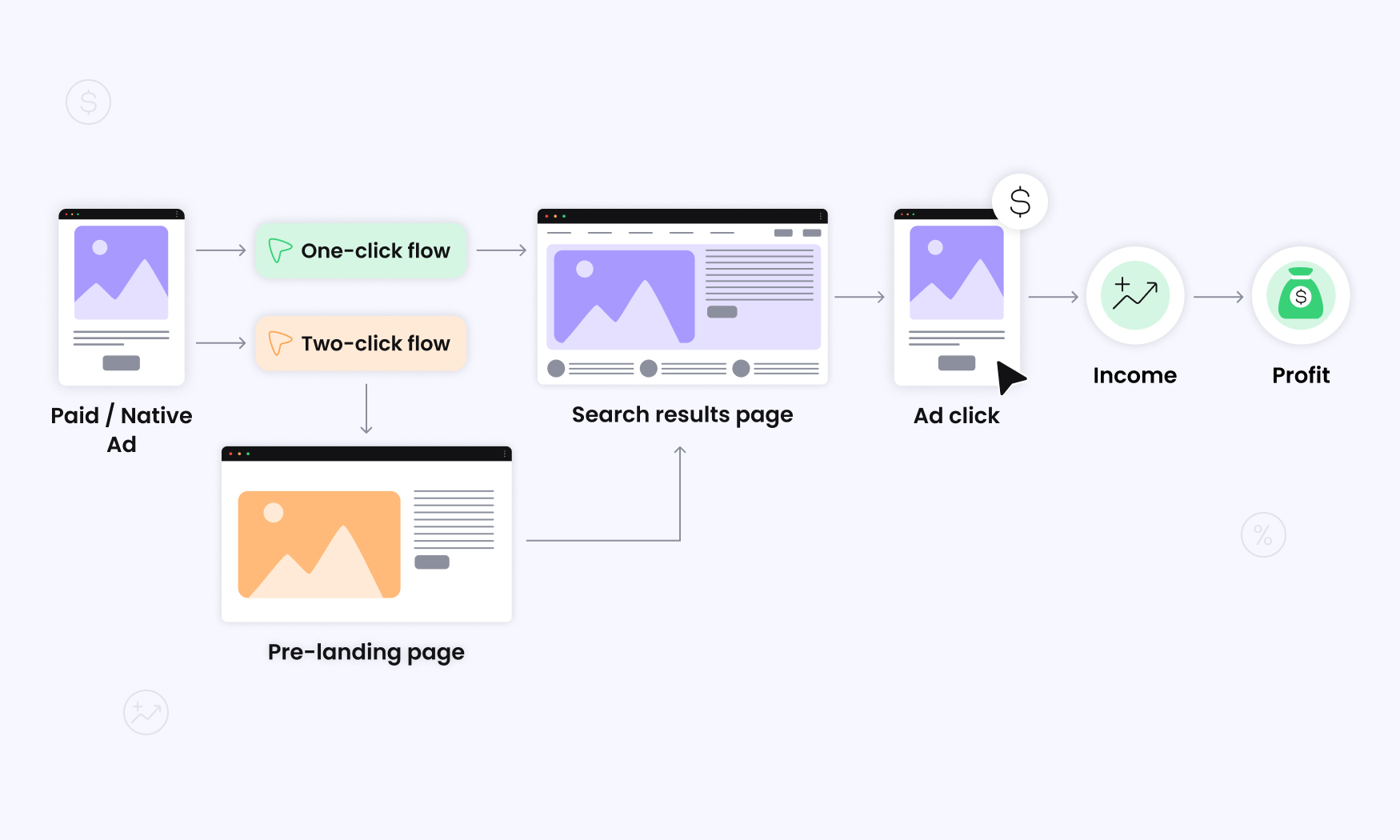
Search arbitrage works through a simple click path. You buy traffic from a paid marketing channel and send those users to a search feed. From there, users see search results with paid ads tied to the keywords they’re interested in.
When a user clicks one of those ads, the advertiser pays for that click. The search feed generates revenue from that interaction and shares a portion of it with you. You just have to make sure the traffic arriving at the search feed has real intent and matches what advertisers are bidding on.
This focus on intent matters. Industry benchmarks consistently show that search ads convert at 2–3× higher rates than display and most social traffic, largely because users are already looking for a solution. Most setups run on either a one-click or two-click flow, depending on how warm your traffic is and where it’s coming from.
With a one-click flow, users hit the search results page right away. This is perfect when your traffic already has strong intent. For example, if you’re buying search-style traffic for “best car insurance,” users are ready to compare, so sending them straight to the SERPs feels more natural.
A two-click flow adds a pre-lander into the mix. So, if someone clicks a native ad like “compare home warranty options,” they get to a pre-landing page first, where they pick a location or category. This little detour turns curiosity into real intent, so you get cleaner, higher-quality traffic, which naturally leads to higher conversion rates.
How to Set Up a Search Arbitrage Campaign
Search feed arbitrage rewards real effort. Cut corners, and you’ll get banned or lose money. The choices you make early on determine whether or not your campaign will succeed.
Here’s how to make money with search arbitrage:
1. Choose a Search Feed Provider
A search feed provider controls what users see after they click and how ad revenue is calculated. They decide which ads appear, what traffic is acceptable, and how earnings are shared. If the feed is weak, overly restrictive, or poorly managed, no amount of optimization on your side will fix the campaign.
When choosing a search feed provider, focus on the following:
- Clear compliance rules — Look for a provider with well-documented guidelines on approved traffic sources, creatives, and user flows so you know exactly what’s allowed before sending traffic.
- Stable payouts — Choose a search feed provider that offers predictable revenue and doesn’t introduce sudden drops due to vague quality thresholds or unexplained policy changes.
- Visibility into performance — Make sure you have access to keyword-level clicks, revenue data, and basic engagement metrics so you can optimize based on real data.
- Helpful support — Work with a provider that actively reviews traffic, flags potential issues early, and responds quickly when something breaks or needs clarification.
- Flexibility in setup — The feed should support both one-click and two-click flows, allowing you to match the setup to user intent and traffic quality.
If you plan to run native or push traffic (users who aren’t actively searching but are browsing content or clicking headlines), choose a provider that’s comfortable with broader intent but still enforces quality.
On the other hand, if you’re working with search-style traffic, strict search feed providers usually perform better because the intent is already there. Those setups tend to reward cleaner flows and tighter keyword matching.
The right choice comes down to how you plan to buy traffic and how involved you want to be in shaping intent and optimization.
2. Select Profitable Keywords and Niches
Keywords and niches determine how much advertisers are willing to pay, how consistent revenue will be, and how tolerant the model is while you’re testing. Campaign optimization becomes easier with the right niche because you can quickly tell which traffic sources deserve more budget and which ones need to be cut. However, when you choose the wrong niche, you’ll see clicks without value.
Profitable search arbitrage niches usually have two things in common: strong advertiser demand and clear user intent. These are areas where users are actively looking for solutions and advertisers are competing for visibility.
Evergreen niches that consistently perform well in search feed arbitrage include:
- Insurance and finance — auto insurance, health insurance, loans, and credit-related searches;
- Legal services — personal injury, immigration, family law, and local legal help;
- Health and wellness — weight loss, nutrition, supplements, skincare, and fitness;
- Home services — roofing, plumbing, HVAC, pest control, and home repairs;
- Technology and software — antivirus, VPNs, SaaS tools, and business software;
- Travel and mobility — flights, car rentals, hotels, relocation services.
Once you’ve chosen a niche, keyword selection becomes about alignment. Keywords should match what the user expects to see after clicking and what advertisers are willing to pay for. Broad, misleading, or sensational terms (like “home insurance”) may drive clicks that barely convert.
On the other hand, a long-tail keyword like “best renters insurance for apartments” attracts users who are ready to compare options. Long-tail keywords account for more than 70% of all search queries, despite lower individual volume.
3. Choose a Traffic Source
Your traffic source determines how much intent users bring with them, how much guidance they need before reaching the search feed, and how strict you’ll need to be with compliance. This means that if you pick the wrong traffic source, good keywords or not, the campaign will flop.
Some traffic sources are better for search arbitrage because they line up well with search-like intent.
Here are the ones to consider:
- Native ads — considered the least intrusive form of advertising because they blend into content and attract users who are already problem-aware.
- Push traffic — usually needs more filtering to get high-quality traffic because users mostly click out of curiosity, not intent.
- Search-style traffic — tends to bring the strongest intent, but is most expensive and has the toughest restrictions from ad networks
Users who arrive via search are further down the decision path than those clicking social or push ads. This explains why search-style traffic carries higher intent and stricter platform rules.
That said, the best traffic source is the one that matches your keywords, your compliance comfort level, and how much work you’re willing to put into shaping intent before users reach the search feed.
4. Create Ads
Successful search arbitrage ads set expectations clearly and stay close to what users will see on the search results page. Sensational claims might spike click-through rates (CTRs), but they usually attract the wrong clicks and trigger quality issues fast.
Follow these best practices when writing ad copy:
- Match the keyword intent — If the keyword signals comparison, your ad should invite comparison; if it signals a problem, your ad should acknowledge that problem and hint at solutions.
- Avoid exaggerated claims — Click-bait visuals and text might win the click, but it erodes trust and triggers quality issues that could get you banned.
- Keep messaging clear — Use a clear, conversational tone that filters in the right clicks and aligns with the paid ads people see next.
Don’t forget to test and optimize. Even minor tweaks to wording, tone, or framing can shift the type of users who click, which often matters more than the click-through rate itself.
5. Set Up Campaign Tracking
Ad tracking shows you what traffic sources are profitable, what keywords are wasting your money, and where quality issues begin. That’s why tools advertising tracking software like RedTrack are essential.
Instead of juggling traffic costs on one platform and revenue on another, use RedTrack to:
- track traffic costs and clicks in one dashboard;
- tie ad revenue back to specific keywords and sources;
- separate campaigns by traffic type;
- monitor engagement and quality signals;
- use alerts or rules so bad traffic doesn’t quietly drain the budget.
With proper tracking in place, you can scale campaigns with confidence and keep margins under control as volume increases.
6. Optimize for Traffic Quality
Traffic quality is the lifeblood of any search arbitrage campaign. You can have perfect keywords and a flawless setup, but if your traffic is weak, you’ll barely make any money even if you get high impressions.
To improve quality, start by watching how users behave after they land. The difference between good and bad traffic usually shows up fast. Solid traffic clicks through, engages with the search results, and converts. Low-quality traffic looks busy at first, then drops off immediately.
Here’s what experienced media buyers focus on:
- Engagement after the click — whether users actually interact with the results or bounce right away;
- Consistency by source — strong sources perform steadily instead of swinging wildly day to day;
- Keyword-to-traffic match — poor alignment shows up as clicks with no downstream activity;
- Sudden drops or spikes — sharp changes often point to quality issues or compliance problems;
- Sub-ID performance — helps pinpoint the exact placements or creatives causing trouble.
Catching these signals early lets you cut losses fast and double down on traffic that actually converts.
Why Use RedTrack for Search Arbitrage Campaigns?
RedTrack is your single source of truth. You get one dashboard where traffic, ad spend, and revenue are all connected. That’s a lifesaver when margins are thin, and traffic quality can flip overnight.
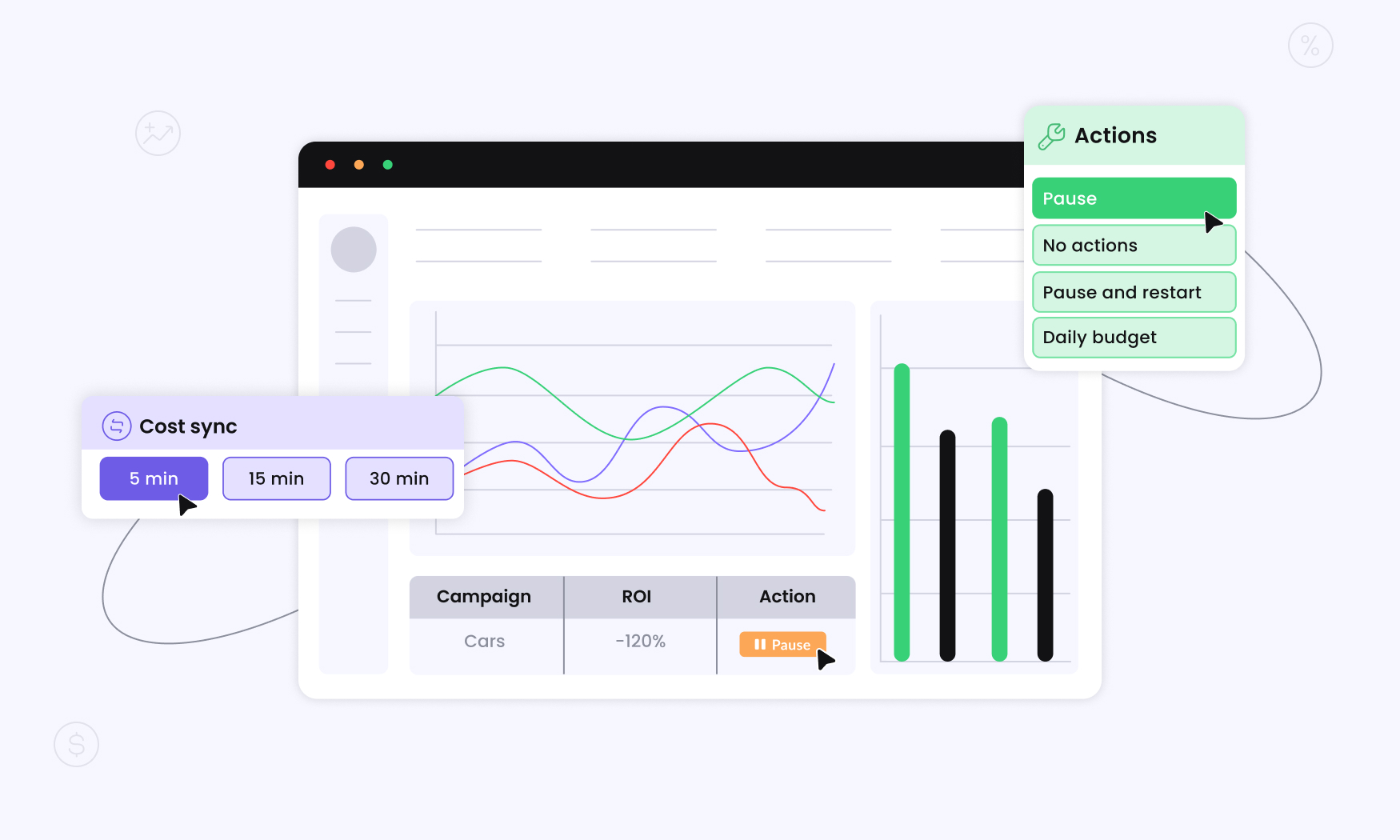
RedTrack also makes scaling far safer. With granular tracking in place, you can spot low-quality traffic almost immediately. If a placement starts leaking money, you cut it. If a source underperforms, you pause it. And when a campaign works, you can scale it confidently because you know exactly why it’s working.
This is where the bigger industry problem shows up. Poor marketing attribution and fragmented tracking are one of the main reasons ad spend gets wasted and optimization slows down, especially in performance-driven models like search arbitrage. When data lives in different tools and updates on different schedules, you end up reacting late or optimizing the wrong elements.
RedTrack removes that friction. You see what’s happening as it happens, not a day later. You can act before small issues turn into big losses.
These RedTrack features make search arbitrage campaigns easier to manage:
- Unified tracking — Instead of jumping between spreadsheets and dashboards, everything shows up in one place, so you’re not guessing which numbers are real.
- Keyword and source visibility — You can quickly see which keywords and traffic sources are doing the heavy lifting, and which ones just look busy.
- Sub-ID and placement tracking — when something feels off, sub-IDs let you zoom in and cut a single placement without tearing down the whole campaign.
- Automation rules — When traffic quality drops or CPC crosses limits, rules pause the campaign to protect your ad spend.
- Real-time reporting — You’re not waiting until tomorrow to notice problems (performance updates as it happens, so you can quickly fix them)
- Cost syncing — Costs stay accurate across multiple traffic sources and accounts, so scaling doesn’t turn into a math problem.
- Clean historical data — Make long-term optimization decisions based on what actually worked over time.
That’s why affiliate marketers and media buyers use RedTrack. Not for flashy dashboards, but because it shows what’s actually happening and lets you act fast, before small mistakes snowball into real losses.
Factors Influencing Search Arbitrage Profitability
Search arbitrage can be profitable if you play by the rules. Here are some factors that might impact your profits:
- Traffic quality (and cost) — Cheap traffic only works when it still produces higher conversion rates. Otherwise, cheap clicks quickly turn into expensive mistakes.
- Keyword intent — Keywords indicate whether someone is comparison shopping or trying to make a decision, which generally monetizes way better than vague curiosity.
- Advertiser competition — More competitive niches are likely to have higher click payouts but also require higher-quality traffic. That balance is where most affiliate marketing campaigns win or lose.
- Cost per click (CPC) — Even small CPC increases can wipe out margins if revenue doesn’t increase with it.
- Testing and optimization speed — The faster you can identify bad traffic and ramp up high-quality traffic, the more room you have to be profitable.
Conclusion – Is Search Arbitrage Worth it in 2026?
Yes, search arbitrage is still worth it in 2026, but only when it’s done properly. This approach works best for affiliate marketing teams and media buyers who are comfortable watching numbers, testing deliberately, and cutting things that don’t work.
If you want to “set it and forget it,” this isn’t the marketing strategy for you. But if you’re willing to optimize consistently, search arbitrage can still be a strong channel. This is also where having the right tracking setup stops being optional.
Advertisement management software like RedTrack are game-changers because they kill the guesswork. You no longer have to bounce between traffic sources, spreadsheets, and laggy reports. All your data is in one place, so you know exactly how much you’re spending, which keywords are making you money, and where your budget is leaking.
The best part? RedTrack shows you everything in real time. If your traffic quality tanks, you can fix the campaign before it turns into a big loss. With RedTrack, you can pause, adjust, and scale with confidence.Ready to run search arbitrage with clear data? Try RedTrack free for 14 days and see how proper tracking changes the way you run search arbitrage campaigns.


