
As privacy regulations tighten and browsers phase out third-party cookies, marketers everywhere are asking the same question: how does cookieless tracking work and what does it mean for their analytics strategy?
Traditional cookie-based models are no longer reliable, leaving gaps in data accuracy and campaign measurement. That’s where cookieless tracking methods come in – offering new, privacy-first approaches that help businesses collect meaningful insights without relying on outdated technology.
From server-side tracking to probabilistic models and advanced attribution systems, these methods ensure you still capture the data you need to optimize campaigns, even when consent banners are declined or browser restrictions are in place.
In this guide, we’ll break down the most important cookieless solutions, explore how they maintain accuracy while respecting privacy, and show why they are essential for building a sustainable analytics strategy in 2025 and beyond.
What is Cookieless Tracking & How It Works
Cookieless tracking is the practice of analyzing user behavior without relying on traditional browser cookies to identify or follow visitors.
Instead of placing files on a user’s device, modern cookieless solutions collect data through server-side processing, technical identifiers, and behavioral signals – giving marketers valuable insights while respecting privacy requirements.
The process begins when someone visits your site.
Rather than dropping a cookie, the system looks at available technical data points such as IP address, device type, browser version, or user agent strings. These elements are combined into an anonymous identifier, often generated through hashing, that allows you to recognize sessions and interactions without ever storing personal information.
The backbone of this approach is server-side tracking. Because data is captured and processed directly on your server (instead of relying on the browser) you gain greater control over accuracy and compliance.
This means more reliable reporting, even in environments where ad blockers, tracking restrictions, or privacy settings would normally disrupt analytics.
Most importantly, cookieless tracking is built for resilience. It operates independently of both first- and third-party cookies, ensuring consistent measurement even when users decline consent banners or when browsers tighten privacy policies. The result is actionable data that helps you optimize campaigns and understand user journeys, while still maintaining compliance with modern privacy standards.
Technical Methods Behind Cookieless Tracking

Cookieless tracking can be implemented in several different ways, and while the goal is always the same – collecting accurate data without relying on browser cookies – the methods vary in how precise they are, how complex they are to set up, and how compliant they are with privacy rules.
At a high level, there are three primary approaches to know: server-side tracking, which shifts data collection to your own server; probabilistic tracking, which uses algorithms to make educated guesses about user behavior; and browser fingerprinting, which relies on technical signals from devices and browsers to identify visitors.
Each comes with its own trade-offs. Server-side tracking delivers the highest accuracy and strongest compliance benefits but also demands the most technical resources. Probabilistic tracking strikes a middle ground, offering scalability with moderate complexity. Browser fingerprinting is the easiest to implement but raises significant privacy concerns and requires careful legal consideration.
Server-Side Tracking Implementation
Among all cookieless tracking approaches, server-side tracking stands out as the most accurate, reliable, and privacy-compliant solution.
Instead of relying on the browser to drop cookies or capture events, all data collection and processing happens on your server, giving you full ownership and control over what is measured and how it’s shared with analytics or ad platforms.
In practice, this means that when a visitor interacts with your site – whether clicking a button, submitting a form, or completing a purchase – those actions are captured directly by your server.
Rather than leaving data vulnerable to browser restrictions, ad blockers, or cookie consent choices, server-side tracking maintains continuity through anonymous session identifiers that link user interactions across multiple visits without ever storing personal information on a device.
Tools like Google Tag Manager server containers make this possible by enabling event processing with server-generated identifiers, while hosting providers such as Stape simplify the technical side of implementation. Together, they allow marketers to set up server-side environments without needing to manage complex infrastructure from scratch.
The result is consistent, accurate tracking that bypasses the pitfalls of client-side methods while staying compliant with modern privacy laws. Because everything happens within your own infrastructure, sensitive data remains secure, attribution accuracy improves, and you gain a future-proof foundation for measuring user journeys in a world where cookies no longer provide the full picture.
Probabilistic Tracking Algorithms
Probabilistic tracking is one of the most widely used cookieless tracking methods, designed to fill the gaps left by the decline of third party cookies.
Instead of relying on persistent identifiers, it uses machine learning algorithms to detect patterns in device characteristics, browsing behavior, and geographic signals, building statistical models that estimate how users move through the customer journey.
Unlike deterministic approaches that rely on exact identifiers, probabilistic tracking is about probability – it looks at how groups of similar users behave and predicts likely actions, conversions, and paths across multiple touchpoints.
Platforms like Meta Ads already rely heavily on these models, processing massive datasets to provide advertisers with audience insights and attribution data even when direct identifiers aren’t available.
The real strength of this method lies in its adaptability.
As the algorithms process more interactions, they continuously refine themselves, improving prediction accuracy over time and becoming better at recognizing user segments and forecasting likely outcomes. This makes probabilistic tracking particularly valuable in privacy-first environments where deterministic data is limited.
However, accuracy depends on scale.
These models need significant volumes of behavioral data to function effectively, which means larger websites and ad platforms benefit the most. Smaller sites may struggle until they accumulate enough traffic to train the models.
Even with those limitations, probabilistic tracking provides marketers with a reliable way to estimate campaign performance, attribute conversions, and understand audience behavior – all without relying on third party cookies.
Browser Fingerprinting Techniques
Browser fingerprinting is one of the more controversial cookieless tracking methods, as it creates unique identifiers by collecting detailed technical signals from a user’s device.
Instead of storing files or relying on cookies, fingerprinting combines characteristics like screen resolution, operating system, language settings, installed fonts, and hardware specifications to generate a profile that is statistically unique for most visitors.
The process works by layering these attributes together – browser version, plugins, timezone, and even hardware details such as graphics card or processor information – to form a digital fingerprint. When paired with IP data, these identifiers remain consistent across browsing sessions, even if cookies are cleared.
This makes fingerprinting effective at bypassing many common browser restrictions, including private browsing modes or frequent cookie deletion.
Because the fingerprint is tied to a user’s device configuration, it can persist for long periods as long as those settings don’t change. That persistence allows marketers to recognize returning visitors and map behavior across sessions, even in environments where other tracking methods fail.
However, the very strength of browser fingerprinting is also its biggest drawback.
Since users cannot easily control or opt out of this form of tracking, it raises significant privacy concerns and regulatory risks. In fact, some regulators classify advanced fingerprinting as invasive, requiring explicit consent before implementation.
While fingerprinting can provide continuity in data collection, businesses must carefully weigh the compliance challenges before relying on it as part of their tracking strategy.
Data Storage Alternatives to Cookies
A critical part of cookieless tracking is finding reliable ways to store data without relying on traditional cookies. Modern alternatives fall into two main categories: browser-based storage and server-side storage.
Browser-based options include session storage and local storage, both supported by Web Storage APIs. Session storage saves data only for the duration of an active browsing session, clearing automatically once the user closes their tab. Local storage persists across visits, though users can easily delete it through their browser settings.
Server-side storage, on the other hand, offers a far more robust solution. By keeping all information within controlled backend systems, businesses gain stronger security, longer retention, and more flexibility for integrating with analytics and ad platforms.
For marketers looking to balance accuracy with privacy compliance, server-side storage often becomes the cornerstone of sustainable data collection in a post-cookie world.
| Storage Method | Retention Period | Privacy Level | Implementation Complexity |
| Session Storage | Single session | High | Low |
| Local Storage | Until user clears | Medium | Low |
| Server Storage | Configurable | Highest | High |
| Hybrid Approach | Variable | High | Medium |
Session and Local Storage Solutions
When moving away from cookies, browser-based storage options like session storage and local storage play an important role in keeping analytics accurate while respecting privacy boundaries. Both are part of the Web Storage API, which allows developers to store data directly in a user’s browser without relying on cookie-based tracking.
Session storage is designed for short-term retention. It holds data only while the browser tab remains open and clears automatically once the session ends. This makes it especially useful for temporary tasks like preserving UTM parameters, referral sources, or progress through a multi-step checkout flow. By storing this kind of information temporarily, businesses can ensure smooth user experiences without overstepping privacy limits.
Local storage, on the other hand, persists across multiple sessions, making it better suited for storing user preferences, remembering return visits, or maintaining continuity in attribution data for frequent site visitors. Unlike cookies, local storage doesn’t automatically send data back to the server with every request, which reduces bandwidth usage and provides an added layer of privacy.
In practical terms, many data layer setups use session storage as a temporary holding space for attribution data until user consent is confirmed, then transfer approved data into permanent analytics systems.
Still, it’s important to note that neither session nor local storage should be used for sensitive information.
Their role is to support user experience and short-term marketing attribution, not to replace more secure, long-term storage methods like server-side tracking.
Server-Side Data Management
When it comes to data storage alternatives to cookies, server-side systems provide the most secure and flexible option.
Unlike browser-based solutions such as session or local storage, server-side data management allows website owners to collect data and store it within controlled backend environments that are shielded by encryption, role-based access, and regular monitoring.
This method eliminates the vulnerabilities of local storage, where users can view or delete stored information directly from their browser.
Instead, centralized infrastructure ensures data integrity, with every access point authenticated and every interaction logged for accountability.
Scalability is another major strength. Enterprise-grade server environments can process and store vast volumes of visitor data without degrading performance, making them well-suited for high-traffic websites and applications that depend on consistent speed and reliability.
Integration is also streamlined. Through secure APIs, server-stored data can be shared with analytics tools or reporting platforms while maintaining strict control over what leaves your environment. This balance lets businesses gain insights without compromising ownership of sensitive information.
Finally, server-side management simplifies compliance.
When users request data removal under privacy laws, website owners can locate and erase records quickly without relying on browsers or third-party systems. By keeping retention periods, permissions, and deletion processes in-house, businesses can stay aligned with evolving regulations while protecting user trust.
Popular Cookieless Tracking Tools and Platforms
In today’s privacy-first environment, relying on cookieless tracking solutions is no longer optional—it’s mandatory for businesses that want to capture all the data needed to optimize performance and stay compliant. Traditional cookie-based methods are quickly losing relevance, and success now depends on platforms designed to work within modern browser restrictions and evolving regulations.
Two of the most widely adopted tools leading this shift are Google Analytics 4 and RedTrack. GA4 leverages advanced machine learning models to fill data gaps, while RedTrack provides advertisers and media buyers with precise attribution, conversion tracking, and optimization tools tailored to performance marketing.
Together, these platforms represent the new standard for accurate measurement, helping businesses maintain visibility into the customer journey and make smarter decisions even in a cookieless world.
Google Analytics 4 Cookieless Features
One of the standout features of Google Analytics 4 (GA4) is its ability to function in a cookieless tracking environment, helping businesses adapt as browsers continue to restrict third-party cookies. While GA4 is much broader than just privacy-first analytics, its cookieless capabilities make it a key part of future-proof measurement strategies.
Instead of depending solely on persistent identifiers, GA4 uses an event-based tracking model that captures user interactions at a more granular level. When users opt out of cookies, GA4 applies machine learning models to fill in the blanks, estimating user journeys and maintaining reporting accuracy. These models work by analyzing aggregated data from users who consented, then applying patterns to those who didn’t.
The platform also provides predictive insights, such as purchase probability, churn likelihood, and potential customer lifetime value, based on aggregate behavioral patterns rather than individual tracking. This allows marketers to optimize campaigns while staying compliant with evolving privacy regulations.
That said, GA4’s cookieless capabilities are not turnkey.
Setting up server-side tracking, and configuring custom events, require both time and technical expertise. Moreover, its machine learning features deliver the most value at scale, meaning smaller websites may need significant traffic before seeing reliable predictions.
For businesses with the resources to implement it properly, GA4’s cookieless tracking features offer a strong foundation for maintaining visibility into performance – even as cookies become less reliable.
RedTrack: The Ultimate Cookieless Tracking Solution
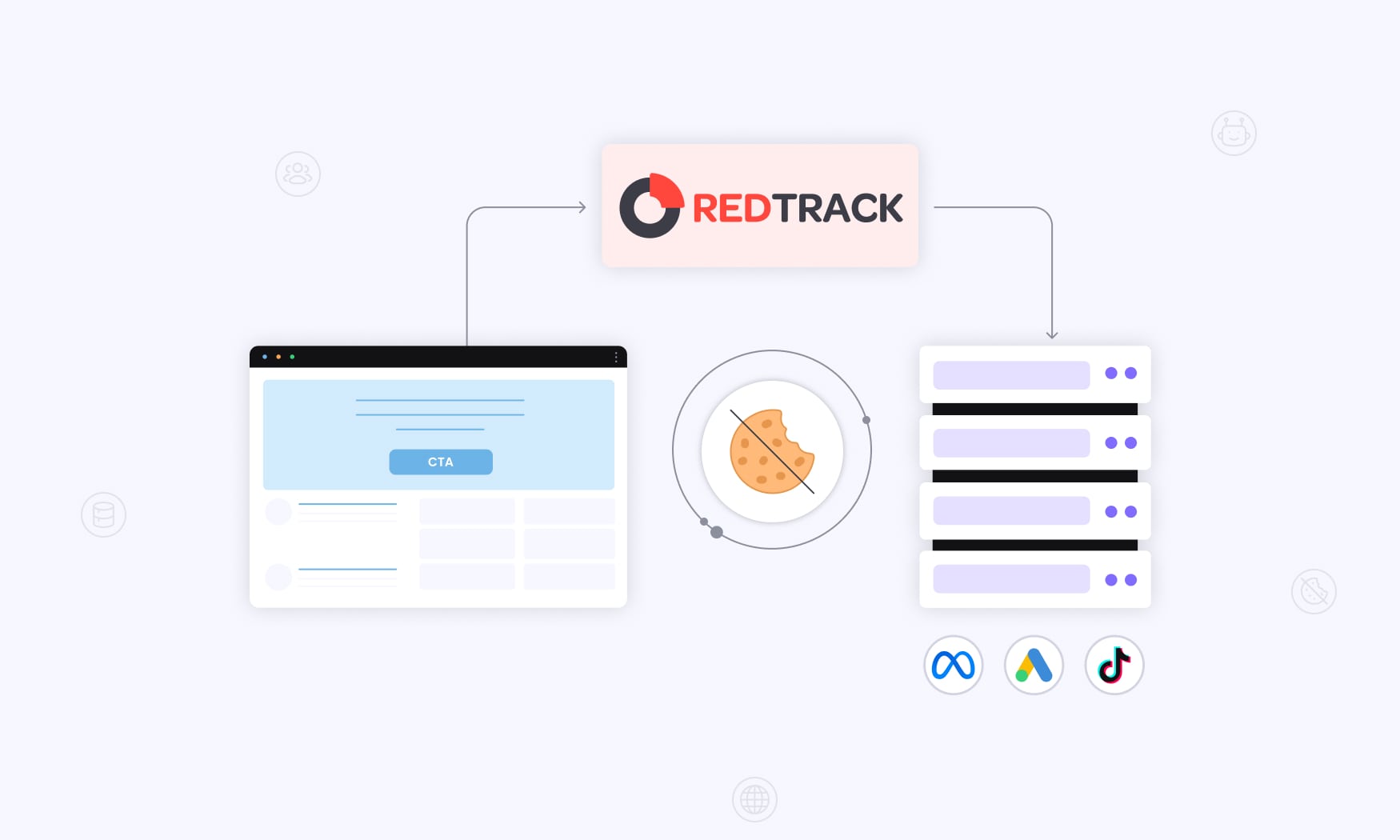
While platforms like Google Analytics 4 offer useful modeling features, performance marketers need more than estimates – they need precision, transparency, and control over every ad dollar spent.
That’s where RedTrack stands out as the ultimate cookieless tracking solution.
RedTrack doesn’t just patch the gaps left by disappearing third-party cookies – it eliminates reliance on them entirely by leveraging server-side tracking, API integrations, and first-party data pipelines. This ensures that every click, conversion, and revenue event is captured accurately, even when users decline cookies, use ad blockers, or browse in restrictive environments.
Unlike GA4, which often requires significant technical expertise to configure, RedTrack is built specifically for performance marketers, affiliates, ecommerce brands, and agencies. Its plug-and-play integrations with platforms like Google Ads, Facebook, TikTok, and Shopify mean you can launch privacy-compliant, cookieless tracking without months of setup or heavy developer involvement.
Beyond raw tracking, RedTrack provides multi-touch attribution, budget automation, and performance insights that go far deeper than simple analytics dashboards. Marketers can identify exactly which campaigns, creatives, and audience segments drive profit – and then automatically reallocate budgets to maximize ROAS.
Most importantly, RedTrack gives you full ownership of your data.
Nothing is sampled, modeled, or hidden. You see the real performance picture and maintain compliance with GDPR, CCPA, and other global privacy frameworks.
In a world where measurement accuracy can make or break your marketing strategy, RedTrack delivers the clarity and control modern advertisers need to stay ahead.
Privacy and Legal Compliance
Adopting cookieless tracking is a major step forward for respecting user privacy, but it does not automatically guarantee legal compliance.
Regulations like GDPR and CCPA are not focused only on whether businesses use cookies, but rather on how data is collected, stored, and processed, regardless of whether that happens on the user’s device or through backend systems.
Even without third party cookies, if the method of data collection could reasonably identify individuals, it still falls under the same legal obligations.
Compliance expectations also vary depending on where you operate. In regions such as Germany, Denmark, and Belgium, regulators have taken a strict approach, requiring explicit consent before almost any form of tracking can take place, including cross site tracking or advanced cookieless techniques like browser fingerprinting.
In contrast, other jurisdictions allow more flexibility as long as companies provide transparency, user choice, and clear opt-out options.
The California Consumer Privacy Act (CCPA) expands these obligations further by requiring businesses to give users the ability to opt out of data collection entirely, regardless of whether cookies are used. Looking ahead, the planned expansion of the EU’s ePrivacy Directive in 2025 will likely bring additional restrictions to cookieless tracking, particularly around behavioral modeling and device-based identifiers.
The safest path forward involves implementing transparent consent flows, documenting data practices, and conducting regular legal reviews. Beyond meeting the legal baseline, clear communication about privacy builds trust with users and strengthens brand reputation.
Conclusion: Building a Future-Proof Analytics Strategy
For anyone still asking how does cookieless tracking work, the answer lies in understanding that it is not a single technology but a collection of privacy-first analytics methods designed to replace outdated reliance on third party cookies.
From server-side event processing to probabilistic models, these approaches ensure that visitor data can still be measured accurately even as browser restrictions grow tighter and consent rules become more demanding.
Traditional tracking models are fading, and while first party cookies still play a role in maintaining some continuity, they are no longer enough on their own to provide the depth of insights that performance marketers need. This makes cookieless tracking not just a compliance strategy but the new backbone of data-driven decision making, ensuring your campaigns can scale with clarity and precision.
While platforms like GA4 attempt to bridge the gap with machine learning predictions, advertisers who need dependable attribution require a more specialized solution.
That is where RedTrack comes in.
Built specifically for performance performance marketers, ecommerce brands, and agencies, RedTrack provides accurate, cookie-independent attribution, connects ad spend with conversions in real time, and works reliably across channels and devices without being disrupted by ad blockers or browser-level tracking limits.
The cookieless future is already here.
With RedTrack, you can move beyond guesswork, unlock the full value of your visitor data, and keep every campaign aligned with both business goals and privacy-first expectations.


