
Are you really sure you know which campaigns are making profit, and, maybe even more importantly, which ones are total duds?
According to one report, a whopping 46% of marketing respondents feel their lack of insight into attribution is what’s hurting their marketing efforts most.
What this means basically is that millions of dollars in ad spend are left completely unaccounted for.
And then there’s the interactions rule; on average, it takes approximately seven marketing touchpoints with your brand before a customer actually makes a purchase. Now you can understand why marketing attribution is so important.
So marketing attribution is no longer a nice-to-have analytics feature for marketing campaigns. It’s an essential component of any successful marketing strategy. With the average customer journey spanning multiple marketing channels and extending over weeks or months, marketing teams need sophisticated marketing attribution models and methods to track, measure, and optimize their efforts across the entire customer journey and sales funnel.
In this guide, we’ll walk you through everything you need to know about marketing attribution in 2026, from basic concepts to advanced implementation strategies. We’ll show you how the right kind of approach to marketing attribution helps boost your marketing ROI.
What is marketing attribution?
Marketing attribution is basically about one thing: figuring out which of your marketing efforts actually helps you get a sale.
Not to guess or to feel, but give you actual insight as data that presents the proof.
Every ad, click, email, or page visit reveals multiple touchpoints that leave trace, and marketing attribution shows you which of those touches mattered and which ones were nothing but a noise.
Think of it like watching a shopper move through a store – they don’t just walk in, grab the very first thing they see, and check out. They look around, scan the room, touch a few items, think, walk away, come back, and only then decide. It’s basically the same with online customers.
Here’s a simple example. Someone clicks your Google ad. They look around and bounce. A few days later, they see your Facebook ad and check out a blog post. Later, they open your email and hit the pricing page. A week passes. They type your URL directly and finally buy your product.
If you only look at the last interaction (and not all the touchpoints that took place across multiple platforms), you’ll think “direct traffic” made the sale. It didn’t. It just happened to be the last step. The real work came from everything before: Google created the spark, Facebook kept them warm, and email pushed them closer to buying. All of the customer interactions mattered.
Marketing attribution models help you spread the credit in a way that matches consumer behavior. Some give every touch the same weight. Some focus on the first click or the last one. Others look at the whole path and highlight the touches that made the most lasting impact.
The goal isn’t to make things complicated. It’s to see what’s really working so you can put more money where it counts and stop wasting budget on stuff that doesn’t (like unresponsive ad campaigns).
Why marketing attribution matters for modern businesses
Customer behavior isn’t a straight line – they jump between search, social, email, ads, and your site before buying. Most people hit six to eight touchpoints on their way to a purchase, and if you’re only looking at the final click, you’re missing almost everything that pushed them there.
Marketing attribution solves this through advanced attribution models. By showing which channels actually help and which ones just look good on the surface, you’ll be able to lift your game. Without the right attribution model, teams pour money into channels and ad campaigns that appear to “convert” simply because they happen to close the last step. Meanwhile, the channels that create awareness and push people back into the funnel get ignored – even though they’re doing real work.
When businesses move from last-click to proper multi-touch attribution, results improve fast because they stop guessing and start putting money where it actually matters. It’s not magic. It’s simply seeing the full picture instead of the final frame.
Most marketers already know this. But less than half have a mature setup in place. That gap is the advantage. If you understand the real customer journey before your competitors do, you make smarter decisions, cut waste, and scale faster.
So marketing attribution isn’t a theory. It’s a proven practice that provides clarity — the kind that saves budgets, shows you which digital campaigns and channels truly drive revenue, and leads to marketing success.
Key benefits of marketing attribution
The biggest win is simple: with accurate attribution, you stop guessing where to put your budget. Attribution shows which channels actually bring in revenue, and where you need to be assigning credit. We’re not talking about vanity metrics here, like clicks or engagement; we’re talking about touchpoints that lead to an eventual purchase. With full customer journey sales data, you can shift marketing spend to the advertising campaigns (media spend), marketing campaigns, and efforts that have proven to deliver results.
You also get a clearer view of how people move through your sales funnel and how they interact across multiple channels. Seeing the full customer journey makes it easier to understand which messages hit the mark, which channels pull people back, and what different segments respond to. Better insight means better targeting and stronger campaigns.
Attribution models also give marketing and sales teams something real to grab onto so they can collaborate to achieve better results. Sales sees which ad platforms and campaigns bring the best leads. Marketing sees which touches show up in deals and retention. Everyone stops arguing over whose numbers are “right,” because they’ve landed attribution models that tell one story.
It helps with planning, too. When you know which channels drive real outcomes, you can predict the impact of shifting budgets or testing new ones based on historical data. Past patterns can reveal potential opportunities that you haven’t tapped into yet.
And maybe the most underrated benefit: accountability. Every channel and campaign stands on its own results. No assumptions. No hiding behind vanity metrics. Just a clear contribution to actual business goals, which tends to raise the bar for everyone involved.
Types of marketing attribution models
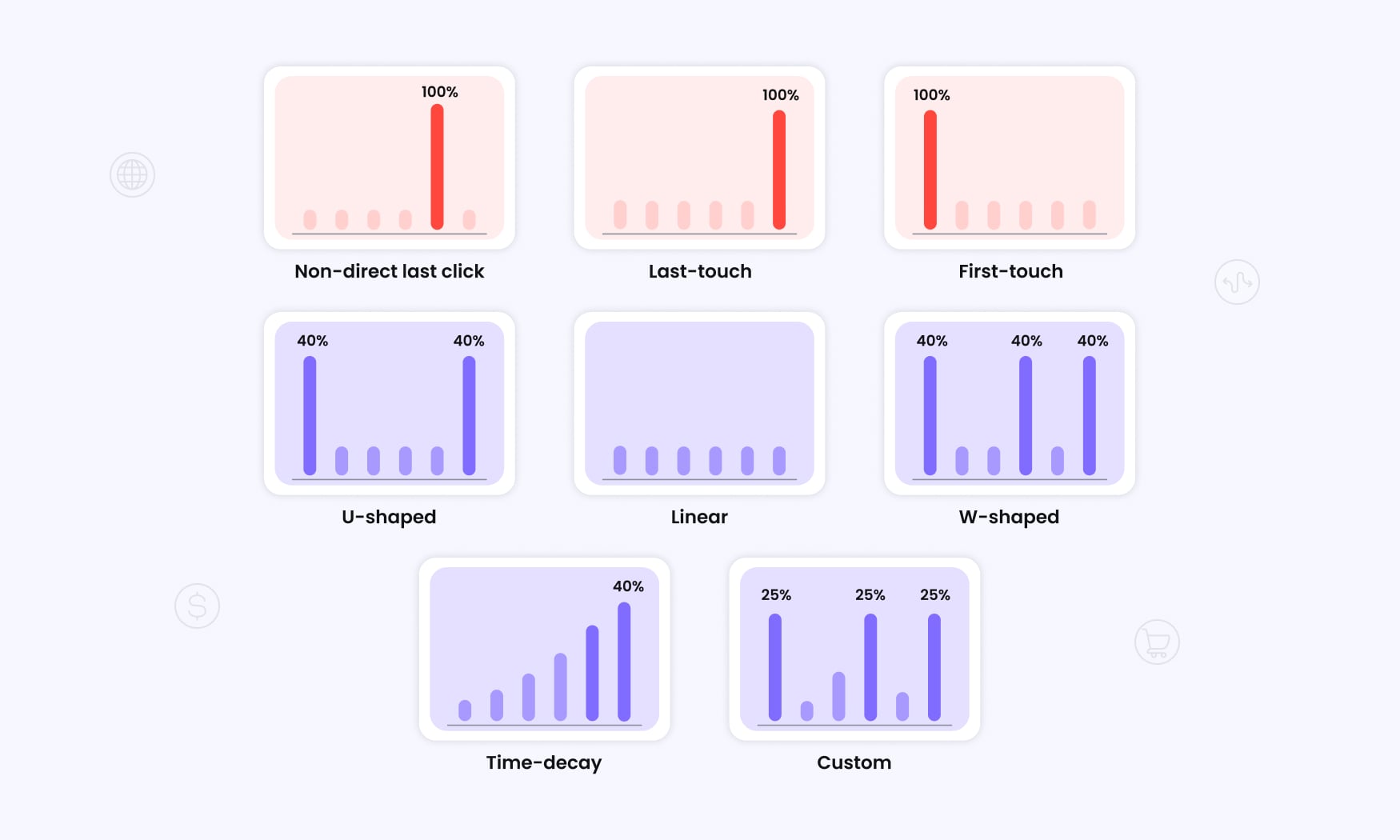
There are different types of marketing attribution models, but in general, all of them fall into one of two broad categories:
- Single-touch models that assign all conversion credit to one touchpoint.
- Multi-touch models that distribute credit among multiple interactions.
Which one is the right one for you? Well, it dpends on your sales cycle, customer journey complexity, and general business objectives.
Understanding the strengths and limitations of each attribution model helps with selecting the approach that best aligns with measurement needs and customer behavior patterns. In a nutshell:
| Model Type | Credit Distribution | Best For | Limitations |
| First-touch attribution models | 100% to first interaction | Brand awareness campaigns | Ignores nurturing and closing activities |
| Last-touch attribution models | 100% to final touchpoint | Direct response campaigns | Misses top-funnel influence |
| Linear attribution model | Equal credit to all touchpoints | Short, simple customer journeys | Lacks nuance for key interactions |
| Time-Decay attribution model | More credit to recent interactions | Sales-focused organizations | May undervalue early awareness |
| U-Shaped attribution model | 40% each to first/last, 20% to middle | Balanced awareness and conversion focus | Arbitrary weight assumptions |
| W-Shaped attribution model | 30% each to first/lead creation/last | Complex B2B sales processes | May miss post-opportunity influences |
| Algorithmic attribution model | Data-driven credit assignment | Large datasets, complex journeys | Requires significant resources |
If you want to learn more, check out our post on types of attribution models, where we go into details!
How to choose the right attribution model
There’s no “perfect” attribution model. The right one depends on how your business works, how your customers buy, and what you’re trying to measure. Most companies end up using more than one model because each one shows a different angle of the same story.
Start with your sales cycle. That’s the biggest deciding factor. Long cycles with lots of research need multi-touch marketing attribution models that capture every step. Short cycles can get away with simpler models because people don’t wander around as much before buying.
Next, try to grasp how your target customers think and operate. Are they the kind of people who jump between different channels and then sit on a decision for days (or even weeks), or are they the quick type of buyer that goes through a couple of touchpoints and almost instantly clicks the “buy” button? While B2C buyers can be part of that latter group, most B2B buyers go through a long research process spanning dozens of touch points before they choose you.
The channels you’re using also play a big role here. If you’re across the whole board with search, social, email, content, and display ads, a “single touch” model just isn’t going to give you the whole picture of how it all fits together. However, if most of your budget is going into one or two channels, then you can still get by with something a bit more straightforward.
And then there’s your aim. If raising awareness is your primary goal, then first-touch or position-based models are probably your best bet. But if conversion is your main priority, then last-touch or time-decay is the better option. And if you want to understand both, then going for a balanced approach (linear attribution models), where you spread the credit along the path to purchase, might be the way to go.
Last thing to keep in mind is, be real with yourself about what kind of resources you’re working with. A comprehensive model needs clean data, tight integrations, and someone who can keep it all running smoothly. If you’re a smaller team, it’s unlikely you’ll be able to manage this kind of model. Something a bit more low-key and rule-based is the more realistic option.
A quick way to choose:
- Short cycle → simple model
- Long cycle → multi-touch model
- Few channels → simple model
- Many channels → multi-touch model
- Awareness → first-touch model
- Conversion → last-touch model
- Clean data + strong team → advanced model
And remember, you don’t have to pick one forever. Start simple, learn from it, and move up as your data and team grow. Also, there are many teams out there running multiple models at once so they can get the full picture.
Common marketing attribution challenges and solutions
Attribution isn’t easy. A mix of tech limits and privacy rules makes it tough to track the full customer journey. But most of these problems have practical fixes once you know what you’re dealing with.
Cross-device tracking is the biggest headache right now. iOS 14.5 cut off most device identifiers unless users opt in, and almost nobody does. Google killing third-party cookies doesn’t help either. Both moves break the old way of following people across devices and sessions.
So the solution to these two blockers lies in turning to first-party data. Use logins, emails, and any direct relationship points to connect the dots. Build unified profiles so a user on their phone and the same user on their laptop don’t look like two different people. When you can’t match directly, use smart probabilistic methods to estimate the link.
Another thing you can’t ignore is privacy laws, such as GDPR and CCPA. These add more pressure on your organization, limiting the data you can collect and how long you can hold onto it. Old-school cookie tracking simply won’t do the job anymore.
What will, is server tracking because it reduces your dependence on the browser and lets you keep data tidy and compliant. First-party data platforms also make it easier to put all the pieces together without exposing you to various legal issues.
The obstacle you’ll probably come against is offline to online conversions. This is another one that’s proving difficult to connect, especially for brands that run both digital and offline campaigns. TV, radio, and print advertising – none of these come with built-in tracking, so how will you be able to measure their impact on the final sale?
To overcome this barrier, you can use marketing mix modeling and the standard trackable hooks that marketers have been using for years, like promo codes, QR codes, and unique URLs. They help tie offline activity to online conversions in a way that makes sense.
And then let’s not forget the online giants: Google, Meta, and Amazon are all trying to claim kudos for the same set of conversions, but with different rules and time windows. One way you can manage this is to use an independent attribution setup and run incrementality tests to keep their numbers honest. Standardize your own attribution windows so every channel plays by the same rules.
Speaking of windows, choosing the wrong lookback period can skew everything. Short windows miss early touches. Long windows give too much credit to weak ones.
So set your window based on real behavior. Look at how long customers take to convert and choose a window that covers most of your conversions without overreaching. Test a few lengths to see how the picture shifts.
Data Quality and Integration Issues
Bad tracking leads to bad attribution. If your channels aren’t tagged the same way or your tracking is sloppy, your reports will never match reality. Teams that use different UTM styles, forget tags, or place scripts incorrectly create holes that are super difficult be fixed later.
The solution is simple: set just one standard and stick to it. Define how UTMs should look, where tracking codes must go, and what needs to be checked before anything goes live. Run regular audits so mistakes don’t pile up.
Another common problem is the data gap between your marketing team and your sales team. When the records in your CRM aren’t syncing up with your marketing platform, you don’t get the full picture of what’s going on. That means you can’t figure out which campaigns are actually driving real leads, real deals, and delivering long-term value.
To get around this, use integrations. Get all your data to sync up automatically. Make sure you’re using the same ID for customers across all your systems, and keep a close eye on everything so you see issues the moment they occur, not three months down the line when it creates a real problem.
One thing that often gets overlooked is UTM tags. If different people are labelling things slightly differently, you won’t be able to compare your campaigns or figure out which ones worked.
A simple way to avoid this is to set clear rules for how you use UTM tags – source, medium, campaign, and content. Make sure everyone knows what they’re doing, and if you can, use tools that check for mistakes before campaigns go live.
And finally, don’t forget data hygiene. If you’re data isn’t clean, you won’t be able to work out how well your campaigns are doing. So, do a monthly data audit to pick up any errors like missing tags or wrong parameters.
Marketing attribution implementation walkthrough (With RedTrack)
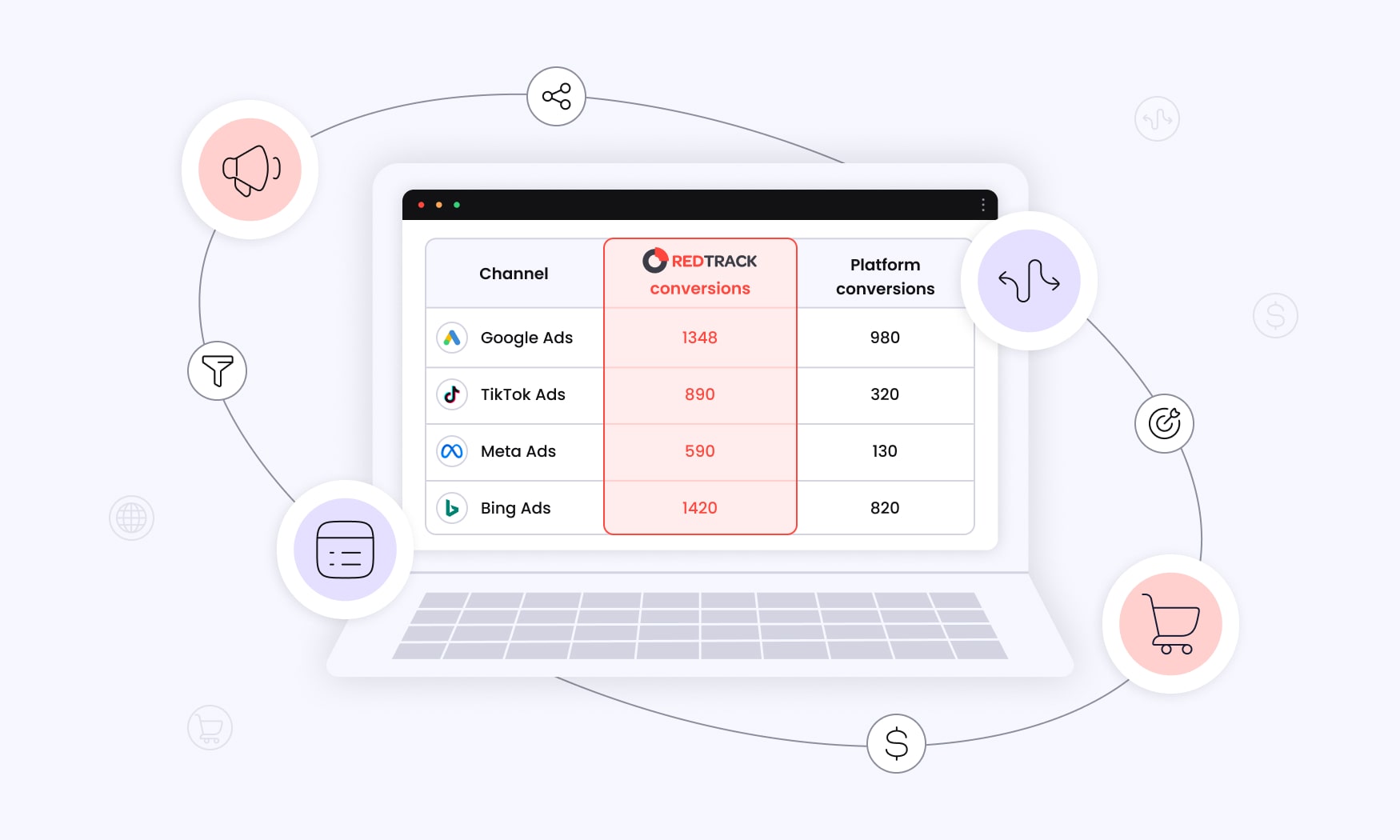
Most media buyers don’t wake up excited about “attribution models.” You just want the truth about what’s driving sales so you can scale without guessing. RedTrack gives you that truth fast, without the drama. Here’s the clean, real workflow.
Step 1: Fix tracking so nothing slips through the cracks – Set up RedTrack and onboard. Connect your ad accounts and your store. Turn on CAPI for Meta, TikTok, Google, and anything else you use. Do a few test events to make sure everything is working the way it should. This alone will save you from those “Meta shows two sales but the store shows nine” moments we all hate.
Step 2: Turn on attribution and see how your traffic actually behaves – You don’t need to pick a “fancy model” because RedTrack shows you first-touch, last-touch, assists, and the entire conversion path. You’ll see which channels start the journey, which ones close the sale, and which ones you’ve been missing even though they’ve been making your money.
Step 3: Feed the good data back to the ad platforms – This is where your costs drop. With proper CAPI and conversion syncs, your ad algorithms finally get the signals they need. Better event match quality. Better optimization. Fewer mystery CPAs. You basically stop paying for the platform’s blind spots.
Step 4: Use attribution to make smarter moves every day – Break down winners by channel, campaign, ad set, and placement. Spot the cheap assist channels. Shift budget with confidence. And if you want to go full pro, let RedTrack’s automation rules eliminate your waste before you even notice it.
Step 5: Review, adjust, repeat – Once a week, look at your paths, look at your winners, and move money to where it actually works.
Sounds simple? That’s because it actually is. Of course, things are definitely more complex in between, but RedTrack is made to make marketing attribution implementation as simple and manageable.
Advanced attribution strategies
Advanced attribution strategies help you get to the bottom of what’s actually driving results. They require a bit of work, but it will be more than worth the effort. Why? Because you’ll get a crystal clear understanding of how your channels are working together, and where the money is actually being made.
Incrementality testing is the most honest way to see if a channel is delivering what it should be. Instead of relying on correlations, you pause a channel or exclude part of your audience and see what happens.
Geo-holdouts are great for this. Split regions into test and control, run your campaigns in one group, and watch the difference in conversions. It’s one of the best ways to measure both digital and offline impact.
For digital, randomized controlled tests work the same way. Hold out a slice of your audience and compare results. Meta’s conversion lift and Google’s brand lift do this for you, making it easy to see which campaigns are working well.
Marketing Mix Modeling (MMM) takes it further by looking at everything: digital, offline, brand spend, seasonality, competition, and more. It uses statistical models to separate what’s actually driving results. MMM fills the gaps that attribution can’t see, especially for brand-heavy or omnichannel marketers.
Combining MMM with attribution gives you the full story – attribution shows the detailed digital path, and MMM shows long-term and offline impact.
Cohort-based attribution adds another layer. Group customers by value, behavior, or location and check how their paths differ. Some channels bring in high-value buyers, while others bring in volume but low return. These patterns help you adjust bids, budgets, and strategies toward growth that actually pays off.
And if you’re a B2B, that’s where account-based attribution really matters. Buying decisions involve a whole team, not just some person. This means you need to track interactions across the whole account, so you can see how the decision committee moves together. Also, don’t forget to take a look at what individual contacts are doing, as well as what’s going on at the account level. That way, you can tailor your targeting and instruct the sales team on their approach.
Cross-channel attribution uncovers how campaigns across different channels support each other. Display ads often give search a boost. Email can kick off social media buzz. And content can get paid ads working even better. By measuring these interactions, you can start to optimize your whole marketing system. Your goal should be to stop treating every channel in isolation and see the entire production for what it actually is: an interdependent ecosystem.
The goal is simple: understand how channels influence each other, how people really buy, and where your marketing creates actual lift — not just last-touch credit.
The future of marketing attribution
Marketing attribution is changing fast. Privacy rules, disappearing cookies, and new tracking standards are forcing every team to rethink how they measure performance. The old “follow the user everywhere” playbook is gone. What matters now is how well you work with the data you can collect – and how fast you can turn it into action.
Google’s Topics API and Apple’s SKAdNetwork show where the industry is headed: aggregated signals, delayed reporting, and zero user-level tracking. You don’t get perfect visibility anymore, but you still get enough to make smart decisions – if your tool stack is built for it.
That’s where first-party data becomes the real advantage. Brands that build direct relationships through logins, email, loyalty, and account systems keep clean, reliable attribution even as third-party tracking disappears. RedTrack already leans heavily in this direction with first-party tracking, server-side events, customer journey reports, and deterministic matching wherever users authenticate.
The future belongs to unified measurement.
This is attribution for granular path insights, marketing mix modeling for offline and brand impact, and incrementality testing to confirm what delivers results. RedTrack fits directly into this framework by giving you accurate click and conversion data, clean server-side tracking, conversion paths, and easy integrations with whatever modeling layer you use on top.
You’ll see its true value when you move from insights to automation. With real-time reporting and rule-based optimization, RedTrack turns attribution into action: adjusting budgets, killing waste, and scaling winners faster than manual work ever could.
The shift is already happening.
Teams that embrace privacy-first tracking, first-party data, unified measurement, and automated optimization will stay ahead. RedTrack gives you the tools to do all of it – cleanly, accurately, and in a way that still lets you scale.


