
Reporting, attribution, and decision-making – three pillars for performance marketers that they’re unfortunately often struggling with.
Privacy rules are getting stricter each year, partial data is becoming even more fragmented, and signals are almost always delayed. 2026 is not shaping up to be any easier for media buyers, and solutions like Google Analytics are simply no longer good enough.
Wicked Reports has been around for quite some time and has been a favorite for many. Don’t get us wrong – it still is among the favorites, but issues keep surfacing year after year.
In this day and age, it’s completely natural to start looking for alternatives when data is slow and delayed. When there’s limited possibility for real-time optimization. When costs keep stacking up and the tool isn’t resolving them.
That being said, in this article, we’ll cover the top 5 alternatives to Wicked Reports – and the cases and scenarios in which these tools might be a better fit.
1. RedTrack – The Best Alternative To Wicked Reports
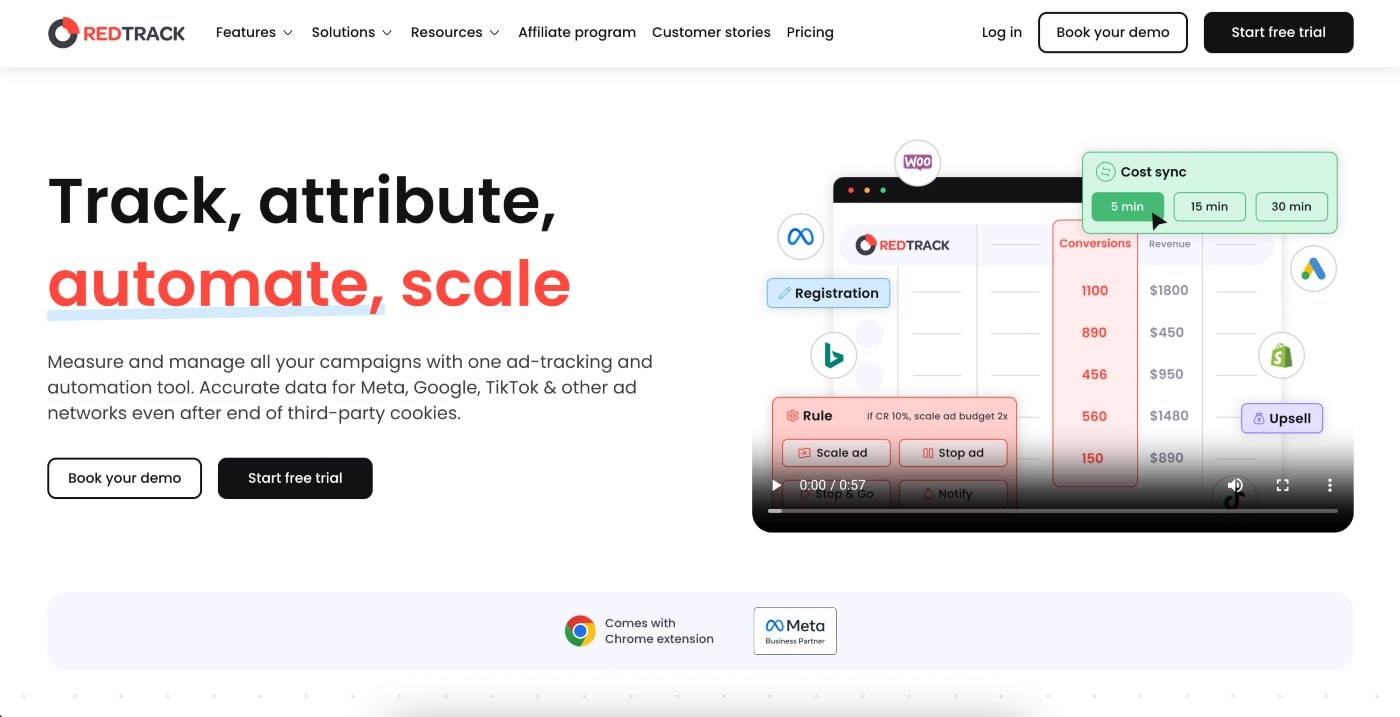
RedTrack is a first-party ad tracking, conversion attribution, and automation platform that’s been designed for marketers and businesses that want clean data and need to make fast ad strategy decisions.
It helps performance marketers, media buyers, agencies, e-commerce businesses, and brands get real-time data, unify it so they can scale and automate their media buying, and drive better results.
What makes RedTrack the best Wicked Reports alternative
While both RedTrack and Wicked Reports are tools that use cookieless, first-party server-side tracking to collect and collate attribution and conversion data from multiple channels, there are a few core differences when it comes to the primary use case.
RedTrack is a tool:
- Built for real-time campaign performance management and ad platform optimization.
- Gives you handy tools to scale and pause ads based on live data.
Wicked Reports is a tool:
- Designed to give you deep insights and historical data of complex customer journeys, conversions at each funnel stage, and the entire lifecycle.
- That helps you uncover, understand, and attribute revenue back to cold traffic leads over several months.
So, when you compare the two, RedTrack is a superior alternative simply because of its broader capability set. Wicked Reports is laser-focused on multi-touch attribution reporting, which is a huge priority for e-commerce businesses that run Meta and Google ads.
RedTrack is an entire solution that combines server-side tracking, real-time attribution, and media optimization into one neat system. This is what makes it ideal for performance marketers, agencies, and brands that are channel-agnostic and trying to deliver results across everything from paid ads to affiliate programs and lead generation funnels.
RedTrack is more instantaneous because it refreshes its data every five minutes.
RedTrack features worth calling out
- Real-time, unsampled, campaign insights – RedTrack refreshes its attribution data every 1-5 minutes, so you can optimize your marketing efforts during campaigns, not after.
- Multi-touch conversion paths – You are given a unified view of every interaction, right across channels, browsers, and devices, letting you see conversion paths as they happen.
- Feeds accurate data back for optimization – RedTrack doesn’t just show you the path; thanks to CAPI, it feeds multi-touch attribution data back to platforms like Google, Meta, and TikTok so the systems can improve their native algorithms for optimization in real time.
- Choose your attribution model – You can choose from the standard attribution models, such as First-Click, Last Click, Linear, Position-Based, or customize your own multi-touch attribution model.
What RedTrack does better
- Real-time ad management – You get to manage and optimize multiple ad campaigns from RedTrack’s UI and dashboard.
- Data storage – Unlike many competitors, which offer between 3-14 months of data retention, RedTrack gives you 18-24 months of data storage (even on the entry-level plan). This is super helpful if you want to truly understand your customer base, LTV, as well as if you want to do year-on-year analysis, long-term forecasting, and strategy.
- A/B testing tools – Want to know which landing pages or headlines are hitting the spot and which aren’t? RedTrack’s A/B Testing feature can help you run tests on creatives so you can repeat your success.
Want to see it in action? Book a demo, or start a free trial!
2. Triple Whale
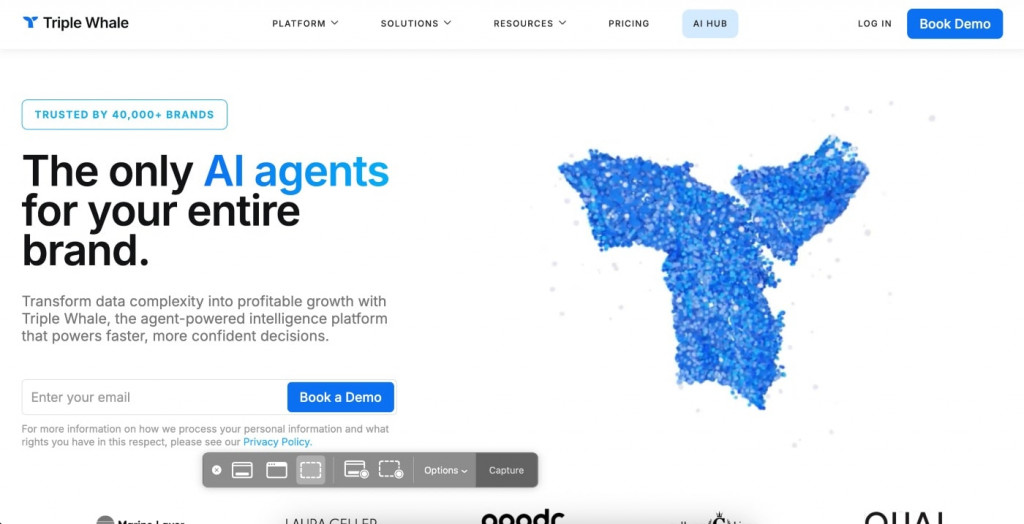
Triple Whale was originally a simple reporting platform that has evolved into an AI-powered tool that unifies various data streams, including marketing, sales, and operations.
Ultimately, what you get in the finished product is a centralized, actionable dashboard that helps online brands scale high-spend campaigns across ad channels.
The platform is ideal for D2C brands and agencies that need to manage entire portfolios from one place.
What makes Triple Whale a good Wicked Reports alternative
If you’re an e-commerce brand that operates on Shopify, Triple Whale might be a better choice because it simplifies performance visibility for paid media teams and e-commerce brand founders.
One thing it’s particularly good at is removing complexity. You get a centralized, clear view of what is and what isn’t working when it comes to your ads across Google, Meta, Microsoft, TikTok, Pinterest, and Snapchat.
If you’re after simplicity rather than the detailed attribution modeling offered by Wicked Reports, Triple Whale is a solid alternative.
Features worth calling out
- Single e-commerce dashboard – You don’t need to jump back and forth across ad channel platforms because all your ad channels, revenue, and performance metrics are displayed in one clean interface.
- “Sonar” server-side tracking – Sonar is Triple Whale’s server-side tracking engine, which pulls event data directly from your Shopify store’s backend and matches it with visitor profiles captured by pixels.
- Creative Cockpit & AI-analysis – Moby, the tool’s AI agent analyzes videos and static images, then automatically tags specific elements like color schemes or hook types to pick up which psychological triggers work well to drive ROAS.
- Product analytics & SKU reporting – The tool does a deep-dive to analyze the unit economics of your product catalogue. You can find out the direct return on ad spend for individual products, uncover popular product pairings, or see which specific SKU seems to deliver a high-LTV customer journey.
Possible cons to keep in mind
- E-commerce-centric – Triple Whale is not an all-purpose marketing attribution tool. It specializes in e-commerce, so if you’re an agency, brand, or performance marketer, working across lead generation, SaaS, or via hybrid funnels, you’d be better off looking at other tools in this list.
- Limited advanced attribution modeling – You don’t have as many custom conversion paths and advanced attribution modelling options, so if you need granular control and understanding of how credit is assigned across complex or long customer journeys, it might be a good fit.
3. Northbeam
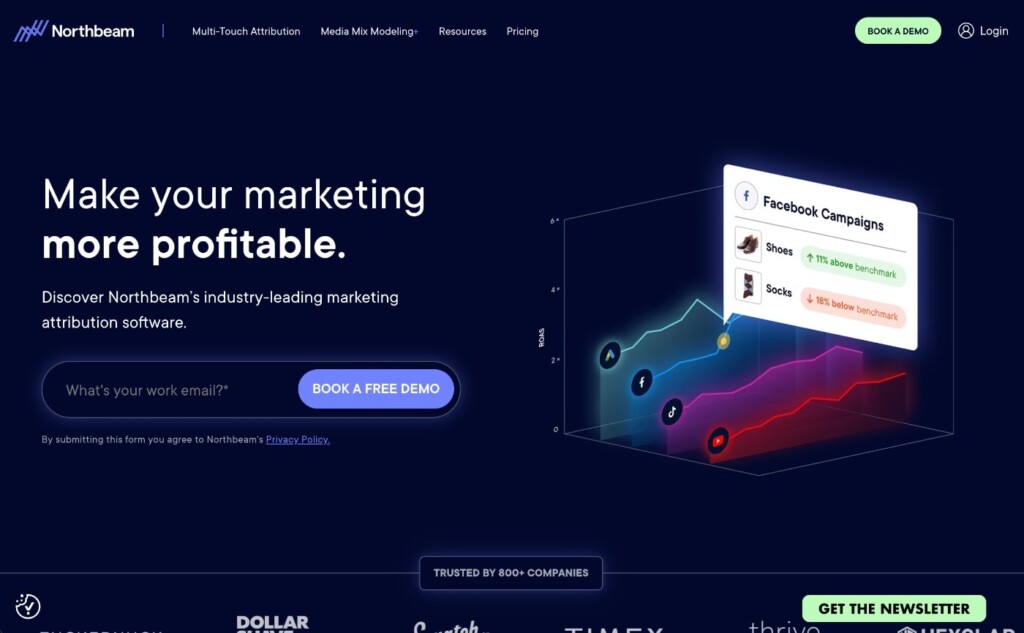
Northbeam is an enterprise-level multi-touch attribution and marketing intelligence platform that’s designed for mid-market and large-scale e-commerce brands.
It’s a tool that helps manage complex, high-spend ad campaigns that span across five or more ad channels and brands that have an annual turnover of $10M+ in revenue.
Suffice to say, it’s not the tool for your typical Shopify store owner.
What makes Northbeam a good Wicked Reports alternative
If you’ve outgrown Wicked Reports and are a strong, high-growth, and more than multi-million-dollar e-commerce brand, Northbeam might be the tool you need that will take your operations to the next level.
The important thing to remember here is that Northbeam is not just a simple attribution reporting tool; it’s an advanced intelligence platform. One that’s going to deliver superior modeling and stronger predictive insights so your marketing team and your brand’s executive team can better understand the links between ad spend and revenue.
Northbeam delivers data-driven insights by using machine learning (ML) models to understand and fractionalize conversion and attribution credit for a single sale across multiple platforms.
Features worth calling out
- Media Mix Modeling (MMM) – A feature that lets you simulate budget scenarios and forecast revenue for your brand, so your team can formulate more effective marketing strategies where you know what to expect.
- “Creative Cards” analytics – A feature that tracks performance metrics at the individual asset level and then alerts your team of creative fatigue so you can change things up before ROAS starts to dive.
- Dual-view dashboards – Northbeam provides two separate interfaces: the Media Buyer View, which shows tactical real-time metrics, and the Leadership/Executive View, which displays a high-level business health dashboard including nCAC, LTV, Contribution Margin, and Marketing Efficiency Ratio.
Possible cons to keep in mind
- Not for instantaneous ad optimization – If you want a tool that’s going to let you make instantaneous campaign actions like scaling or pausing ads, RedTrack is more your vibe. Northbeam is less hands-on with campaign optimization and more focused on high-level analytics, revenue insights, and forecasting.
- Extensive setup and onboarding – Like most enterprise-grade level systems, Northbeam demands a longer setup and onboarding period, which doesn’t usually work well for mid-sized e-commerce businesses.
4. Rockerbox
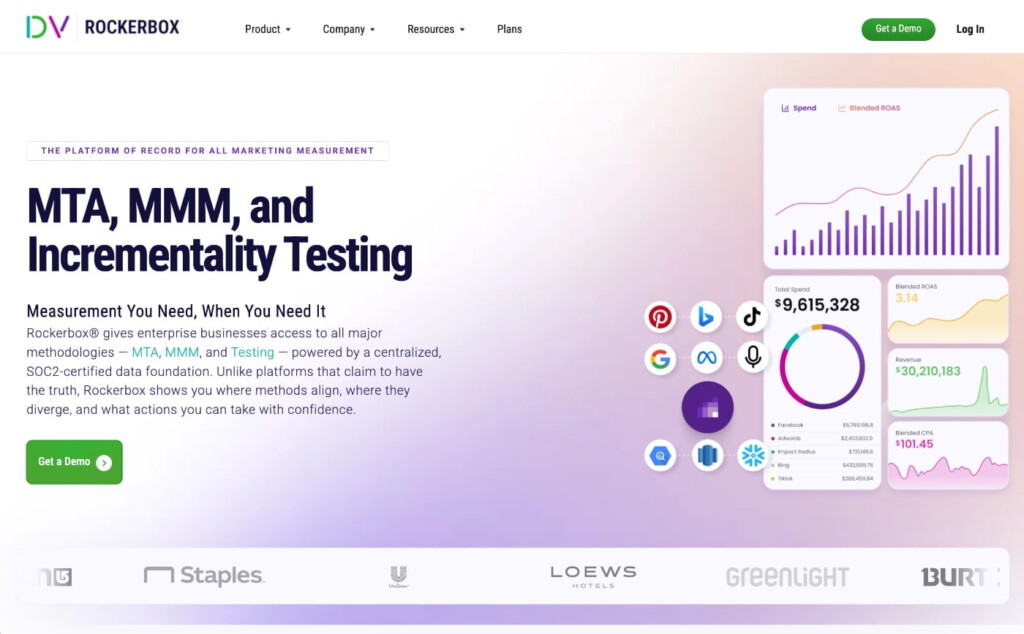
Rockerbox is another enterprise, all-in-one marketing performance tool designed to help large D2C and e-commerce brands. It unifies measurement, centralizes data, and provides a single source of truth for multi-touch, online, and offline attribution.
Like Northbeam, it’s ideal for high-spend marketing teams, but Rockerbox offers a superior system for understanding attribution across hard-to-track channels like TV, direct mail, and podcasts.
What makes Rockerbox a good Wicked Reports alternative
When you compare Rockerbox with Wicked Reports, the tool actually delivers deeper data insights into attribution, and that’s why it’s favored by larger e-commerce brands, marketplaces (such as Amazon), and omnichannel advertisers.
While Wicked Reports focused primarily on CRM-based marketing funnel tracking, Rockerbox combines Multi-Touch Attribution (MTA) with Marketing Mix Modelling (MMM) and Incrementality Testing to display everything in one dashboard.
This lets marketing teams validate their attribution data with statistical modeling.
Features worth calling out
- Shapely Value for fractional credit – Rockerbox uses Shapely Value, which is its foundational algorithmic methodology that delivers data-driven, multi-touch attribution, where it treats every marketing channel as a “player” that helps achieve a conversion. Unlike simple attribution models like First-Click, it works to deliver a more accurate synergy of what actually delivers a single conversion, which is a combination of touchpoints.
- Incrementality Testing Suite – Rockerbox comes with a built-in Incrementality Testing Suite, which lets you test if specific channel changes drive changes in sales. This helps you determine if a channel is truly driving new growth or whether it’s just falsely earning credit for a sale that would have happened anyway.
- New vs. returning customer analysis – You get a special feature that gives you valuable insights and lets you track nCAC separately from CAC, so you can avoid overspending on retargeting if the people you’re sending this marketing to are already loyal customers.
Possible cons to keep in mind
- Needs a tech-savvy user – Unless you’re tech savvy or have the support of an analyst, the tool will feel heavy and overwhelming.
- Not an ad automation platform – Rockerbox is a measurement and reporting tool. It’s not an ad campaign execution platform where you can set up automations, pause, or scale ads.
5. Cometly
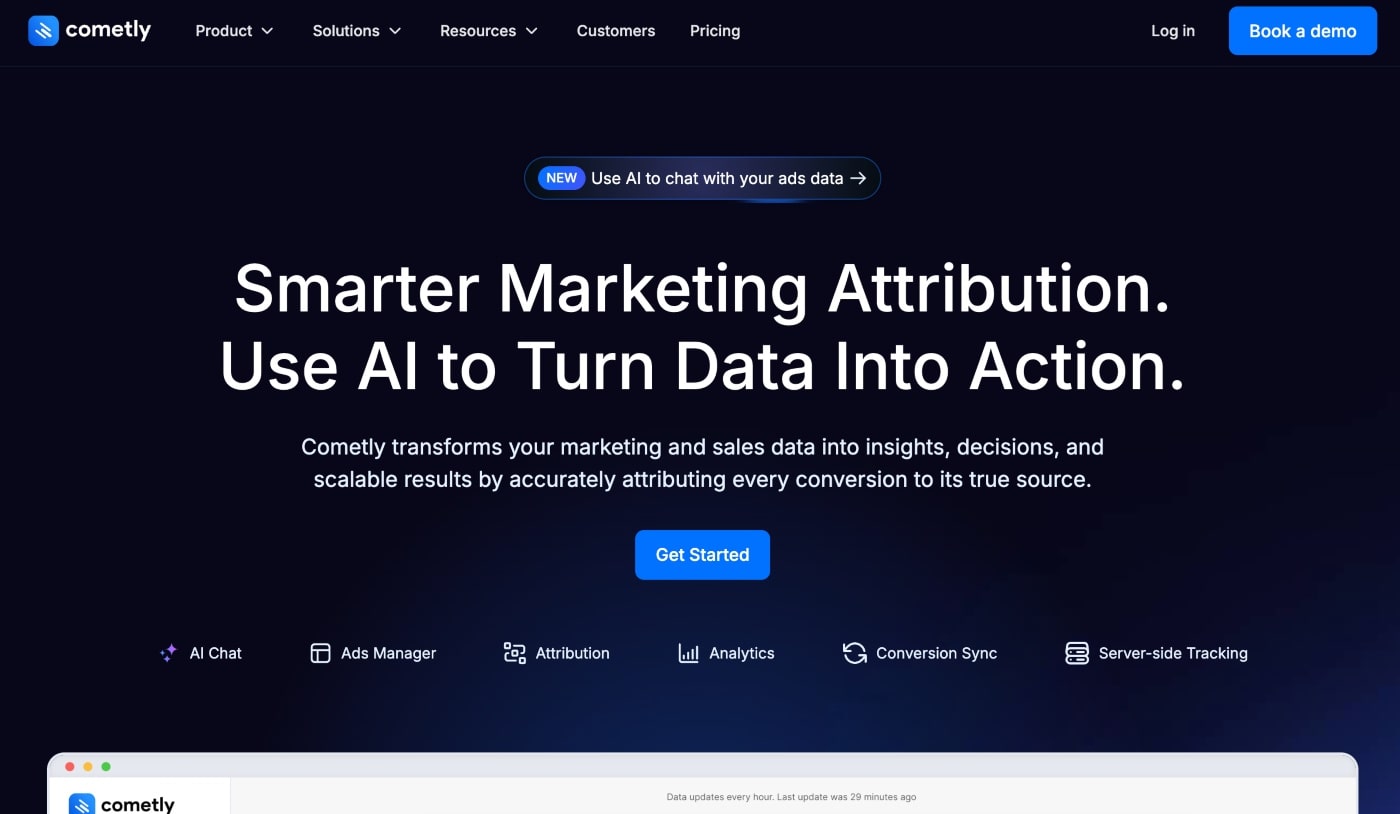
Cometly is a marketing analytics and marketing attribution platform that gives marketing teams a way to monitor campaign performance and gain real-time insights so they can make data-driven decisions.
It’s a tool that collects marketing data and helps performance marketers, B2B SaaS teams, and agencies track their entire customer journeys and connect ad spend directly to revenue.
What makes Cometely a good Wicked Reports alternative?
If your ad focus is mostly across Meta and Google, and you want a simple tool to take care of real-time attribution of your paid ads, you’ll get that with Cometely. As an AI-powered tool, it uses machine learning to recommend actions, telling you when it’s a good idea to scale an ad and when it makes more sense to pause it.
Like Wicked Reports, it also uses server-side tracking to bypass browser-level restrictions, so it captures accurate first-party data, and its “one-click” feature feeds conversion data back to your ad platforms, so it trains algorithms better and helps optimize your marketing.
The main difference between the two platforms is that Wicked Reports prioritizes deep historical CRM analysis and modelling, while Cometely aims to provide a system that requires minimal setup and works to deliver immediate guidance on which actions to take when it comes to optimizing marketing efforts.
Features worth calling out
- Live data feed – Cometely gives you a real-time stream of conversion data, which lets the marketing team immediately see and track the performance of a new campaign so they can make changes quickly if they don’t start to deliver results quickly.
- Attribution model comparison – There is a feature that lets you toggle between various attribution models, side-by-side, on a single screen. That way, you can spot which ads are initiating interest and which are closing the deal.
- AI Ads Manager – You can offload the manual work of ad monitoring and use AI to analyze your historical ad performance and have it determine when an ad should be scaled, put on hold, or cancelled altogether.
- Journey Map – The tool visually maps out the entire customer journey path so you can see every ad the customer clicked across channels before they made the final purchase.
Possible cons to keep in mind
- Lacks deep customization & depth – The platform is great for basic ad campaign monitoring, real-time management, and automation, but it’s not going to let you carry out complex customizations when it comes to unravelling attribution data. If that’s what you’re after, some of the other tools in this list are a better option.
- Not for long or complex sales cycles – This tool is for teams that run short sales cycles, so if you’re managing complex client journeys with long consideration funnels, it will struggle to serve you in the longrun.
Conclusion
As always, it all comes down to coming to that sweet spot where attribution and reporting tools must do much more than just explain what happened.
And to be fair, Wicked Reports does more than that, but just to a certain extent.
Another thing to keep in mind is that there is no feature or angle that only Wicked Reports fulfils which is why alternatives on this list likely don’t require steep learning curve.
If you ask us, we believe RedTrack as an alternative to Wicked Reports might the game changer for your business especially if you’re looking to scale fast and deliver results even faster.
It’s built around first-party data ownership, real time clarity and direct feedback loops with ad platforms, which is exactly what modern optimization requires.
For experienced performance media buyers, owning the data while scaling profitably across advertising platforms is the only way to go, so for them, RedTrack is a step forward.


