
Is having the best ad tracking software on the market without custom domain and SSL certificate good enough to get you results you’re after?!
As someone who’s been working with performance media buyers for years, and helped thousands of companies run successful campaigns, we’ll tell you straight away – no.
Shocker? Not quite sure that it is, because these 5 reasons make it super obvious.
1. Ad Blockers Can’t Block What They Can’t Recognize
Ad blockers work in… Well, not very ordinary way, which is exactly why certain trackers are showing fewer conversion than they should – something is eating your data.
Tools like uBlock Origin or Adblock plus mostly rely on community-maintained blocklists which contain thousands of known domains. So the mechanism is quite simple – user loads a page, and ad blockers scans every outgoing request and checks it against those lists.
If it finds a match, the request gets shut down before it fires, which further down the line might mean your conversion never gets recorded.
This is exactly where a custom domain changes everything.
Once you set up custom tracking domain you tracking requests look like regular first party traffic and the ad blocker has no pattern to match against because your domain can’t be found on the blocklist.
30-50% of your audience might be using an ad blocker, which is a huge chunk of traffic you’re risking for not being able to track.
Custom domain will maek your tracking invisible to ad blockers, so it’s quite a no-brainer from that perspective
2. A Shared Tracking Domain Is a Single Point of Failure
Something we’ve seen performance media buyers learning the hard way is scaling campaigns with good ROAS and waking up one morning to the numbers that that dropped off a cliff.
Shared tracking domain their tracker used just got flagged.
Your shared tracking domain runs campaigns along with thousands of other advertisers, and thinking that everyone is on a green side isn’t really a safe assumption.
In reality, at least 20% of them are spammers that run aggressive redirects, shady offers or trip a spam filter, and your campaigns are directly tied to their behaviour.
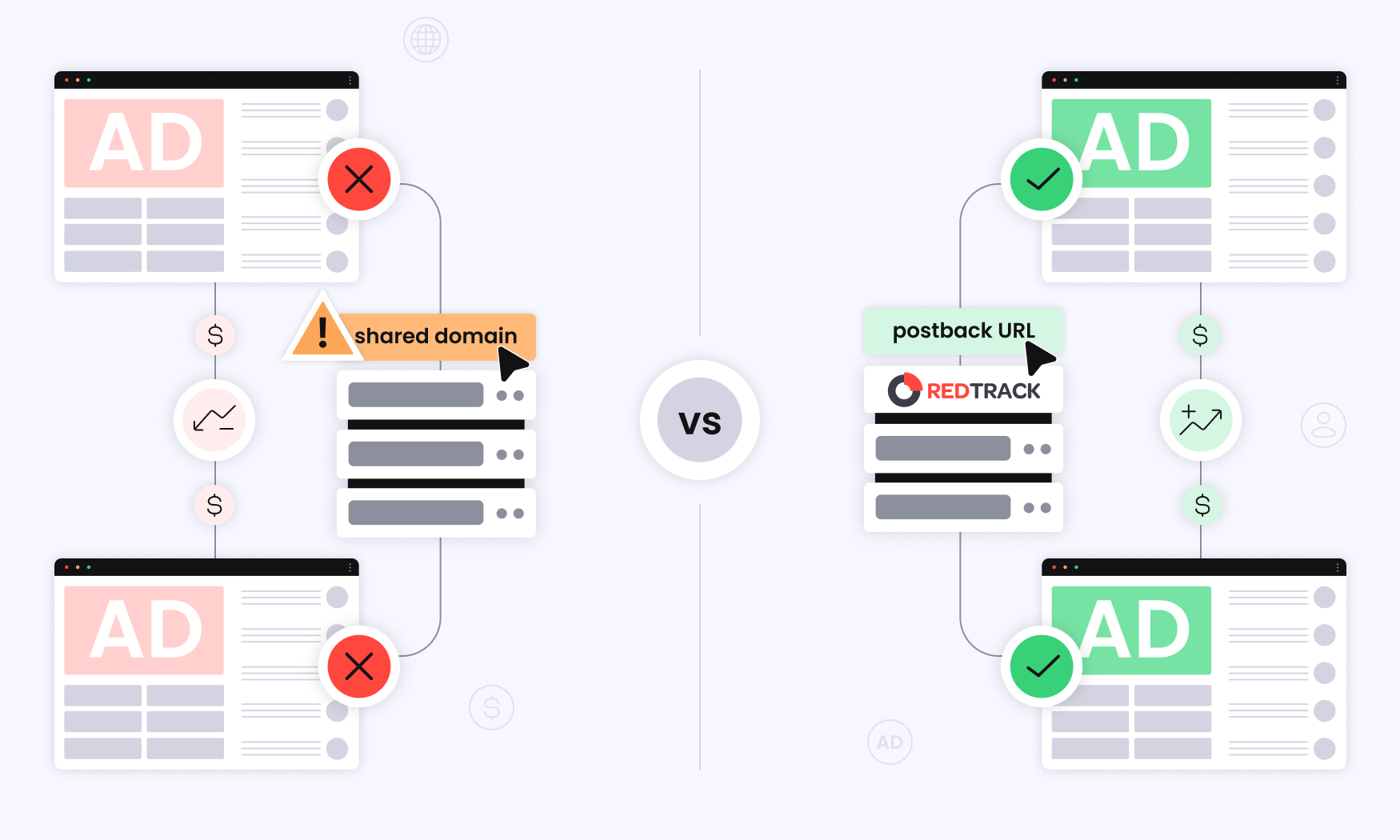
Reputation of the domain takes the hit, browser security filters flag it, email provides block links containing it, ad platforms start penalizing traffic routed through shared domain – and your campaigns go down with it.
What hurts the most – you’re paying the price even though you had nothing to do with it.
Same solution and similar scenario to previous point – custom domain completely isolates your tracking infrastructure and ensures that you own your reputation and control.
If you’re running server-to-server postbacks through RedTrack, your custom domain is literally the front door to entire data pipeline, which is exactly what your clicks pass through and what ad platforms see when they evaluate your traffic quality.
Safe to say, there’s a practical bonus there as well – if you ever switch tools, migrate setups or restructure your campaigns, your custom domain (along with your postback URLs, tracking links and integrations) ALWAYS stays with you.
3. Your Conversion API Match Rates Depend on It
As performance media buyer, you already know the logic behind algorithms working in your favor – the richer and more accurate signals you send back to the platforms, the better results you get.
Here’s a scenario: You’re running campaigns with Meta Advantage+ and Google Performance Max for an ecommerce brand and RedTrack is capturing every conversion server-side and pushing clean, deduplicated events through Conversion API.
Setup is working great, but the quality of what gets sent solely depends on what gets captured at the first click, which is exactly your customer domain’s moment.
When a user clicks an ad and passes through a customer tracking domain with SSL, the redirect happens over an encrypted first-party connection which means that RedTrack starts with a complete data set, which furthermore means higher match scores when those events reach Meta’s CAPI.
Nothing gets flagged along the way.
If you skip the SSL, browsers start causing problems.
Strip referral data or tracking parameters in transit, you end up sending conversion events with missing identifiers which results in your match scores dropping.
Lower scores = algorithm makes worse decisions about who sees your ads (and how your budget gets allocated).
Important to add here: RedTrack users see 82% match rates compared to the 55% industry average and that gap comes from clean signal capture starting at the first click where custom domain with SSL plays vital role.
4. Affiliate Networks and Ad Platforms Judge You by Your Domain
Here’s a practical one.
Tracking links are one of the first things CPA networks look at. If those links run through a generic shared domain, you’re obviously not making the impression you want to be making.
Network compliance teams see shared tracking domains all day long.
Simply because your domain carries your clean Shopify offer just as someone else’s aggressive push traffic, low or slow approvals are something you can expect, regardless of how unfair the situation is.
A branded custom domain sets you apart, and signals that you’re running a professional operation with your own infrastructure.
Same goes for the ad platforms – they all evaluate the domains tied to your campaigns. A dedicated SSL-secured tracking domain with a clean history is far less likely to trigger automated reviews or get caught in platform-level filters.
Last but not least – when your clients, partners, or network managers clicka tracking link and see your brand in the URL, it builds confidence which is super important for agencies managing multiple clients through Redtrack.
5. Your Customers Notice When a Redirect Looks Sketchy
If you run a Shopify or WooCommerce store, you’ve probably spent real money making it look legit. Clean design, proper branding, SSL on checkout. That’s what gets a stranger comfortable enough to punch in their card details.
Most store owners never think about what happens before the store loads.
Someone clicks your Meta or Google ad and they don’t land on your site right away. The click bounces through your tracking domain first so RedTrack can attribute the sale, and it’s milliseconds (usually). But people do notice. They glance at the URL bar. Browsers preview the redirect on hover and if what flashes past is x73track.randomdomain.com, you’ve just given them a reason to hesitate at the worst possible second.
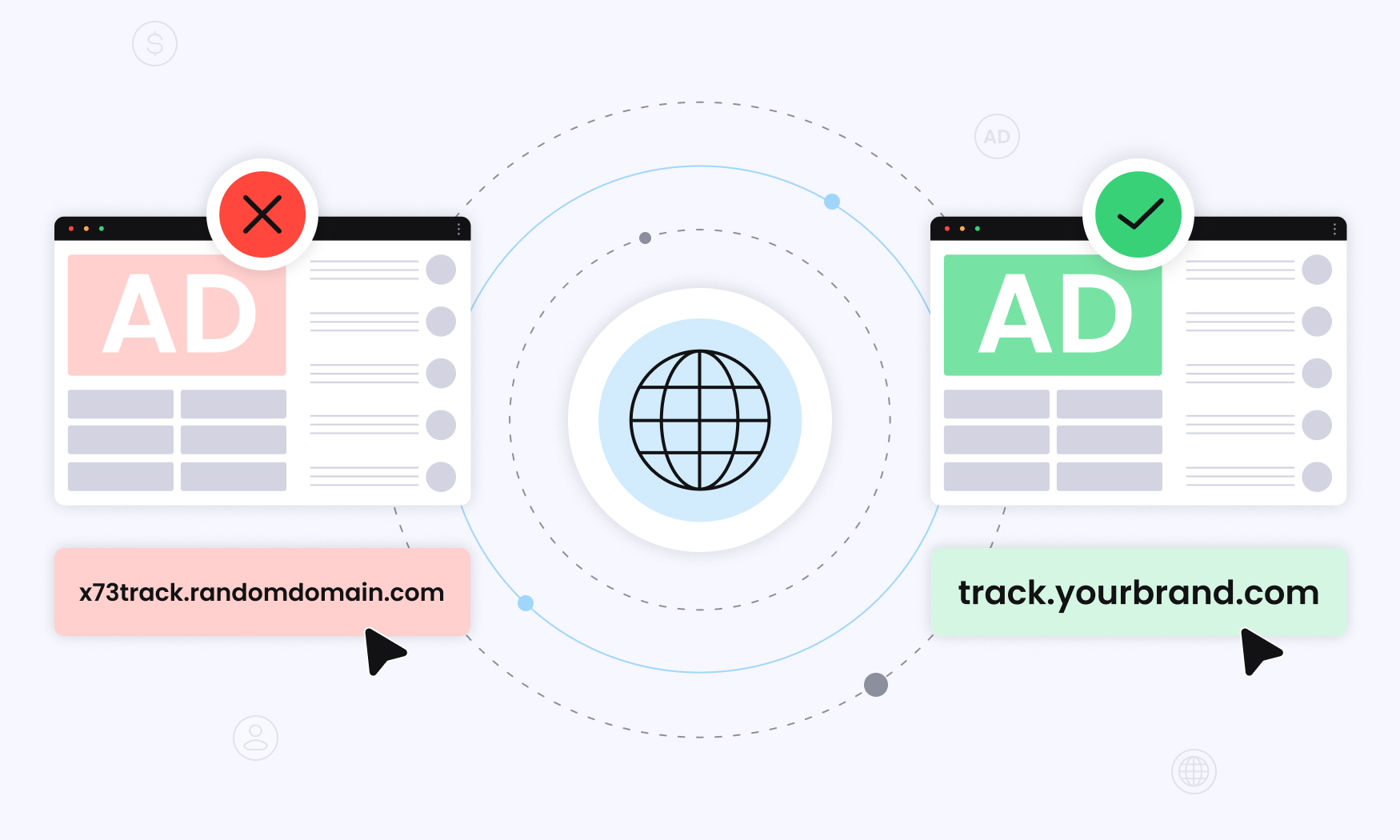
Nobody’s scrutinizing anything but if you’re selling skincare, supplements, electronics, anything above $80 or so, that half-second of “wait, what was that” is enough. They don’t know what the domain is. They don’t know if they just got bounced somewhere shady. A chunk of them close the tab before your page paints.
Custom domain solves it. The hop goes through track.yourbrand.com and it just looks like you. There’s nothing odd to latch onto.
It’s a small thing. E-commerce is mostly small things stacked on top of each other. Anywhere you create a reason to hesitate between the ad and the checkout button, you lose people. Your tracking domain doesn’t need to be one of those places.
Conclusion
A custom domain with SSL isn’t a nice-to-have.
It’s the foundation that everything else in your tracking setup depends on. Without it, you’re leaving conversions on the table because ad blockers are eating your data.
You’re exposing your campaigns to risk because a shared domain ties your reputation to strangers.
You’re sending weaker signals to Meta, Google, and TikTok because click data gets stripped before it even reaches your tracker.
You’re losing network approvals and platform trust because your links look generic. And you’re introducing doubt in the minds of shoppers right at the moment they should be feeling confident about clicking through to your store.
Each of these problems is fixable. And the fix is the same every time.
One custom domain. One SSL certificate. Set it up once, and it quietly protects your data quality, your platform relationships, and your revenue from day one.
If you’re already running RedTrack, setting up a custom domain takes minutes – and it’s one of the highest-impact things you can do to make sure your server-side tracking, your CAPI connections, and your attribution are all working with the cleanest possible data.
If you’re not on RedTrack yet, this is a good reason to take a look.
RedTrack gives you server-to-server tracking, first-party data capture, and direct CAPI integrations with Meta, Google, TikTok, and Snapchat, all built to work with your custom domain out of the box.
Sign up for the 14-day free trial, set up your custom domain, and see what your data looks like when nothing gets in the way. No credit card, no commitment – just clean signals and clear results.


