
TL;DR: This article is for media buyers and affiliates who use Voluum, or are thinking about it, but are running into its limits: pricing that grows with your volume, paying for features you don’t use, or ad platforms not getting good enough data. It explains which Voluum alternative to pick and why, based on what each tool really does and where it falls short, not marketing hype. The article compares five alternatives, covering each one’s best features, honest drawbacks, and who it fits. It also shows you how to choose the right alternative by matching the tool to your actual problem.
When you start exploring alternatives to Voluum, it quickly becomes clear that the question isn’t only about switching from one tracking tool to another, but about understanding how each platform interprets the work you do every day.
Although many tools connect to major ad networks (and have ad network integrations) and affiliate networks, the way they organize information (and the assumptions they make about what matters) can differ quite a bit, and we’re saying that knowing how different is working setup of media buyers can be.
Workflows vary, and you soon realize that finding Voluum alternative isn’t all about which solution is technically more advanced. It’s about can it actually fit your case.
But speaking about alternatives – what are the best alternatives to Voluum in 2026? Why are they actually good and how to choose the one that fits your need best? That’s exactly what we’ll cover in this post.
1. RedTrack
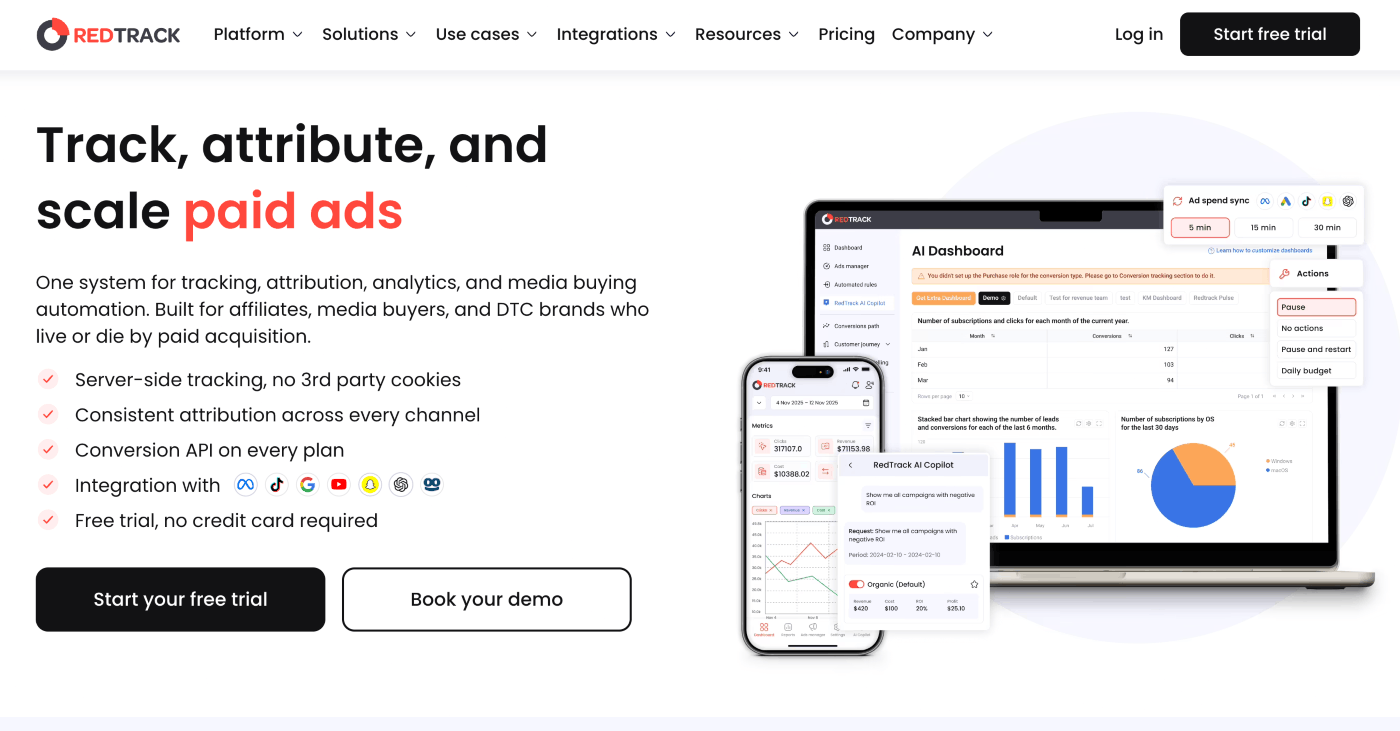
We designed RedTrack to bring every part of performance media buyer’s workflow into one place, so instead of treating tracking, attribution and real-time reporting as separate systems and tasks, RedTrack approaches them as connected dots of the same process.
But there’s more to it than consolidation.
Why Exactly is RedTrack Great Alternative to Voluum
Voluum and RedTrack both track activity across ad campaigns, but the difference is what each platform is architected around.
Voluum is a redirect-and-distribution engine and its core job is revealing the structure of traffic and routing it, which is mostly why its flagship optimization feature is Traffic Distribution AI, a machine learning that shifts more clicks toward your best-performing offers, landing pages, and paths.
RedTrack on the other hand is built around a different job: getting clean, server-side conversion signal back to the ad platforms that actually decide who sees your offers and that’s the axis where the capability gap opens up.
Here’s why we believe RedTrack is truly great Voluum alternative:
- Conversion API is the core, not an add-on – A real conversion fires on a third-party network. Seconds after that, RedTrack receives the server to server postback, confirms it’s a legitimate purchase, and immediately sends a real conversion event into Facebook Conversion API, Google Enhanced Conversions, and TikTok Events API. There’s literally no synthetic events, no firing a “conversion” on the affiliate-link click. For an affiliate running paid traffic to offers, this is the difference between training Meta to find people who click and training it to find people who buy.
- Conversion API that covers your whole funnel, not just one network’s clicks – RedTrack’s Conversion API sends all conversions back to a connected platform (including conversions that originated on other traffic channels or organically) not only the ones attributable to that platform’s own click. If you run the same offer across Meta, native, and Google at once, each platform gets a fuller picture than isolated server-to-server postbacks provide.
- Richer payloads for higher match quality – Where the network supplies it, RedTrack passes hashed PII (email, phone) in the conversion payload. Better match quality means better optimization on the platform side and lower CPAs.
- Cost sync and automation are included, not gated. RedTrack ships real-time ad-spend sync (down to 5-minute updates across 20+ networks) and a full rules engine plus AI Copilot, in the product. Much of Voluum’s comparable automation depth lives in its Automizer module and higher tiers.
- One system across the whole funnel. Offers, networks, and multiple traffic sources unified, with click-level drill-down, up to 5 nested groupings, templates for 100+ traffic channels and 80+ affiliate networks, plus pay-per-call (Ringba) and app (AppsFlyer) tracking many trackers skip.
Interested to see how it works?
2. BeMob
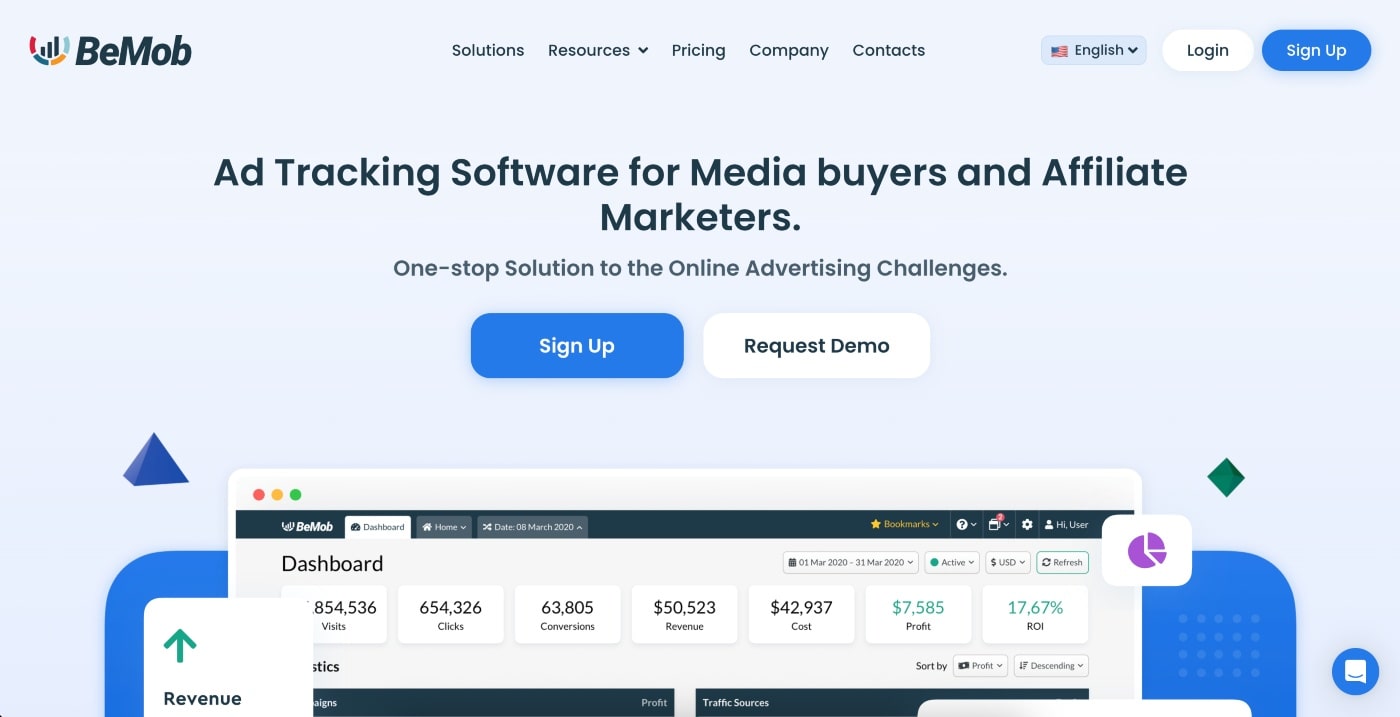
BeMob is cloud-based ad tracker and platform designed to provide steady and simple insight into performance of paid campaigns and paid ads.
It’s made for and works perfectly well for affiliates who are shaping the early and middle stages of their performance journey – CPA or CPL marketers, arbitrage buyers, and marketers who need a reliable solution without taking on the responsibility of maintaining servers without steep learning curve of technical systems.
What makes BeMob a Good Voluum Alternative?
Let’s just address the elephant in the room – it’s impossible to ignore BeMob’s free plan. It’s absolutely perfect for beginners or solo affiliates who need real tracking but still can’t justify Voluum’s entry price. BeMob’s free plan literally lets you validate campaigns before paying anything, which means a ton when you’re a beginner.
BeMob genuinely does a very good job at covering the core need of affiliate tracking: server to server postbacks with 200+ affiliate networks and traffic sources, advanced rules and advanced tracking features, bot/anti fraud kit, cookieless tracking and auto optimization – all that well below Voluum’s pricing plans.
It’s also a very good pick for agency or team that needs multi-user Workspaces and Shared Reports without paying for enterprise rates.
BeMob’s Best Features
What makes BeMob stand out are some of the core features it offers:
- Redirect tracking that behaves predictabily
- routing logic that allows affiliates to send visitors where they’re most likely to convert
- reporting features that help affiliates follow patterns across their traffic
All these together work on creating an environment where making performance related adjustments comes in intuitive rather than complicated.
Potential Drawbacks of BeMob
Of course, when compared to Voluum, picking BeMob comes with few compromises you might have to make:
- Potentially limiting automation and optimization tools
- No super advanced analytics tools and detailed reporting
- Not quite fit for extreme scaling
- Fewer built-in templates and integrations
In a nutshell, BeMob is a really good Voluum alternative when you’re growing, but in case you decide to step it up and scale aggressivly, it might be a bit limiting.
3. ThriveTracker
ThriveTracker is a self-hosted tracking platform made to give affiliates more control of how their data is stored, processed and interpreted, as it doesn’t rely on external environment or third-party tools.
If you’re the affiliate who has grown beyond the introductory stage and require a structure that supports both scale and customization all while having resources to develop your own framework, then ThriveTracker is the tool made for you.
What makes ThriveTracker a Good Voluum Alternative?
Both Voluum and ThriveTracker help their users understand and optimize their traffic, but the difference lies in how deeply ThriveTracker lets users influence and manage the tracking environment itself.
ThriveTracker basically offers a system that hands over the keys: the ability to run tracking on your own server, decide how resources are allocated and manage performance at level that cloud-only tools can’t replicate.
ThriveTracker’s Best Features
ThriveTracker truly offers some advanced features, and according to its users, core ones are:
- Self-hosted infrastructure that lets affiliates shape performance on their own terms
- Flexible routing and redirect logic built for super complex, multi-layered traffic flows
- Filtering and quality controls that keep data stable during high-volume testing
Potential drawbacks of
Picking self-hosted ad tracker is super beneficial, but far from being all sunshine and rainbows.
Potential drawbacks of picking ThriveTracker of Voluum include:
- Responsibility self-hosted brings – managing servers, updates and uptime. If something breaks, it messes up the tracking
- Performance depends on your server
- Higher cost when scaling
In a nutshell, ThriveTracker is a really good Voluum alternative if you want full control and responsibility for the setup, but it comes with a price of potentially losing stability and instant scalability.
4. Keitaro
Another self-hosted affiliate tracking platform that lets you run your own tracking infrastructure is Keitaro. Just like with ThriveTracker, you own the data, server, and the way everything performs.
Keitaro perfectly fits marketers who have outgrown basic trackers and now want to level up the reliability of processes. To be more precise, it’s built for CPA/CPL affiliates, arbitrage buyers scaling push/pop/native traffic of teams balancing multiple offers, geos and devices because they want control and flexibility, especially when handling larger traffic volumes or more complex campaign logic.
What makes Keitaro a Good Voluum Alternative?
Although many trackers promise coverage, Keitaro delivers control, and that’s where it shifts from being just another alternative into something fundamentally different.
In simple terms, we’re talking about here is a solution that bypasses the limits often imposed by cloud-based tools: unlimited traffic handling, no forced plan jumps as volume grows, and the power to shape routing and attribution logic exactly as you need it.
Keitaro’s Best Features
Keitaro has some unique features which makes it top Voluum alternative for a reason:
- flexible traffic-distribution rules,
- support for unlimited clicks and conversions, and
- deep customization capabilities even for crafting custom campaigns that are near impossible on cloud platforms
- granular routing: geo, devide, connection type, multi-offer splits
- real-time metrics across 30+ paramenters
- postback tracking and API access,
- built-in capacity to host landing pages locally
Potential drawbacks of Keitaro
Despite all the features that might be your next game level-up, picking Keitaro over Voluum definitely comes with some drawbacks:
- Just like with ThriveTracker, self-hosted solution means additional responsibility and risk of affecting the processes at extra cost
- Steep learning curve as the solution is advanced and technical and doesn’t really have user friendly interface
- No centralized automation rules and features
- Heavy workloads may require powerful servers
In a nutshell, Keitaro is quite an attractive option because it’s extremely flexible for technical marketers, but may be inefficient or risky even for experienced marketers and teams who lack technical expertise but require speed, stability and guaranteed uptime.
5. AdsBridge

Last but not least, AdsBridge is a cloud based tracker and optimization platform that combines link-tracking with built-in funnel and traffic management tools.
It’s built and suits affiliates who run campaigns across varied traffic sources and need both tracking and funnel control in one unified workspace without adding extra tools and juggling multiple servies.
What makes AdsBridge a Good Voluum Alternative?
Even though both trackers aim to give clarity to campaign structure over clicks and conversions, AdsBridge distinguishes itself by offering more than tracking alone – merging tracking with funnel and landing page management, and giving users a more holistic campaign workspace.
What this essentially means is that AdsBridge doesn’t just log data but helps you shape where traffic flows, how landers behave, and how offers are served which are capabilities that go beyond what Voluum (or many trackers) offer by default.
AdsBridge Best Features
What stands out in AdsBridge are the following key features:
- built-in landing page and funnel builder,
- ability to route and distribute traffic flexibly,
- real-time tracking and stats that let you react fast to performance trends.
- proxy detection,
- bot filtering,
- offer rotation,
- multi-currency support and
- traffic monetization logic
Potential drawbacks of AdsBridge
Even though AdsBridge has some significant differentiators compared to Voluum, it also has few drawbacks you may experience if you choose it over Voluum:
- In case daily volumes go to extreme levels, you may experience flaws in stability
- Fewer advanced optimization options (including audience optimization) compared to Voluum’s Automizer
- Landing page build is amazing, but super simple
- Voluum’s reporting, filtering, and breakdown combinations are far more detailed and flexible
In a nutshell, AdsBridge is great alternative to Voluum for affiliate teams who want “all-in-one” solution and are okay with that solution not being strong enough for high-performance top media buyers who need super precise, high-resolution data and automation
Based on what should you choose the best Voluum alternative
Choosing the right Voluum alternative begins with understanding what your tracking setup is actually responsible for, and how each platform supports the way you buy traffic.
It may appear that these tools are similar on the surface, and watching at who has more features simply makes no sense because the differences start to show once you look at how they handle tracking links, attribution depth, cross device tracking, campaign performance, conversion tracking, and the realities of your monthly ad spend.
So we’re talking about making a decision that reflects the demands of your workflow rather than the features listed on a comparison page.
Why are you initially looking for Voluum alternative and researching other ad trackers?
If the problem is the major ad platforms getting worse at finding buyers because they’re starved of clean conversion data, then you the pick should be a tool that sends real-server-side conversions back so the algorithms learn who actually buys, not just who clicks. In that sense, RedTrack would be the best fit.
If the problem si purely money and you’re at low or medium volume, not even finding justification for Voluum’s starter plan, then look at BeMob. Amazing free plan, and cheap paid tiers, and it does the core job.
Sick and tired of cloud based ad tracking software that don’t let you customize the setup? ThriveTracker and Keitaro are worth looking into.
If Voluum is limiting and you want all-in-one place for building landing pages fast, AdsBridge might be a good option as well.
Bottom line is don’t chase “the best” tracker.
Chase the one that fixes your specific headache.
If you match the tool to the pain, the choice makes itself.
Conclusion
Once you step back and look at everything together – all the channels you’re running, how you’re tracking conversions, how much you lean on platforms like Google Ads – one thing gets pretty clear: not every tracker handles this stuff the same way.
Some are built to record what happened while others care more about what it all means, did the conversion land, was it attributed right, did the ad platforms get the clean signal they need to do their job.
RedTrack sits in that second camp. It treats attribution, cost data, and signal quality as pieces of the same puzzle, and not three separate things you stitch together at the end of the week so instead of wrestling with reports that don’t agree or syncing numbers by hand, you’ve got one system where it all just talks to each other.
That matters most exactly when things get messy: when a customer bounces across devices before buying, or when the algorithms need steady, reliable data to actually optimize.
None of this makes RedTrack the only answer.
The other tools on this list are solid, and depending on your setup, one of them might be your best move. But if the headache you’re trying to fix is “my platforms aren’t getting good enough data to find real buyers,” RedTrack is the one built from the ground up to solve that. For a lot of performance teams, that’s the whole ballgame, which is what makes it a pretty logical place to start.


